You Vibe-Coded the AWS Calls — Do You Know What IAM Permissions You Actually Need?
You asked the IDE for “sync Kubernetes services to Route 53.” It wrote the Go code. Tests pass. The PR looks fine.
The pull request still needs a review of Identity and Access Management (IAM) permissions: which AWS actions the code needs, on which resources.
CCE (Code Context Engine) is a static-analysis CLI that reads your source tree and answers:
Which cloud API operations does this code actually call?
This guide covers what CCE can infer from source, how to run it locally and in continuous integration (CI), and how to read its output. Deeper reference lives at appcd-dev.github.io/cce.
On this page: What it solves · What it is not · Concepts · Install · CLI cheat sheet · Personas · Worked example · Recipes & packs · Enterprise lenses · GitHub Actions · Reading output · Resources
What CCE solves
CCE is read-only inventory: it maps SDK and library call sites to structured tuples (provider, resource, operation) using tree-sitter, a parser for source-code syntax. It does not rewrite code, execute your app, or parse Terraform.
| Problem | How CCE helps |
|---|---|
| IAM / least privilege | Produce candidate Action names for review before opening a platform ticket |
| AI-assisted cloud code | Ground permission reviews in static facts, not guesswork or route53:* templates |
| PR drift | cce diff --fail-new fails CI when a branch adds mapped cloud API calls |
| SDK modernization | sdk-uplift recipe labels legacy vs v2 SDK usage in one parse |
| Tech debt / forbidden libs | Custom lenses flag deprecated packages (TECH_DEBT, FORBIDDEN) |
| CVE reachability | Lenses tie packages associated with Common Vulnerabilities and Exposures (CVE) identifiers to call sites in your repo (a function-level software bill of materials, or f-SBOM, style of inventory; not proof that a vulnerable path executes) |
| Platform golden path | Detect raw boto3 / AWS software development kit (SDK) calls bypassing your internal platform SDK |
| Audit evidence | JSON or Static Analysis Results Interchange Format (SARIF) reports with file, line, and method for each mapped call |
| Pre-deploy review | Attach entitlement reports to change tickets the way you attach test coverage |
CCE does not replace security sign-off. It gives reviewers and platform teams a machine-readable baseline — the same facts you’d reconstruct with grep, code review, and spreadsheets.
An AI-assisted editor can produce compilable cloud calls without settling their permission scope. CCE gives reviewers a source-based inventory to compare with IAM policy and to diff when new SDK calls appear. Dynamic dispatch and unmapped wrappers still require manual or runtime review.
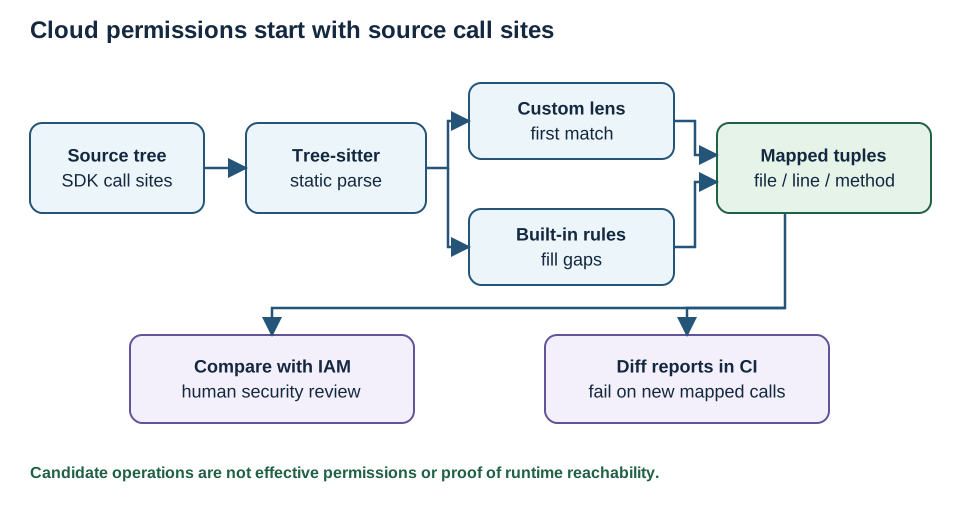
Mapped operations are review candidates, not a calculation of effective IAM permissions.
What CCE is not
Keep expectations aligned:
| Limitation | Detail |
|---|---|
| Static only | No runtime tracing, reflection, or dynamic plugin dispatch |
| Source, not IaC | Does not parse Terraform, CloudFormation, or IAM JSON — diff app code vs IaC externally |
| Languages | Go, Java, Python, JavaScript (.go, .java, .py, .js/.jsx/.mjs/.cjs) |
| Polyglot folders | One language per scan; use AUTO or run per language |
| Facades | Internal wrappers may hide underlying SDK calls unless you scan the SDK or add lens rules |
| Effective permissions | Reports mapped call sites, not effective AWS permissions after service control policies (SCPs), permission boundaries, resource policies, and conditions |
Full list: Known limitations.
Core concepts
| Term | What it is |
|---|---|
| Entitlement | One mapped call row: (provider, resource, operation) plus file/line/method; here an entitlement is a candidate operation, not a granted permission |
| Lens | YAML mapper (*_lenses.yaml) — rules that turn call sites into entitlements; passed via -mapper-file |
| Recipe | Catalog entry (id, languages, filter) pointing at a lens — discover with cce catalog |
| Pack | Named bundle of recipe ids (e.g. modernization-pack) — one parse, merged JSON |
| Diff | Compare two JSON reports; --fail-new for CI gates |
Mapper precedence: With -mapper-file, your lens runs first; built-in cloud rules fill gaps when the lens does not match. Review custom rules for coverage and false matches.
Filters: -filter cloud keeps cloud-style rows only. Use -filter all for custom providers (PLATFORM, TECH_DEBT, CVE, …).
Install
| Where | How |
|---|---|
| macOS / Linux | brew install stackgenhq/homebrew-stackgen/cce (formula, v0.0.5) |
| CI | sks/cce-action@v1.2.1 → pulls ghcr.io/stackgenhq/cce |
| Container | docker pull ghcr.io/stackgenhq/cce:0.0.5 |
# Local
brew tap stackgenhq/homebrew-stackgen
brew install stackgenhq/homebrew-stackgen/cce
cce -version

# Docker (same image as the GitHub Action)
docker run --rm -v "$PWD:$PWD" -w "$PWD" ghcr.io/stackgenhq/cce:0.0.5 \
  -folder . -language GO -filter cloud -format json -output report.json
CLI cheat sheet
Run from your project root. CCE honors .gitignore by default (skips vendor/, node_modules/, …).
| Goal | Command |
|---|---|
| Preview files (no parse) | cce plan -folder . -language AUTO |
| Cloud entitlements (IAM) | cce -folder . -language AUTO -filter cloud -format json -output cloud.json |
| Human-readable scan | cce -folder . -filter cloud -format text |
| SARIF for security tools | cce -folder . -filter cloud -format sarif -output findings.sarif |
| List recipes / packs | cce catalog · cce catalog --remote |
| Modernization pack | cce run -folder . -language AUTO -pack modernization-pack -remote -output pack.json |
| Pick recipes | cce run -recipes cloud-entitlements,sdk-uplift -remote -output subset.json |
| Custom lens | cce -folder . -filter all -mapper-file ./my-lens.yaml -format json -output out.json |
| CI gate | cce diff baseline.json current.json --fail-new |
| Policy-aware diff | cce diff baseline.json current.json -policy policy.yaml |
Performance: Prefer cce run -pack … over multiple cce invocations on the same folder — parse once, map many. Tune CCE_MAX_PARALLELISM on large CI runners.
Which command when:
| You need | Use | Not |
|---|---|---|
| One cloud report | cce -filter cloud … |
Three separate scans |
| Cloud + SDK + tech-debt | cce run -pack modernization-pack |
Shell loop of cce commands |
| Custom org rules | -mapper-file + -filter all |
-filter cloud alone |
Browse the full use case catalog (modernization, security, governance, SRE, AI).
Who it’s for
| Role | Typical workflow |
|---|---|
| Developers | Scan before the “fix my IAM” ticket; paste JSON into the PR |
| DevOps / platform | Diff app entitlements vs Terraform/IRSA; add sks/cce-action to pipelines |
| SREs | Scan before/after deploys; catch new cloud APIs in change review |
| Security | SARIF + diff gates; CVE reachability and audit-evidence recipes |
| Engineering managers | Entitlement count and top services in release artifacts — like test coverage |
Worked example: external-dns
kubernetes-sigs/external-dns syncs Kubernetes services to DNS providers. The AWS provider is a small Go package using AWS SDK for Go v2 (Route 53 + STS). Real software, not a toy repo.
Scan
git clone --depth 1 https://github.com/kubernetes-sigs/external-dns.git
cd external-dns

cce -folder provider/aws -language GO -filter cloud \
  -format json -output external-dns-aws.json
CCE parses provider/aws with tree-sitter and emits (provider, resource, operation) tuples for mapped calls, including Route 53 operations and Security Token Service (STS) assume-role wiring.
Derive IAM actions
jq -r '.entitlements[]
  | select(.provider == "AWS")
  | "\(.resource):\(.operation)"' external-dns-aws.json | sort -u
CCE proposes action names from mapped static call sites; confirm them against the AWS action model and the actual deployment path. Resource Amazon Resource Names (ARNs) and condition keys need separate policy review in Terraform or IAM Roles for Service Accounts (IRSA). The following JSON is an illustrative starting point, not a deployable least-privilege policy: each action may need its own resource scope.
{
  "Version": "2012-10-17",
  "Statement": [{
    "Effect": "Allow",
    "Action": ["route53:ListHostedZones", "route53:ChangeResourceRecordSets", "sts:AssumeRole"],
    "Resource": ["arn:aws:route53:::hostedzone/YOUR_ZONE_ID"]
  }]
}
What to expect on provider/aws
| AWS area | Why it shows up |
|---|---|
| route53 | Hosted zones, record sets, change batches |
| sts | Assume-role chain for cross-account Route 53 |
Optional DynamoDB registry backend: scan registry/dynamodb separately — a second IAM story. There is no S3 in the AWS provider package.
Local PR gate
cce -folder provider/aws -language GO -filter cloud -format json -output after.json
cce diff baseline.json after.json --fail-new
Recipes and packs
Discover built-in analysis recipes:
cce catalog --remote
Modernization pack (cloud + SDK uplift + tech-debt in one parse):
cce run -folder . -language AUTO -pack modernization-pack -remote -output pack.json
jq '.summary' pack.json
Public lenses are hosted at https://releases.stackgen.com/cce/lenses/… and …/cce/recipes/latest/.
| Recipe id | Purpose |
|---|---|
cloud-entitlements |
Built-in cloud SDK → IAM-oriented tuples |
sdk-uplift |
Legacy vs modern SDK labels |
tech-debt-inventory |
Deprecated / forbidden library call sites |
cve-reachability |
CVE-related package usage at call sites |
platform-adoption |
Internal platform SDK vs direct cloud SDK |
pre-deploy-iam-review |
Same extraction as cloud entitlements, CI-oriented |
change-control |
Signal for new cloud API usage |
Details: Analysis recipes & packs.
Enterprise lenses and catalogs
Platform teams can ship org-specific rules without waiting on upstream releases.
Path A — lens only (fastest): Host idp_lenses.yaml on internal HTTPS, pin version in CI:
cce -folder . -language AUTO -filter all \
  -mapper-file https://artifacts.corp.example/cce/lenses/idp/v1.2.0/idp_lenses.yaml \
  -format json -output idp-inventory.json
Path B — catalog + pack: Register recipes in your catalog.json / packs.json, host on HTTPS, run:
cce catalog --remote \
  -catalog-url https://artifacts.corp.example/cce/recipes/latest/catalog.json \
  -packs-url https://artifacts.corp.example/cce/recipes/latest/packs.json

cce run -folder . -language AUTO -pack corp-platform-pack -remote \
  -catalog-url https://artifacts.corp.example/cce/recipes/latest/catalog.json \
  -packs-url https://artifacts.corp.example/cce/recipes/latest/packs.json \
  -output platform.json
Full guide: Enterprise lenses and catalogs (templates, pitfalls, CI policies).
GitHub Actions
Add CCE to any workflow with sks/cce-action (@v1.2.1). Pulls ghcr.io/stackgenhq/cce — no Homebrew on the runner.
Basic scan on every PR
.github/workflows/cce-scan.yml:
name: Cloud entitlements

on:
  pull_request:
  push:
    branches: [main]

jobs:
  cce:
    runs-on: ubuntu-latest
    steps:
      - uses: actions/checkout@v4

      - uses: sks/cce-action@v1.2.1
        with:
          folder: provider/aws
          language: GO
          filter: cloud
          output: cce-report.json
PR gate: fail on new cloud APIs
name: CCE PR gate

on:
  pull_request:
    branches: [main]

jobs:
  entitlements:
    runs-on: ubuntu-latest
    steps:
      - uses: actions/checkout@v4
        with:
          ref: main
          path: baseline-tree

      - uses: sks/cce-action@v1.2.1
        with:
          folder: baseline-tree/provider/aws
          language: GO
          output: baseline.json
          upload-artifact: false

      - uses: actions/checkout@v4

      - uses: sks/cce-action@v1.2.1
        with:
          folder: provider/aws
          language: GO
          output: pr.json
          baseline: baseline.json
          fail-on-new: true
Enterprise lens in CI
- uses: sks/cce-action@v1.2.1
  with:
    folder: .
    language: AUTO
    filter: all
    mapper-file: https://artifacts.corp.example/cce/lenses/idp/v1.2.0/idp_lenses.yaml
    output: idp-inventory.json
Recipe pack in CI
- uses: sks/cce-action@v1.2.1
  with:
    mode: run
    pack: modernization-pack
    remote: true
    output: modernization.json
More examples: github.com/sks/cce-action.
Reading the output
Scan JSON
{
  "files_scanned": 9,
  "entitlements": [ … ],
  "summary": {
    "total_entitlements": 11,
    "by_provider": { "AWS": 11 }
  }
}
| Field | Meaning |
|---|---|
provider |
AWS, AWS_V2, PLATFORM, TECH_DEBT, … |
resource |
Service id (route53, sts, s3, …) |
operation |
API operation (ListHostedZones, AssumeRole, …) |
file, line, column |
Call site location |
method, signature |
FQN and call shape for reviewers |
jq '.summary' report.json
jq -r '.entitlements[] | "\(.file):\(.line) \(.resource):\(.operation)"' report.json | sort -u
IAM action string: "${resource}:${operation}" → route53:ListHostedZones.
GitHub Actions log
After Pulling CCE container ghcr.io/stackgenhq/cce:0.0.5:
Entitlements found: 11
| Job (cce-action CI) | Mode | Typical count |
|---|---|---|
external-dns |
scan + diff smoke |
11 |
modernization-pack |
run + modernization-pack |
33 (AWS + AWS_V2 from SDK uplift) |
custom-lens-url |
scan + remote lens |
≥ 11 |
Use mode: scan + filter: cloud for IAM gates. Pack mode counts are higher by design.
Step outputs: report-path, entitlement-count, diff-path (when baseline is set). Artifact: cce-entitlements (download from Actions → Artifacts).
Diff JSON (PR gate)
No drift:
{
  "baseline_total": 11,
  "current_total": 11,
  "added": null,
  "removed": null,
  "provider_delta": { "AWS": 0 }
}
Mapped new SDK usage appears in added — that is what --fail-new enforces. Review each added resource/operation as a potential new IAM surface; absence of added rows does not prove permissions have not changed elsewhere.
How it fits your workflow
| Step | What happens |
|---|---|
| 1. Code | IDE or agent writes SDK calls |
| 2. Scan | cce or sks/cce-action → entitlements JSON |
| 3. Actions | Derive IAM action strings; scope ARNs in Terraform / IRSA |
| 4. Gate | baseline + fail-on-new blocks unreviewed cloud surface |
The workflow is code → candidate operations → policy review. Static inventory helps start the conversation; it does not establish effective least privilege alone.
Resources
| Resource | Link |
|---|---|
| User docs | appcd-dev.github.io/cce |
| Get started | Get started with CCE |
| Use case catalog | All workflows by goal |
| GitHub Action | github.com/sks/cce-action |
| Container image | ghcr.io/stackgenhq/cce |
| Homebrew | stackgenhq/homebrew-stackgen |
| Custom lens YAML | Grok rules & prefixes |
| CCE vs OpenRewrite | When to use which |
| Enterprise lenses | IDP catalogs & packs |
| Limitations | Known limitations |
| Action CI example | Run #28751246690 |
Where the scan ends
AI-assisted development lowered the cost of adding cloud integrations. It did not lower the cost of proving you only requested the permissions you need. A CCE scan before merge may catch a new mapped call early, but it is not a substitute for security review or testing the role in its deployment environment.
The public CLI handles local source-based entitlement extraction. StackGen extends this with multi-cloud lens packs in corporate CI/CD, centralized governance, and runtime alignment. Enterprise questions: sales@stackgen.com.
Sabith builds production AI and cloud governance systems in Go. Related on this blog: defense-in-depth for agents · Terraform for agent governance.
We build incident-triage agents at StackGen; the SRE offering is at ai.stackgen.com.
Stay in the loop — production notes on AI agents, workflows, and SRE.
Low volume — new posts and curated reading lists. Unsubscribe anytime.