What Breaks with ClickHouse CAS, and How to Decide If You Should Run It
ClickHouse on AWS: Self-Managed from First Principles · Part 23
Every storage engine is sold on its happy path. This post is the unhappy one — and then the deciding one.
Part 1 is every failure mode I found before I’d trust a shared pool, written from a dev cluster where we attempted a writer→reader verification and hit a wall that had nothing to do with CAS — which is itself the lesson: the failure modes that will actually get you are usually one layer below the feature you are evaluating. Part 2 is the scorecard I’d run those failure modes through: CAS vs ClickHouse Cloud SharedMergeTree vs plain ReplicatedMergeTree replication, with the costs and the exit costs, and one honesty up front that shapes everything below — CAS is experimental.
Key takeaways
- CAS fails closed. Mount refusal, ambiguous GC, lost leases: all stop work rather than proceed unsafely. That is good design and it still means an outage if you ignore the signals.
- Most real failures are identity, config render, or bucket misconfiguration — not the CAS algorithm.
- Your replication layer is a prerequisite, not a beneficiary. Broken
ON CLUSTERDDL stays broken with CAS. - Alert on
cas_mountsandcas_gc_logbefore you need them. - Plain replication is the right default. CAS is a cost optimization for the cold tier, gated on evidence.
- CAS wins when the storage multiplier is your dominant cost and you can run experimental software deliberately. SharedMergeTree wins when you would rather pay ClickHouse to own the problem and you accept Cloud lock-in.
- The decision is reversible in one direction only if you design for it up front (disks and policies, not engine rewrites).
Failure 0: the cluster underneath is already broken
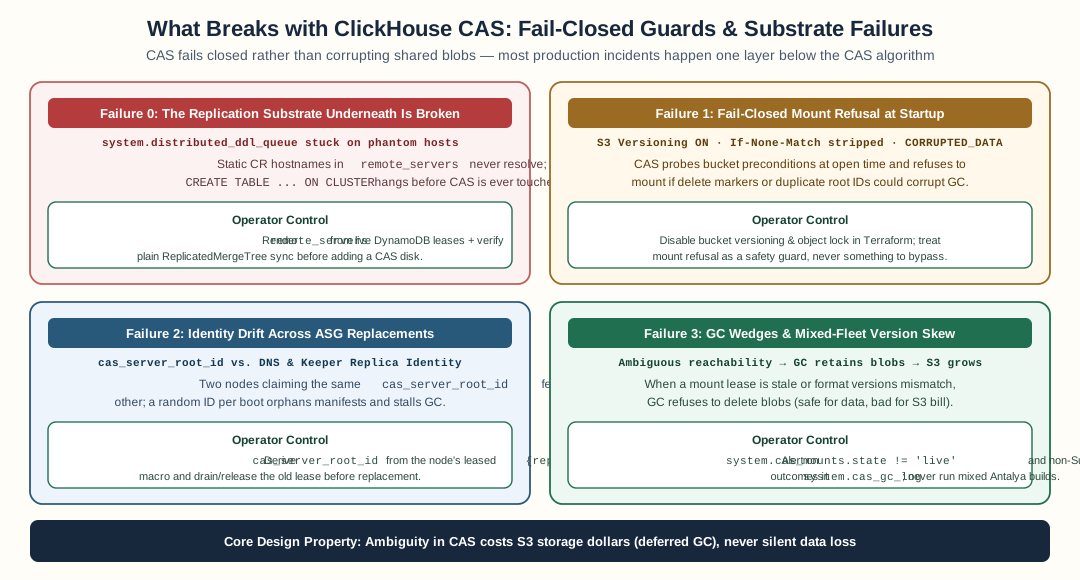
CAS fails closed when bucket preconditions or mount leases are ambiguous — and most field failures originate one layer below in remote_servers host lists or replica identity drift.
Before any CAS semantics matter, the cluster has to replicate. On our dev cluster the pre-CAS smoke test failed for boring reasons that CAS cannot fix and will not hide:
system.distributed_ddl_queue — every task Inactive on all 12 listed hosts
reason: hosts chi-ch-int-dev-ch-int-dev-01-2 … -01-11 resolve to nothing
The config render produced a static list of CR-style hostnames that have no DNS entries. DDL is dispatched to the full list, every unreachable host holds its slot, the task never completes, and nothing is applied anywhere — not on the writer, not on the reader. Symptoms that followed:
CREATE TABLE ... ON CLUSTERnever materialises the table on either node.- The reader’s
replication_queuedrained once/etc/hostson the reader pinnedwriter-0to the live IP (10.0.1.162was the pre-refresh writer; the replacement is10.0.1.254). - Writer replacement by the ASG left
writer-1-era state behind: stale Route53 records, a stale Kubernetes-style CR name in the remote servers list, and a Keeperreplicasznode forwriter-1that nothing cleaned up.
None of this is CAS. All of it must be fixed first. If your ON CLUSTER DDL does not complete reliably today, adding a shared storage pool will only make the resulting confusion more expensive.
flowchart LR
    A["tofu apply / image refresh"] --> B["node reboots with new identity inputs"]
    B --> C{"render matches live fleet?"}
    C -- no --> D["phantom hosts in remote_servers"]
    D --> E["ON CLUSTER DDL never lands"]
    E --> F["tables exist on zero or one node"]
    C -- yes --> G["CAS smoke test means something"]
Failure 1: the mount refuses to come up
CAS probes the bucket at open time. Expect refusal when:
| Symptom | Cause | Fix |
|---|---|---|
| Mount fails, log mentions versioning | bucket versioning enabled | suspend it; re-mount |
Mount fails, If-None-Match not honored |
store or gateway strips conditional headers | use a supporting store or stop |
CORRUPTED_DATA on mount |
cas_server_root_id reused, or orphaned owner record |
pick a fresh id, or decommission the old member properly |
Server boots, disk missing from system.disks |
config not rendered into the node (refresher didn’t fire) | check the config refresher / SSM document, not ClickHouse |
The pattern: the refusal is the feature. A CAS that mounted anyway on an untrusted bucket would eventually delete the wrong object with total confidence.
Failure 2: identity drift across ASG replacements
The writer in our cluster was replaced by an instance refresh. The old DNS record lingered, the reader resolved the dead IP, replication stalled with No route to host, and the parts queue grew to ~1000 entries before anyone noticed. For CAS this is worse, because the pool identity (cas_server_root_id) and the network identity (DNS, leases) are separate things that can each go stale independently.
Controls:
- derive
cas_server_root_idfrom the same ordinal/lease mechanism as the rest of the node’s identity; - TTL the DNS records aggressively; never pin cluster peers in
/etc/hosts - alarm on
replication_queuedepth and onsystem.replicasabsolute_delay; - on replacement, verify the old node’s lease is actually released before the new one claims the slot.
Failure 3: GC distress
CAS GC is not a cron rm. A round is 18 phases over ref logs and manifests; it loses leadership politely, defers when the fold is expensive, and aborts rather than guess. What you will see in practice:
SELECT outcome, count() FROM system.cas_gc_log
WHERE event_type='Finish' GROUP BY outcome;
| Outcome | Meaning | Action |
|---|---|---|
Success |
round completed | none |
NotALeader |
another replica holds the GC lease | none — by design |
Deferred |
not enough change to fold | none |
Aborted |
interrupted; retried next round | watch the streak |
Error |
round failed | investigate now; sustained = stop writing to the pool |
A rising wedged_namespace_count in system.cas_mounts means a ref-append lane is stuck; pending_reclaim climbing without bound means GC is not keeping up with ingest. Both are capacity/tuning signals, not corruption — but treat them as pages, not graphs.
Failure 4: the mixed fleet
Antalya 26.6 and upstream 26.8 do not share a storage format on disk. If a pool contains objects written by a build whose manifest version the reader does not understand, you get UNKNOWN_FORMAT_VERSION — loud, not silent, but hard to recover without the matching binary. Never let two different CAS builds write to one pool.
Failure 5: the blast radius is the pool, not the node
With per-replica prefixes, one broken replica costs you its copy. With CAS, one pool holds everyone’s bytes. That is the point of dedup and also the risk:
- a corrupt bucket policy that revokes
s3:GetObjectoncas/*takes out every reader at once; aws s3 rm s3://bucket/cas/ --recursiveexecuted by a tired human deletes the deduped 60% and leaves some parts unreadable everywhere;- lifecycle rules that expire “old” objects without knowing they are referenced will do the same, slower.
Mitigations: separate prefix + explicit IAM allow (not wildcard), no lifecycle expiry on the pool, object-lock disabled (required) compensated by out-of-band backups, and a tested restore.
Failure 6: the 8 GiB reader that passed the soak and died in the burst
The health gate on our readers reported “degraded: table default.events readonly”
mid-roll during a 30 TB/day soak. The reason was not CAS and not replication — it
was a brand-new c8g.xlarge (4 vCPU / 8 GiB) that had been sized by CPU headroom
alone while carrying the full 8 × concurrency 4 = 32 background merge budget meant
for a 64 GiB writer.
What the soak hid and a 10-minute burst exposed:
max_server_memory_usage_to_ram_ratio = 0.9on 8 GiB means a~6.0 GiBserver cap.background_pool_size = 8×background_merges_mutations_concurrency_ratio = 4= up to 32 concurrent merges in flight, each reserving hundreds of MiB of merge scratch. One 8 GiB reader ran 28 concurrent merges and 24 concurrent fetches at once and loggedCode: 241 MEMORY_LIMIT_EXCEEDED(1,537 occurrences in one 30-minute window) while reporting0logical errors.- The fix is mechanical, not architectural: cap
background_merges_mutations_concurrency_ratioat2for any host at or below ~12 GiB RAM (2 × 8 = 16concurrent merges maximum,12whenvcpus <= 2), and size readers at ≥16 GiB whenever they must also fetch and merge parts on a shared pool.
Two adjacent lessons from the same burst, both now enforced in chinit v0.2.7:
- Percent-encoded Keeper znodes defeat
strings.HasPrefixreapers. ClickHouse writes/clickhouse/<cluster>/task_queue/replicaschildren as URL-encoded names (writer%2D4%2Ech%2Dint%2Ddev%2Eclickhouse%2Einternal:9440). A reaper that compares raw strings never matcheswriter-and never removes the entry, so DDL workers andDNSResolverlog “Cannot resolve host” forever for ordinals that left the fleet weeks ago. Unescape before matching; the entries were drained by hand and now self-clean. opentelemetry_span_logis not like every other system log. Its stock<engine>block ships inconfig.xml, so settingpartition_by/ttlalongside it is a fatal config error (Code: 36), not a no-op warning. Put the TTL inside theengine=string or the server does not start.
The one-line rule from this failure: size readers for the worst-case merge burst, not the steady-state ingest rate, and test with bursts short enough that queue depth hides nothing.
Failure 6: the verification gap
The most expensive failure is declaring success because the server started. Minimum bar before calling CAS healthy:
-- every pool member live
SELECT countIf(state <> 'live') FROM system.cas_mounts WHERE disk LIKE 'cas%';   -- 0
-- GC closing rounds cleanly
SELECT countIf(outcome = 'Error') FROM system.cas_gc_log WHERE event_type='Finish';  -- 0
-- data actually co-located
SELECT disk_name, count() FROM system.parts WHERE active GROUP BY disk_name;
-- and the bucket agrees
-- aws s3 ls s3://bucket/cas/default/ --recursive | wc -l
Plus: create a table on the writer, see it on the reader, restart a node, confirm it rejoins the pool, and restore from backup at least once.
The short list
CAS does not remove the need for the boring work. It removes the duplicated bytes. Everything else — DNS, Keeper, IAM, backups, honest smoke tests — still decides whether you sleep.
Part 2: now that you know what breaks, how do you decide
That is the failure catalog. What remains is whether any of it should stop you — and if not, which option gets the bytes. This is the framework I would use in a design review — weighted the way a bill-paying engineer would, not the way a benchmark author would.
The three options
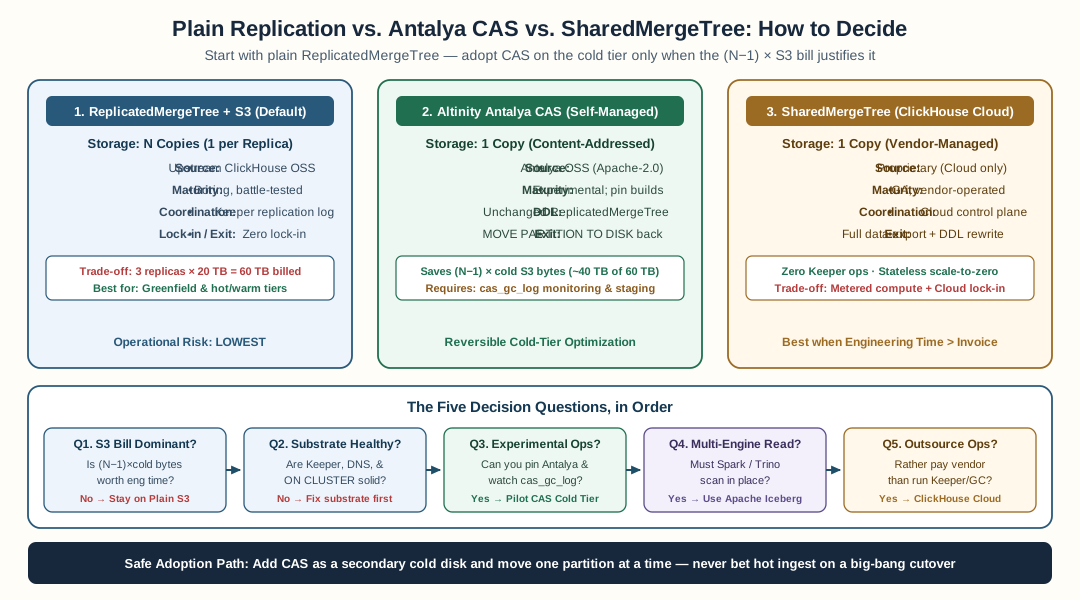
Start with plain ReplicatedMergeTree on S3; adopt Antalya CAS on the cold tier when (replicas − 1) × S3 bytes justifies operating an experimental pool, or choose SharedMergeTree when outsourcing operations outweighs Cloud lock-in.
| ReplicatedMergeTree + S3 | CAS (Antalya) | SharedMergeTree (Cloud) | |
|---|---|---|---|
| Where the bytes live | 1 copy per replica | 1 copy per unique blob | 1 copy, managed |
| Source | upstream OSS | Altinity Antalya OSS (experimental) | ClickHouse Cloud only |
| Coordination | Keeper (replication log) | Keeper (unchanged) + pool-internal leases/GC in S3 | Cloud control plane |
| DDL | ON CLUSTER |
ON CLUSTER (unchanged) |
Cloud semantics; engines are Shared* |
| Maturity | boring, battle-tested | experimental; format may change | GA in Cloud |
| Cost model | S3 × replica count | S3 × 1 (+ request overhead during folds) | Metered storage + compute |
| Lock-in | none | low (data is ordinary parts) | high (SHOW CREATE TABLE shows engines that don’t exist in OSS) |
| Exit | trivial | MOVE PARTITION back |
export + DDL rewrite |
Decision questions, in order
1. Is your S3 line item actually the problem?
If compute and Keeper dominate, stop here. CAS optimizes bytes, not anything else. Pull the last three months of S3 storage by prefix and compute bytes × (replicas − 1) × price. If that number is not worth engineering time, you are done.
2. Is your replication layer healthy?
If ON CLUSTER DDL is flaky, Keeper has drift, or replicas flap, fix that first. CAS inherits the replication substrate; it does not stabilize it. Failure 0 above shows what “broken underneath” looks like.
3. Can you operate experimental software deliberately?
CAS means: pinned builds, a staging pool, release-note reading, cas_gc_log in your dashboards, and a rollback plan you have actually executed. If your org cannot do that, you have your answer.
4. Do you need other engines to read the same data? If Spark/DuckDB/Trino must scan the table in place, neither CAS nor ReplicatedMergeTree is the answer — that is Iceberg territory, a different trade (open format, external catalog, no ClickHouse-native merges).
5. Would you rather pay someone? ClickHouse Cloud exists for teams who looked at items 1–4 and decided their time was worth more than the invoice delta. That is a legitimate answer, and it comes with SharedMergeTree, no Keeper to run, and no DDL fan-out to debug. The cost is meters you cannot turn off and DDL you cannot take with you.
A scoring sheet you can argue with
Weight each 0–3, multiply, sum per column. It is not scientific; it makes the implicit explicit.
| Criterion (weight) | Replicated | CAS | SharedMT |
|---|---|---|---|
| Cold-tier storage cost (3) | 0 | 9 | 9 |
| Operational risk (3, higher=better/safer) | 9 | 5 | 9 |
| Exit cost / portability (2) | 6 | 5 | 1 |
| Feature velocity / support (1) | 2 | 1 | 3 |
| Fit with existing IaC & IAM (1) | 3 | 2 | 0 |
| Total | 17 | 17 | 22 |
Flip the storage weight and CAS wins decisively; flip the risk weight and plain replication does. The point is not the number — it is that the decision moves with your weights, and you should be able to say which weights you used out loud.
The adoption path I would actually take
- Today: per-replica S3 prefixes,
TTL ... TO VOLUME 'cold', tenant policies, per-partition accounting. Zero new risk. Most clusters stop here and should. - When storage cost shows up on a budget review: add CAS disks alongside existing ones, no table touched. Verify mounts on every node.
- Pilot: one cold, low-traffic table;
MOVE PARTITIONone partition; measure S3 bytes before/after and GC behavior for two weeks. - Expand: tenant by tenant. Keep
cas_configin git. Review the GC log weekly until it is boring. - Never: big-bang migration, mixed-version CAS fleets, CAS as primary storage for hot data.
What I would tell a team adopting this quarter
Budget two weeks of platform work before the first partition moves: AMI build, bucket preconditions, IAM scoping, monitoring, rollback rehearsal, and one page of runbook. The software is ready to try. Your control plane probably is not, and that is where the time goes.
References
- Altinity Antalya CAS docs: https://docs.altinity.com/altinityantalya/ —
operations/monitoring,operations/troubleshooting,architecture/garbage-collection - Altinity’s CAS announcement: https://altinity.com/blog/introducing-cas-drop-in-compute-storage-separation-for-clickhouse-mergetree-tables
- CAS source:
src/Disks/DiskObjectStorage/MetadataStorages/ContentAddressed/ - Cloud SharedMergeTree docs: https://clickhouse.com/docs/cloud/managing-services/shared-merge-tree
The failure modes are the price of admission; the scorecard is how you decide whether the seat is worth it. Earlier in this arc: ClickHouse zero-copy replication is dead: what actually replaced it — the intro primer — and Touching CAS Without Betting the Cluster: A Hands-On Staging Walkthrough, where you run every check above on a real pool before trusting it.
FAQ
What is the most likely way a CAS deployment fails?
Mount refused at startup because the bucket violates a precondition (versioning on, or conditional writes not honored), or two nodes sharing one cas_server_root_id. Both are loud, not silent — which is the point.
Can CAS lose data?
The design goal is no. Deletion requires an exact-token match after a full GC round confirms zero in-degree; anything ambiguous is kept. The realistic loss scenarios are operational: deleting cas/ by hand, or a pool bucket that is not the one the disk points at.
What should I alert on?
cas_mounts state != live, cas_gc_log outcomes other than Success/NotALeader/Deferred, CASRefAppendWedged-style events, replication_queue growth, and parts-per-partition thresholds. Plus the same signals you already watch for plain ReplicatedMergeTree.
Did CAS cause the ON CLUSTER failures seen in the field?
No. DDL distribution depends on remote_servers and Keeper, not the disk type. The failures were phantom hosts in the rendered cluster definition — see the body. CAS inherits whatever your replication layer already does, good or bad.
Is CAS a replacement for SharedMergeTree?
It solves the same problem — one copy of the bytes for many replicas — but it is not the same system. SharedMergeTree is Cloud-only, closed source, and coordinates through ClickHouse Cloud's control plane. CAS is open source (Apache-2.0, Altinity Antalya), object-store based, and keeps ReplicatedMergeTree semantics.
Should a greenfield project start with CAS?
Only if you can tolerate experimental software and you have a real replica-multiplier cost problem. Start with plain ReplicatedMergeTree on S3 with per-replica prefixes; adopt CAS for the cold tier when the S3 line item justifies it.
How much does CAS actually save?
It removes the (replicas − 1) × cold-bytes term. For 3 replicas and 20 TB of cold data, roughly 40 TB of S3 storage and its request/IA costs. It saves nothing on compute, Keeper, EBS metadata disks, or backups.
What is the exit cost if CAS goes wrong?
Move the affected partitions back with ALTER TABLE ... MOVE PARTITION TO DISK, then disable cas_config. No export, no re-ingest. The data is ordinary parts throughout.
Stay in the loop — production notes on AI agents, workflows, and SRE.
Low volume — new posts and curated reading lists. Unsubscribe anytime.