Teaching an Operator Without Kubernetes: Building chctl From the Altinity Source
ClickHouse on AWS: Self-Managed from First Principles · Part 12
This is the story of the second half of the migration. The first half — provisioning ClickHouse on Amazon Elastic Compute Cloud (EC2) from Terraform — covered storage, Domain Name System (DNS), and spot autoscaling. This half is the part I keep describing to other engineers as “we taught the Altinity operator to work without Kubernetes,” which sounds impossible. Some of it was.
Why not just run the operator?
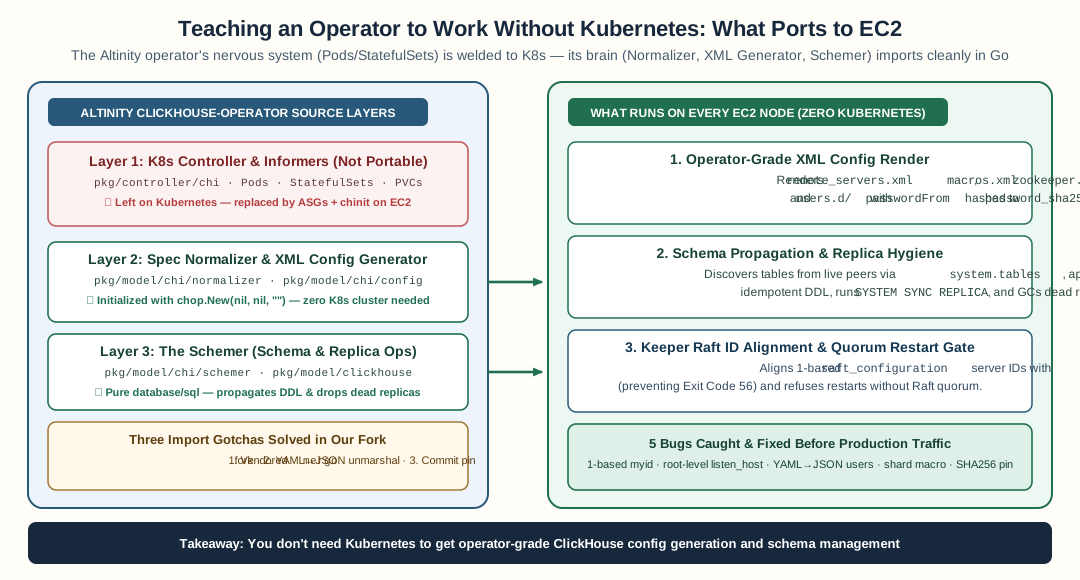
The Altinity operator’s controller layer is welded to Kubernetes Pods and StatefulSets, but its Normalizer, XML Config Generators, Schemer, and SQL client import cleanly into Go to run directly on EC2.
The obvious question. The answer starts with reading the operator’s source tree as three distinct layers, split by how hard each one leans on the Kubernetes application programming interface (API):
graph LR
    A["Cmd + controller<br/>informers, Pods, StatefulSets<br/>NOT PORTABLE"] -->|"not reusable<br/>off-cluster"| X["✗ stays on k8s"]
    B["Normalizer<br/>defaults + validation<br/>CHI/CHK spec types"] -->|"imports clean<br/>(singleton init)"| Y["✓ chctl reuses"]
    C["Config generators<br/>users.d / config.d / raft XML"] -->|"imports clean"| Y
    D["Schemer<br/>CREATE IF NOT EXISTS<br/>propagation SQL"] -->|"imports clean"| Y
    E["ClickHouse client<br/>database/sql, no k8s"] -->|"imports clean"| Y
The controller is the operator, in the informer-watches-a-CRD sense, and it
is welded to Pods. But underneath it sits a domain layer that turns a ClickHouseInstallation YAML Ain’t Markup Language (YAML) document into validated, defaulted,
runtime-wired structures — and generators that emit the config Extensible Markup Language (XML) — with a
coupling to Kubernetes so shallow that the operator’s own unit tests
initialize it with chop.New(nil, nil, "") and a nil clientset.
That was the bet: the operator’s brain is reusable; its nervous system is not. Rebuilding the brain as bash was the mistake this whole exercise started from — three systemd units re-implementing the schemer’s Structured Query Language (SQL), one regular expression (regex) at a time, drifting one upstream release behind.
The import
The mechanics turned out to be boring, which is the good news. One go.mod
require, one commit hash:
require github.com/altinity/clickhouse-operator v0.0.0-20261112224202-7e08a1a
Three things needed handling:
-
The replace does not propagate. Upstream wires a mergo fork —
WithSliceDeepMergeexists only insunsingerus/mergo— through areplacedirective, which the Go modules spec applies only to the main module. Every library consumer gotundefined: mergo.WithSliceDeepMerge. The fix on my fork: vendor the ~840 lines in-repo with provenance. (Proposed upstream; now merged into the fork’s tree so consumers need nothing.) -
Tags are not semantic versioning (semver). Upstream tags read
release-0.27.4; Go module resolution wantsv0.27.4. Every dependency pin is a commit pseudo-version, which in practice means: bumps are an explicit diff review, never@latest. I’ve come to like this even as a constraint — it matches how infrequently a ClickHouse cluster should change. -
YAML parses like JavaScript Object Notation (JSON) if you want the user sections back. The operator’s
Settingstype implementsUnmarshalJSONonly — its YAML unmarshaler is commented upstream. A directyaml.Unmarshalinto the CR silently produces empty users and profiles. Every spec load goes YAML → JSON → Unmarshal through one helper, with a test that would fail if anyone “simplifies” it back.
One more bootstrap line, from the operator’s own test suite:
chop.New(nil, nil, "") // the off-cluster singleton, exactly as upstream tests do
With those four pieces in place, normalizer.CreateTemplated(spec) returned
a fully defaulted, runtime-wired custom resource (CR) on a laptop with no kubeconfig.
What “reusable” is worth
Concretely, chctl is five commands, all thin wrappers over operator packages:
| Command | Operator code underneath | Replaces |
|---|---|---|
config render |
chi + chk FilesGenerator | hand-written config XML |
users render |
Settings emitter + user defaults | users.xml assembled in bash |
schema sync |
ClusterSchemer.HostCreateTables |
60-line clusterAllReplicas SQL port |
replica drop / sync |
HostDropReplica / HostSyncTables |
weekly garbage collection (GC) cron + drain SQL |
keeper safe-to-stop |
raft-safety math from the controller | “restart keepers one at a time” runbooks |
The last one deserves a beat. The operator’s keeper reconciliation won’t disrupt a host if doing so drops the ensemble below Raft majority, and its controller carries that logic as functions. Off-cluster, “restart keepers one at a time” was documentation. Now it’s:
chctl keeper safe-to-stop -keeper 10.0.3.10:9181
# exit 0 — proceed    exit 2 — held, heartbeat the hook    exit 3 — probe error
…and the exit codes are what an autoscaling-group lifecycle hook understands natively.
The five bugs the rollout caught
This is the part worth the read. The whole point of building a validation harness — one script that runs the released binary against the live dev cluster — was that the loop “fix, tag, release, re-verify” took under five minutes. It got used, because real clusters find things unit tests miss. Five findings, in the order the cluster served them:
1. Settings has no YAML unmarshaler (silent)
Specs loaded, normalized, rendered — empty users files. No error anywhere.
The YAML unmarshaler is commented out in the operator because Kubernetes
decodes CRs as JSON. A spec must go YAML → JSON → Unmarshal, or user
sections vanish silently. Now guarded by a test.
2. .gitignore ate the package
chctl — the entry for a stray local binary — also matched the directory
pkg/chctl/. A file added to that package was silently excluded from every
commit, and the first release build failed with undefined: newCloudNamer.
A release gate is only as good as its working tree; the pattern became
/chctl, root-anchored.
3. Two embedded levels, one namer override
The schemer resolves exec hosts through an embedded INameManager, whose
output is the Kubernetes pod fully qualified domain name (FQDN) — fine on a cluster, unresolvable on EC2.
Wrapping the namers: the override had to be set on both embedding levels,
and the live error was exactly the tell — no such host for
chi-...svc.cluster.local. When you adapt a package through composition,
trace which struct instance actually receives the method call.
4. Identity conventions disagree by one
Keeper’s raft entry carried the operator’s convention, the myid file carried the provisioning one, and the two differed by one. Exit code 56, on every start, after the state was already clean. The durable fix was boring on purpose: pick one convention, write it down as the one place both are derived from, and diff the myid file against the rendered entry as a pre-flight check.
5. The wrapper that broke the format
The first users render emitted raw user trees at the document root, and my
wrapper — written to add the <users> element — double-wrapped it.
SAXParseException: Tag mismatch, line 24. That XML now goes through a real parser in continuous integration (CI), not a substring check.
Where the line moved
The honest measure: cloud-init went from ~2,966 lines to 2,909, and what changed is not the count but the shape. The installers are gone — packer bakes every binary, and boot fails loudly if one is missing instead of silently apt-installing an unvalidated version. The operator’s domain work — user rendering, schema propagation, replica hygiene, keeper topology — is not what cloud-init does anymore. It hands specs to the binary that owns the domain.
flowchart TB
    subgraph build ["build time (packer + CI)"]
        G["golden AMI<br/>clickhouse + chctl + agents<br/>pinned, checksummed"]
    end
    subgraph boot ["node boot (cloud-init)"]
        R["binary presence check<br/>fail loudly, ASG replaces"] --> S["fetch specs<br/>checksum-gated, version-gated"]
        S --> U["chctl config render<br/>+ users render<br/>(secrets resolved)"] --> K["clickhouse-server / keeper start"]
    end
    subgraph steady ["steady state (systemd)"]
        K --> M["schema sync<br/>operator schemer, retries + self-prune"]
        K --> N["replica sync + drop<br/>operator SQL, GC timers"]
        K --> O["keeper gate<br/>quorum verdict as exit codes"]
    end
    build --> boot
The line between the two halves is worth stating plainly, because it is the decision I’d make differently a year from now, and it is worth knowing why today’s shape is what it is:
- Operator packages own ClickHouse semantics. Spec → validation → XML → schema data definition language (DDL) → replica hygiene. Everything upstream might improve; everything I’d otherwise re-derive and inevitably drift.
- chctl (my code) owns the boundary. Cloud inventory, secret sources, the command-line interface (CLI), the version gate. Thin, tested, replaceable.
- cloud-init owns the cloud. Mounts by label, DNS, ordinals, secrets fetch, spot drain orchestration. Everything upstream can’t express.
The checklist
If you’re standing the same bridge — operator code, non-Kubernetes target — the version of this audit that would have saved me a week:
- Read the import graph before believing the diagram.
grepfork8s.ioin each candidate package, including tests, and find the singleton initializers. The boundary is where the imports stop, not where a README says it is. - Pin by commit, budget for the pseudoversion. Library forks without semver tags mean every dependency line is a review artifact. That is good discipline for anything feeding a database.
- Ship a harness before you ship the binary. Released binary → live
cluster → verdict, one command, five minutes. Every finding above came
through that loop, and none of them would have come through
go test. - Check for commented-out unmarshalers. If a type implements UnmarshalJSON but not UnmarshalYAML, YAML loading is silently lossy.
- Diff rendered output against live config byte-for-byte at least once per role. The parity diff is what tells you which convention disagreement is actually the migration, and which is a renderer bug.
The series continues with the keeper quorum gate wired into an actual autoscaling lifecycle hook — the last piece that turns “exit codes a machine can read” into automation the cluster can trust.
FAQ
Can I run the Altinity operator's code without Kubernetes?
Yes, partially. The operator splits into three layers: a ClickHouse client (plain database/sql, no k8s imports), a domain layer (normalizer, config generators, schemer — only coupled to the k8s API through a global config singleton that tests already initialize with chop.New(nil, nil, "")), and the controller (informer-driven, welded to Pods/StatefulSets). The first two layers import cleanly as Go modules; the third does not, and rewriting it against EC2 would be building a second operator.
What is chctl?
A CLI (cmd/chctl in the fork) that runs the operator's own normalizer, config generators, and schemer against any ClickHouse deployment — EC2 autoscaling groups, VMSS, bare metal. It renders users.d/config.d XML from the same CHI/CHK spec the operator reconciles on Kubernetes, resolves password secrets from the cloud store at render time, runs schema propagation and replica cleanup, and refuses keeper restarts that would drop Raft quorum.
Why write keeper server IDs as 0-based in one place and 1-based in another?
You shouldn't have to. Keeper server IDs come from whatever generated the config, and the myid file comes from whatever provisioned the disk. When those two generators disagree by one, keeper exits 56 on every start. The fix is picking one convention — we settled on 'the raft entry's id is authority' and made the myid write match it — but the cheap lesson is: diff the two sources before blaming the config.
How does a rendered config carry secrets without leaking them?
The spec carries references, not values: passwordFrom: myapp/admin-password. The renderer resolves each reference through a port backed by the cloud's secret store (AWS Secrets Manager via instance role), SHA-256-hashes the plaintext, and emits password_sha256_hex. The plaintext never touches the spec, Terraform state, or the rendered file.
What does the version gate in node bootstrap do?
The golden AMI bakes chctl at a pinned version; bootstrap compares chctl version against the targeted release and checksum-gates the download only when they differ. Old binary + new target = upgrade; match = skip the 37MB download. A missing release artifact warns instead of silently keeping the AMI's binary.
Stay in the loop — production notes on AI agents, workflows, and SRE.
Low volume — new posts and curated reading lists. Unsubscribe anytime.