Boot Sequence as a Contract: How a Self-Managed ClickHouse Node Comes Up (and How It Fails)
ClickHouse on AWS: Self-Managed from First Principles · Part 13
Boot scripts are the least-reviewed production code in a self-managed database deployment. Everyone reads the data definition language (DDL), the schema, the Grafana dashboards. Almost nobody reads what runs between the instance launching and the first successful query — which is exactly where the interesting failures live. This post walks the boot sequence of the self-managed ClickHouse cluster in this series, built as chinit — a Go bootstrapper that replaced roughly 3,600 lines of Terraform-templated bash — with every step’s failure semantics made explicit, and the production findings that forced its ordering.
The framing I want to defend: the boot sequence is a contract between the node and the rest of the fleet. Not a list of setup chores — an ordering with invariants that, if violated, produce failures nobody can debug from the node’s own logs. Three of the invariants here come from incidents; each one is explained where it appears in the sequence.
The cast: one binary, four roles
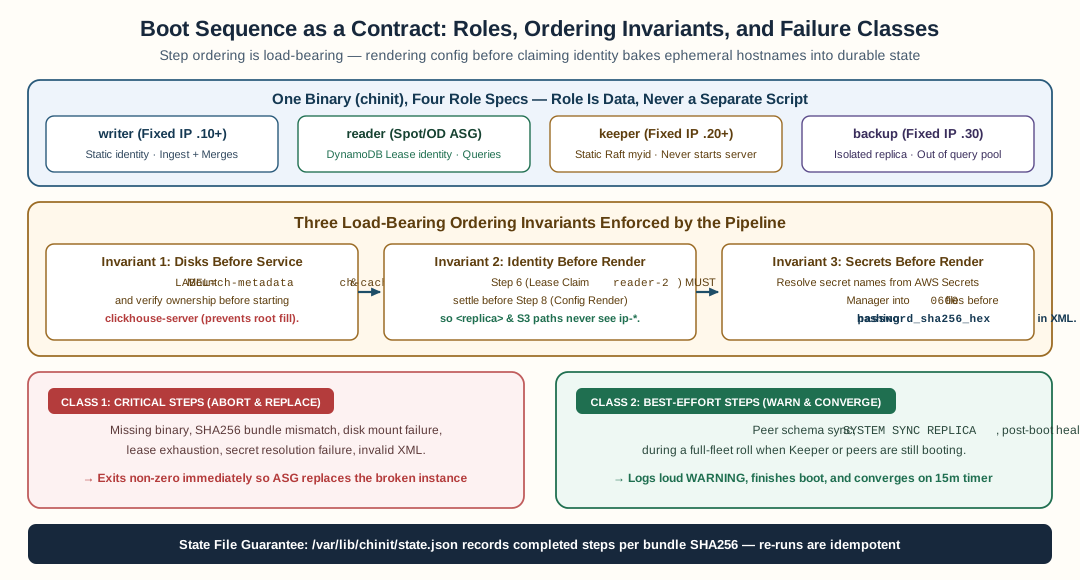
One binary serves all four node roles while enforcing three load-bearing ordering invariants (mount disks first, claim identity before config render, resolve secrets before render) and separating critical abort-and-replace steps from best-effort convergence steps.
Every node boots the same binary and converges against the same shape of spec; the role is data, not code. That one decision deletes an entire failure class the bash era had — four parallel 3,000-line scripts, each drifting at its own pace.
| Role | Compute shape | Identity mechanism | Notes |
|---|---|---|---|
| writer | fixed instance | static — last octet of the private Internet Protocol (IP) address maps to writer-N |
Terraform allocates IPs at offset .10+ |
| reader | Auto Scaling Group (ASG) member (spot/on-demand mix) | lease — claims reader-N from a DynamoDB time-to-live (TTL) lease |
identity outlives the instance; the claim does |
| keeper | fixed instance | static — .20+ → keeper-N |
runs clickhouse-keeper, never the server |
| backup | single instance | static — .30 → backup-0 |
renders out of the custom resource (CR) on purpose |
The static identity works because the fleet’s IP addresses are part of
the Terraform contract. Readers have no such contract — spot reclaims
make them ephemeral — so their identity is claimed, leased and renewed,
never derived. Confusing the two is how you get writer-N name collisions
or a reader whose replica path changes every reboot.
Stage 0: the wrapper is deliberately boring
The user_data payload is ~1.5 kilobytes (KB) of shell with one job: make sure the bootstrapper is the pinned version and hand it the role’s spec. It does not install any database component. The golden image — built by packer, checksum-gated in continuous integration (CI) — owns every binary at a pinned, validated version. The boot only verifies presence:
if [ ! -x /usr/local/bin/chinit ]; then
    echo "ERROR: chinit not found in the golden AMI - wrong or broken image" >&2
    exit 1
fi
exec /usr/local/bin/chinit boot -spec ... -cloud aws
Lesson baked into this shape: the previous generation of scripts
command-guarded their apt installs (command -v curl || apt-get install),
so on the golden image they never ran — and when a node booted from a plain Amazon Machine Image (AMI) they silently installed whatever the distro repo had drifted
to, unvalidated. A missing binary is now a loud image bug, not a quiet
supply-chain gamble. An image that passes the packer build is the
version of the software; the boot treats anything else as foreign and
dies.
The pipeline: eighteen steps, two failure classes
Here is the whole sequence. Two properties matter on every row: what the step converges (probe-then-act — a re-run of a completed step is a no-op), and what happens when it fails.
flowchart TB
    subgraph s0["stage 0 · user_data"]
        WRAP["wrapper: seed role spec<br/>verify baked binary<br/>exec chinit boot"]
    end
    subgraph crit["critical — failure ABORTS the boot<br/>(ASG replaces the node)"]
        direction LR
        FETCH["1 fetch bundle<br/>SHA256 gate vs Terraform's hash"]
        OS["2 os tuning<br/>3 binary presence"]
        DISK["4 mount data disks<br/>by LABEL, mkfs blank only"]
        CFG["5 static configs<br/>validate XML, install 3"]
        ID["6 settle identity<br/>lease claim OR octet map"]
        SEC["7 retrieve passwords<br/>→ 0600 files"]
        RENDER["8 render node config<br/>chctl library: spec → config.d"]
        START["11 start clickhouse-server"]
        FIN["18 boot-finished marker"]
    end
    subgraph best["best-effort — failure WARNS and continues"]
        direction LR
        KEEPER["9 configure keeper"]
        ENV["10 node-env contract"]
        GATE["12 health gate<br/>verdict logged, never fatal"]
        PROM["13 prometheus reload"]
        UNITS["14 install job units"]
        BAK["15 backup config"]
        MON["16 monitoring configs"]
        SPOT["17 spot-watch (readers)"]
    end
    s0 --> FETCH --> OS --> DISK --> CFG --> ID --> SEC --> RENDER
    RENDER --> KEEPER --> ENV --> START
    START --> GATE --> PROM --> UNITS --> BAK --> MON --> SPOT --> FIN
    style crit fill:#3d1f1f,stroke:#8b3a3a,color:#f0d5d5
    style best fill:#1f2d3d,stroke:#3a6b8b,color:#d5e5f0
The color split is the semantics. A critical failure exits non-zero
after its retry policy — for an ASG role the group replaces the
instance, because a node that cannot mount its metadata disk or resolve
its secrets cannot self-heal; it is evidence of a broken image, a broken
tfvars, or a broken platform, and replacement is the remediation. A
best-effort failure logs WARNING: … boot continues and shows up in
the timing summary — the boot should continue past those, and the next
section shows why with a real incident.
That distinction is a first-class property of each step, not a set -e
toggle sprinkled through a script. Criticality is data, which makes it
reviewable in a diff: when someone proposes making health_gate fatal,
the reviewer sees the flag flip in context and can ask “which boot loop
do you want?”
The finding that forced step 6 before step 8
The bug that shaped this pipeline the most was an ordering bug. The reader claims its ordinal from DynamoDB — a conditional put (“this name is absent, or its lease expired”) swept over the fleet’s ordinals, retried for one full lease window because a spot-replacement reader should wait out a dead predecessor’s claim. But the first shipped order rendered config before the claim:
sequenceDiagram
    autonumber
    participant ASG as ASG (spot reclaim)
    participant N as new reader node
    participant DDB as DynamoDB lease table
    participant CH as clickhouse-server

    Note over N: WRONG ORDER — render before claim
    ASG->>N: launch replacement
    N->>N: render config (hostname = ip-10-0-1-101)
    N->>CH: macros/replica paths carry ip-10-0-1-101
    N->>DDB: claim reader-3 (succeeds)
    N->>N: set-hostname reader-3 — TOO LATE
    Note over CH: replica registered under<br/>ip-10-0-1-101 — never joins
    CH-->>CH: "ip-10-0-1-101 is not part of cluster"
The rendered <replica> macro and keeper path are identity-shaped —
they are written into the cluster’s Amazon Simple Storage Service (S3) parts metadata and zookeeper
namespace. Once rendered with an ephemeral ip-* name, no later rename
fixes it; the parts are already registered under the wrong identity. The
fix is the ordering: settle identity first, render second — and make
it part of the contract so a refactor cannot silently swap it:
sequenceDiagram
    autonumber
    participant ASG as ASG
    participant N as new reader node
    participant DDB as lease table
    participant R53 as Route53
    participant CH as clickhouse-server

    ASG->>N: launch replacement
    N->>DDB: conditional put reader-3 (absent OR lease expired)
    alt claim succeeds
        DDB-->>N: ok (lease 15 min)
    else sweep retries one lease window
        Note over N: dead node's renewal cron is gone —<br/>TTL expiry frees the ordinal
    end
    N->>N: set-hostname reader-3 (static + transient)
    N->>R53: UPSERT reader-3 → IP (TTL 60)
    N->>N: persist identity to state.json
    Note over N: ONLY NOW: render
    N->>CH: replica paths carry reader-3

    loop every 5 min (unit timer)
        N->>DDB: renew lease (instance_id-guarded)
    end
The same invariant generalized: identity settles before identity is
consumed. Secrets (step 7) land before the render because the render
resolves passwordFrom references at render time — and I learned from a
nil-resolver panic that “the renderer can skip a missing secret
reference” was not a real property; it dereferences every declared user.
What failure actually looks like: two crash loops, one root cause
The ordering rules earn their keep on the worst day. A real writer crash-loop, repaired during a recon of the dev cluster:
Crash 1 — exit code 347. A leftover users.d/chop-generated-users.xml
referencing an on-cluster-only profile (clickhouse_operator) that the
off-cluster render does not emit. The config-merge accepted it on boot 1
and poisoned every restart after. Remediation: move the stale file aside,
restart. Root cause: the boot did not own its config directory — a
file from a previous software generation outranked the render. The fix
in the pipeline is now structural: the render step installs a per-directory
manifest and prunes every file it previously managed; the boot also
actively removes retired overlays (a hand-written settings.xml from
the bash era, the pre-chctl delete_default_user.xml). A config
directory is a derived artifact — the boot treats drift as its own
bug, not the operator’s chore.
Crash 2 — exit code 36, “Empty protocol in uniform resource locator (URL)”. The S3 disk’s
endpoint is configured through an environment file
(/etc/default/clickhouse-server) the boot writes from the spec. One
spec field was missing from the rendered chinit.yaml → the env-file
step never fired → the S3 disk parsed an empty URL → the server refused
to start. Two lessons, both now structural:
- Specs are validated where they are consumed. The pipeline validates the whole BootSpec on load — role invariants, bucket present, disk label present — before a single provider call. A missing field fails the boot at step 0 with the field named, not at step 11 as an S3 parse error three minutes in.
- The spec is the only mutable input, so the spec is the only thing
to review. Terraform renders it, the SHA-pinned bundle delivers it,
every node consumes the same shape. Nobody edits a config on a node
and hopes —
tofu applyre-renders, and the fleet rolls.
And the meta-lesson, which applies to any database boot anywhere: a
crash-looping node’s exit code is the cheapest diagnostic you have.
Code 347 = config-merge poison. Code 36 = resource-parsing failure. The
runbook table is short and the boot logs now include the step name that
produced each file — triage is a two-minute state.json read.
Convergence: the boot is a loop, not a line
The boot records every step’s outcome — duration, status, and the config bundle Secure Hash Algorithm (SHA) digest it ran against — into /var/lib/chinit/state.json. That file
carries two behaviors bash couldn’t:
flowchart LR
    subgraph rerun["same node, re-run boot"]
        A["state.json<br/>steps done @ SHA X"] -->|"hash unchanged"| B["skip done steps<br/>resume where it stopped"]
        A -->|"hash changed"| C["invalidate all records<br/>re-render everything"]
    end
Re-running a boot is safe by design: a crashed mid-pipeline node resumes where it stopped, and — the important one — a node re-rendering through a config change does not skip the render because yesterday’s run marked it done. The config bundle SHA is the invalidation key: a new hash means a new fleet, and yesterday’s step outcomes are not evidence about today’s release.
Convergence also means the recurring jobs are the same pipeline shape. Schema sync retries whole passes (a materialized view whose TO-target table lands later in the same batch needs a second pass — deterministic, no human in the loop), prunes the node’s own stale replica registration after ASG replacements, and re-runs on an hourly timer as the safety net.
The gate that must not be fatal
The health gate (step 12) runs after the server start: every inventory host must answer Structured Query Language (SQL), every replica must be writable and registered, the keeper ensemble must answer mntr, and the spec’s tables must exist. It is deliberately best-effort, and this is the kind of choice that looks wrong until the failure mode is drawn:
sequenceDiagram
    autonumber
    participant R as booting reader
    participant P as peer (down)
    participant ASG as Auto Scaling Group

    Note over R,P: fleet rolling — a peer is mid-reboot
    R->>P: health probe
    P--xR: down
    alt gate is FATAL
        R->>ASG: boot failed → terminate
        ASG->>ASG: launch replacement
        Note over ASG: the replacement ALSO probes<br/>the down peer — boot loop<br/>until the fleet settles
    else gate is BEST-EFFORT (shipped)
        R->>R: WARNING logged + verdict in boot log
        R->>R: boot-finished marker written
        R->>P: (peer returns) replication catches up
        Note over R: reader serves stale reads<br/>until sync — never wedged
    end
A reader booting during a fleet roll will see downed peers — that is the normal case for spot churn, not an anomaly. A fatal gate turns a fleet’s ordinary rolling upgrade into a synchronized boot loop. The degraded boot is loud in the logs instead, because the worst outcome is not “node is behind” — it’s “nobody can tell whether the node is behind or broken.”
The contrast is the step list’s asymmetry, and it is worth internalizing as a design rule: fail-fast on things only a rebuild fixes (image content, disks, secrets, identity); warn-and-continue on things time fixes (peer availability, replica lag, a metrics endpoint that comes back after a reload).
Steady state: the boot installs its own maintenance
The boot’s last act is installing the systemd units — and their ExecStart lines are the same binary in job mode, not a second hand-written script family. The recurring jobs are the operator’s own semantics (the Altinity schemer’s propagation SQL, replica garbage collection (GC) parity), carried into the Go codebase rather than re-derived in bash — the reason the operator’s domain layer was imported, not reimplemented.
| Job | Role | Cadence | Operator-parity job |
|---|---|---|---|
| replica-sync | server nodes | per boot | HostSyncTables |
| schema-sync + hourly timer | server nodes | on-boot + hourly | ClusterSchemer / HostCreateTables |
| lease-renew | readers | 5-min | (identity lease, TTL 15 min) |
| spot-watch | readers | daemon | HostShutdown / HostDropReplica parity |
| keeper-health | keepers | cron | keeper mntr + quorum math |
| dead-replica-gc | writer-0 | weekly | replica GC |
| orphaned-data-gc | writer-0 | weekly | S3 census vs referenced metadata |
| backup-daily | backup replica | 02:00 | clickhouse-backup create/upload/prune |
Every job reloads its identity from the boot’s state file — never re-derives it. That one rule closes the last identity bug class: a cron script that re-derives the hostname at 03:00 captures whatever the platform calls the node at 03:00, which for a spot-replaced reader is not always the cluster’s name for it anymore.
The spot drain: the one place a boot rule inverts
Spot reclamation gives a reader ~120 seconds. The drain daemon watches the Instance Metadata Service (IMDS) interruption endpoint (or Azure scheduled events — the same contract, different wire), then executes a strict sequence, time-budgeted:
SYSTEM STOP REPLICATION QUEUES+SYSTEM STOP DISTRIBUTED SENDS— stop starting work before stopping the server (merges and sends killed mid-flight are the expensive failure)chctl replica dropagainst writer-0 — peer-side removal cleans the table replica and the database replica registration the local-only statement misses; the weekly GC is the safety net if writer-0 is unreachable inside the window- Release the Domain Name System (DNS) record and the lease (best-effort — the TTL expiry is the real backstop; the instance may not get another second)
SYSTEM SHUTDOWN
Step 1 first is the drain’s own ordering invariant: fastest-failure-first. Networking calls (steps 2–3) may fail inside the window; stopping local queue processing cannot. Everything that costs replication integrity is done before anything that costs network round-trips.
The checklist, as a contract
If you are building this — for ClickHouse or any stateful node — the version of the checklist that would have saved the crash loops above:
- Make the ordering invariants named, testable properties. Not comments — assertions. “Identity settles before render” and “secrets before render” are two lines of test that fail loudly when someone reorders steps.
- Give every step a criticality, and review changes to it like schema changes. Flipping the health gate to fatal is a cluster-wide behavior change wearing a one-flag diff.
- Consume-specs-where-they’re-defined: validate the whole spec at load. The spec is data; a missing field should fail at parse time with the field named, not three steps later as a resource error that looks like a platform bug.
- Treat the config directory as a derived artifact. Install a manifest, prune what you own, actively remove what your predecessors shipped. Leftover config files from a previous software generation are the classic crash-loop source, and they always survive longer than the machine’s uptime.
- Hash the mutable input and use the hash as the re-run’s invalidation key. Re-run safety and config-roll correctness are the same property.
- The golden image is the version. Pinned, checksummed at build; boot verifies presence and dies otherwise. Boot-time installers are how unvalidated versions enter a fleet quietly.
- Write down what the boot can and cannot tolerate. Peer-down at boot: tolerable, warn. Broken metadata disk: not tolerable, abort. The matrix is small, but unwritten it drifts one incident at a time.
The boot sequence is the cheapest place to encode everything your team has learned about running the database — because it is the only code that runs on every node, every day, before anything else gets a chance to be wrong. Treat it like you’d treat schema migrations: versioned, tested, reviewed, and boring on purpose.
Related in this series: why the data flows are drawn, spot readers and stable identity, operator runbooks without Kubernetes, and teaching the operator’s brain to run off-cluster.
FAQ
Why is the boot sequence of a ClickHouse node 'a contract'?
Because the order is load-bearing, not stylistic: identity must settle before any config render (a pre-claim hostname gets baked into keeper paths and macros), secrets must land before the render resolves passwordFrom references, keepers must never start clickhouse-server, and the health gate must be non-fatal so a reader booting during a fleet roll can still join. Reordering breaks the cluster in ways that only show up on the third reboot.
What is the difference between a critical and a best-effort boot step?
A critical step's failure aborts the boot with a non-zero exit — for Auto Scaling Group roles that means instance replacement, because the node cannot self-heal a broken disk or a wrong golden image. A best-effort step logs a loud WARNING and the boot continues — the deliberate shape of the health gate, so a degraded boot is visible instead of wedged in a boot loop.
Why do readers claim their ordinal from a lease table before rendering config?
Readers are ASG members and ephemeral — their platform hostname is an ip-* name that changes with every replacement. The claim (one conditional DynamoDB put over a TTL lease) produces a stable reader-N name that replication paths, macros and DNS can key on. Claiming before the render is what makes the identity a property of the cluster rather than of the instance.
Why does the boot fail on a missing binary instead of installing it?
The golden image owns installation at pinned, validated versions — packer bakes every binary and the build checksum-gates them. A boot-time installer silently apt-installs whatever the distro repo has drifted to. A missing binary at boot is an image bug; failing loudly and letting the ASG replace the node is the correct remediation.
What does 'convergence' mean for node boot?
Each step probes real system state before acting — a mounted disk stays mounted, a claimed lease is not re-claimed, a rendered config directory is diffed and pruned. Re-running the boot on the same node is safe by design, and a node that crashed mid-pipeline resumes where it stopped rather than redoing destructive work.
How does a booting reader know which steps to skip on re-run?
Every completed step is recorded in a state file (/var/lib/chinit/state.json) with the config-bundle SHA it ran against. A re-run skips steps recorded done for the same bundle hash, re-runs everything after a hash change, and a changed hash is treated as a new fleet — the configs it installed are not what the current release vouches for.
Stay in the loop — production notes on AI agents, workflows, and SRE.
Low volume — new posts and curated reading lists. Unsubscribe anytime.