The Honest Cost Model: Load-Testing a Log Stack Until the Bill Tells the Truth
ClickHouse on AWS: Self-Managed from First Principles · Part 28
The scene: you build a log pipeline on ClickHouse on EC2 with S3 behind it, you sketch the costs on paper, and the paper says a few hundred dollars a month. Then you load-test the thing at 30 TB/day for a month of runs — calibrating, breaking, fixing, re-running — and the bill tells you a different story. Not a dramatically different one, but an honest one: the compute you sized was never the problem, the buffer you forgot was quietly bigger than the database, and the only cost lever that matters is a number you set in a TTL clause.
This post is the cost model that came out the other side — every number measured, not modeled — and the lessons that only appear when you run a stack hard enough to see where the money actually goes. The stack: a producer writes NDJSON files to an S3 prefix, ClickHouse’s S3Queue engine drains them into a replicated MergeTree with tiered storage (EBS hot, S3 cold), and readers serve queries.
The setup, in one paragraph
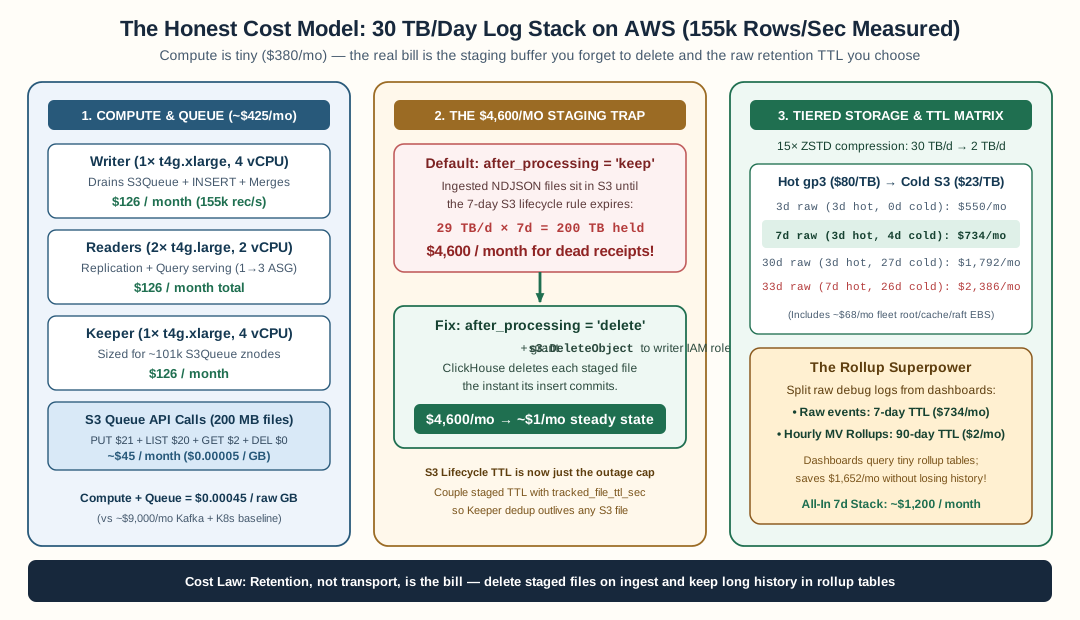
At 155,000 records/second (30 TB/day raw), EC2 compute and S3 queue requests cost ~$425/month; the real levers are after_processing = 'delete' on the staging prefix (collapsing a $4,600/month buffer to ~$1/month) and pairing a 7-day raw TTL with cheap 90-day rollup tables.
One writer instance (4 vCPU, on-demand) runs the S3Queue engine and the INSERT pipeline. Two readers (2 vCPU each) replicate and serve queries, scaling 1→3 on CPU via target-tracking. One keeper. The data path is deliberately boring: producer → S3 staging prefix → S3Queue table → materialized view → events table (hot on gp3, TTL-moved to S3). No Kafka, no worker fleet — the queue is S3, and the drain is ClickHouse’s own engine. That design choice is itself the first cost lesson: when the buffer is object storage, the buffer bills like object storage.
What 155k records/second actually costs in compute
Across the verification runs the cluster sustained 155,000 records/second — 29 TB/day — for a full hour with zero insert errors: 560M records, 1.1 TB of NDJSON, and the reader’s count caught up with and passed the writer mid-run. The generator itself ran at 20% CPU on a 16-vCPU instance (the one piece you must remember to stop — a left-on load generator is $670/month of nothing).
The compute that absorbed all of this:
| Node | Shape | $/month | What it does at full rate |
|---|---|---|---|
| Writer | 4 vCPU (t4g.xlarge class) | $126 | S3Queue drain + INSERT + merges; ~84% CPU at sustained rate on the smaller shape, comfortable on xlarge |
| Readers ×2 | 2 vCPU each (t4g.large class) | $126 | Replication target + query path; scaled 1→3→2 autonomously during the test |
| Keeper | 4 vCPU (t4g.xlarge class) | $126 | Raft + S3Queue per-file tracking; 35–40% CPU, ~101k znodes |
Total: ~$380/month of EC2 for ~912 TB of monthly ingest — $0.0004 per raw GB. The writer never needed ingest-driven scaling; the ASG exists for failure classes, not throughput. Two caveats from the measurements: a fresh writer draining an old backlog while ingesting new data pins at 98% CPU (dual-load headroom is real, and it’s why the scale-out alarm exists), and the keeper’s capacity axis is znode count, not CPU — one znode per tracked file, ~101k at full rate, which is what sized the keeper up, not load.
The request-driven queue costs almost nothing: at 200 MB/file the producer writes ~141k files/day — PUTs ~$21/month, the engine’s LIST polls ~$13–26, GETs ~$2, DELETEs free. ~$40–50/month total: $0.00005/GB. With after_processing='delete' (below), the staging prefix itself holds minutes of data — ~$1/month at any volume.
The uncomfortable arithmetic for the alternative: a Kubernetes-hosted pipeline measured at the same ingest class — Kafka brokers, worker deployments, a heavier compute floor — runs ~$9k/month, and it bills whether data flows or not. The EC2 stack concentrates its cost in storage, which means in retention, which means in a number you choose. That’s the whole trade.
The $4,600/month no one was watching
Here is where paper estimates die. The staging prefix — where the producer drops NDJSON and the S3Queue engine picks it up — had a 7-day S3 lifecycle rule, the standard “buffer safety” hedge. The assumption was that files get consumed quickly and the prefix stays shallow.
What actually happened: files are kept after successful processing by default. The engine tracks what it consumed (keeper znodes for dedup), but the objects stay in S3 until the lifecycle rule eventually deletes them, seven days later. At 29 TB/day of raw NDJSON, a 7-day window is ~200 TB held — $4,600/month of already-processed files sitting in the prefix like a receipt you never threw away.
The fix is one setting in the S3Queue DDL — after_processing = 'delete', which makes the engine delete each file the moment its insert commits. We verified it end-to-end at full rate: after the hour at 155k rec/s, the prefix contained zero files from the test day. The lifecycle rule stays as a backstop for the failure case — but with delete-on-ingest it only ever touches files the drain never successfully processed.
Two operational notes from applying it live. First, it needs s3:DeleteObject in the engine’s IAM role — without the grant, the setting silently degrades: files drain into ClickHouse but pile up in S3 exactly as before, and nothing errors. Second, the staging lifecycle’s TTL now means something different than you think: it’s not a cost line anymore, it’s the drain-outage exposure cap — how much raw data accumulates if the drain breaks, bounded at $rate × days:
| Staged-file TTL | Steady state (healthy drain) | Worst case during a drain outage |
|---|---|---|
| 3 days | ~$1/mo | ~$2,000/mo held |
| 7 days | ~$1/mo | ~$4,600/mo held |
| 30 days | ~$1/mo | ~$20,000/mo held |
(One subtle coupling: if you stretch the staged TTL to 30 days, the engine’s tracked_file_ttl_sec — the keeper dedup window — must rise with it, or a rebuilt queue table re-ingests everything past the old window and you get duplicate rows. The keeper cap and the storage cap have to move together.)
Pricing storage honestly: two TTLs, one matrix
Once the buffer was fixed, storage settled into its real shape: two independent TTL classes with completely different price behavior.
Incoming (staged) data: transient by design — steady-state ~$1/month at any volume; the TTL only sets the outage cap above.
Processed (queried) data: the classic tiered pattern, priced per retained day — $80/TB-month on gp3 while hot, $23/TB-month on S3 after the TTL move (data compresses ~15× from NDJSON, so 30 TB/day raw is 2 TB/day stored). The TTL clause that does the move is plain ClickHouse: TTL timestamp + INTERVAL 7 DAY TO VOLUME 'cold' — the engine validates the destination volume at DDL time (MergeTreeData.cpp) and the move is a background job on the moving assignee, per-part, tracked in each part’s TTL info (MergeTreeDataPartTTLInfo.h).
The matrix at 30 TB/day:
| Raw retention | Hot days | Hot (gp3) | Cold days | Cold (S3) | Storage total |
|---|---|---|---|---|---|
| 3 days (debug window) | 3 | $480 | 0 | $0 | $550 |
| 7 days (recommended) | 3 | $480 | 4 | $184 | $734 |
| 30 days (compliance) | 3 | $480 | 27 | $1,242 | $1,792 |
| 33 days (as-configured) | 7 | $1,120 | 26 | $1,196 | $2,386 |
(EBS fleet disks — roots, metadata, S3 read cache, keeper raft — add a flat ~$68 regardless of volume; the summary tables add ~$2.)
And here is the second place a paper estimate was wrong, in the opposite direction. We had penciled “move the hot TTL from 7 days to 3 and save $640/month.” The matrix says the honest number is $456/month, because shortening the hot window doesn’t delete anything — those 8 TB of days just move from gp3 to S3. The saving is the rate delta on the moved days (8 TB × ($80−$23)), not the hot line minus zero. Deleting data is what deletes cost: cutting retention 33d→7d saves $1,652/month, and the hot-split optimization is a further $456 on top.
The lesson that saved the most: retention is tiered, so tier it
The single biggest post-test lever wasn’t a knob on the buffer or the instance sizes. It was noticing that raw events and dashboard answers are different data with different retention needs. The dashboards serve from materialized-view summaries (per-minute, per-hour rollups) — and those aggregates are microscopic: 36.5M aggregated rows is about $2/month. So the raw table can carry a 7-day window while the summaries keep 30+ days of history, and the dashboards never notice:
- Raw events, 33d: $2,386/mo → raw events, 7d: $734/mo
- Summaries: ~$2/mo either way
- Net: −$1,650/month with zero loss of dashboard history.
If you take one design rule from this post: put the TTL on the raw tier, not on the analytics. Aggregates are nearly free; raw rows are the whole bill.
The all-in picture, per scenario
Everything above assembles into five shapes people actually choose between (30 TB/day sustained, ~912 TB/month of ingest; compute $378 + queue ~$45 + control plane ~$140 + the storage shape):
| Scenario | TTL shape | Total $/mo | $/TB ingested |
|---|---|---|---|
| Debug window | raw 3d · hot 3d · staged 3d | ~$1,155 | $1.27 |
| Recommended | raw 7d · hot 3d · staged 3d · summaries 30d+ | ~$1,340 | $1.47 |
| As-configured | raw 33d · hot 7d · staged 7d | ~$2,990 | $3.28 |
| Naive (pre-fix) | same, without delete-on-ingest | ~$7,590 | $8.32 |
| Compliance | raw 30d · hot 3d · staged 30d | ~$2,400 | $2.63 |
Read the naive row carefully — it is not a straw man. It is the same stack as the as-configured row, one setting apart. The gap between $7,590 and $2,990 is a single after_processing value; the gap between $2,990 and $1,340 is a TTL clause and the summary-tier design. Two configuration decisions, $6,250/month.
For production hardening, add the multipliers: keeper quorum ×3 (+$252) and, if readers replicate the full cold tier, cold ×2 (the recommended shape’s 4 cold days only cost +$184/month to replicate — another argument for short raw retention).
The seven lessons
- Buffers bill like storage when the buffer is storage. An S3-backed queue makes the drain cheap and the backlog visible — but any file kept after consumption is a stored object with a monthly bill. Delete-on-ingest or the prefix becomes a receipt box.
- Silent degradation is a cost bug, not just a reliability bug. The missing
s3:DeleteObjectgrant didn’t error — the setting just quietly didn’t apply, and $4,600/month accumulated behind an “everything green” dashboard. Cost-visible settings need cost-visible alarms (or at least a prefix-size metric). - Price per retained day, not per tier. “Hot vs cold” hides that moving data isn’t deleting data. Every TTL decision decomposes into: how many days at $80/TB, how many at $23/TB, how many deleted. The matrix is the budget.
- TTL the raw tier; keep aggregates forever. Summaries are ~$2/month. There is no reason raw NDJSON-shaped rows and dashboard rollups should share a retention window, and every reason they shouldn’t.
- Compute is not the story at this scale — until it’s a dual-load story. One 4-vCPU writer absorbs 29 TB/day; the fleet bills ~$380/month. But backlogs and live traffic stack: the same writer at 98% CPU while draining and ingesting is why headroom alarms and scale-out steps exist even when steady-state never needs them.
- The capacity axis of your coordination service is not CPU. Keepers at 35–40% CPU looked comfortable until the znode count told the truth: ~1 znode per tracked file, 101k at full rate. A “keeper at 97% capacity” reading was never CPU — it was tracked-file count. Size for the metadata, alarm on the metadata.
- A cost model you haven’t load-tested is a hypothesis. Every number in this post changed at least once under load — the staging line by 460×, the hot-lever savings by 30%, the keeper axis entirely. Run the stack at its intended rate for a full billing cycle before you promise anyone a per-GB figure. The bill is the only benchmark that never lies.
Appendix: the constants, for repricing
Measured at 30 TB/day raw NDJSON (CloudTrail-shaped records, ~2,175 B each; 200 MB S3Queue files):
| Constant | Value |
|---|---|
| Compression (NDJSON → stored) | ~15.2× (157 B/row on disk) |
| Raw → stored | 30 TB/day → 2 TB/day |
| Hot tier | $80/TB-mo (gp3) |
| Cold tier | $23/TB-mo (S3 Standard); $12.5 after a 30-day IA transition |
| Reprice formula | storage $/mo ≈ ingest_TB/day × (hot_days × $5.3 + cold_days × $1.5) + $70 fleet |
| EC2 compute | ~$380/mo at this class; $0.0004/raw-GB |
| Queue requests | ~$45/mo; $0.00005/raw-GB |
| Keeper znodes | ~1 per processed file |
| Writer capacity | ~29 TB/day on 2 vCPU at 84% CPU; 4 vCPU for headroom |
Plug in your own ingest: at 10 TB/day the recommended shape is ~$890/month; at 60 TB/day, ~$1,990. The per-GB story only degrades gracefully because the fixed floor (compute + fleet disks + control plane, ~$600/month) is small relative to the storage lines — keep it that way, and the TTL matrix remains the only cost conversation you need to have.
FAQ
What does it actually cost to ingest 30 TB/day into ClickHouse on EC2?
At sustained full rate the compute is surprisingly small: one 4-vCPU writer absorbs ~155k records/second, two 2-vCPU readers and one keeper ride along — roughly $380/month of EC2 for ~912 TB/month of raw ingest, or about $0.0004 per GB. The real money is storage: with a 7-day raw window it is ~$1,300/month all-in; with a 33-day window ~$3,000. Retention, not transport, is the cost.
What was the biggest cost surprise the tests uncovered?
The staging buffer. A 7-day S3 lifecycle on the NDJSON prefix where the S3Queue engine reads from quietly held ~200 TB — $4,600/month — because files were kept after successful ingest by default. Setting after_processing='delete' in the S3Queue DDL makes ClickHouse delete each file the instant it is ingested, collapsing the prefix to a minutes-deep in-flight window (~$10/month).
How do you price storage when TTLs are the variable?
Split it into two classes. Incoming (staged) data is transient with delete-on-ingest — its lifecycle TTL only sets the drain-outage exposure cap ($2,000/month at 3 days of raw backlog, $4,600 at 7 days). Processed (queried) data is priced per retained day: $80/TB-month on gp3 while hot, $23/TB-month on S3 after the TTL move. A 3/7/30-day matrix over those two prices IS the storage budget.
Why did the naive hot-tier savings estimate turn out wrong?
Because moving the hot-to-cold split earlier doesn't delete the data — it moves those days from gp3 to S3. The honest saving is the rate delta on the moved days: 8 TB x ($80 - $23) = ~$456/month at 30 TB/day, not the flat hot-line difference. Cutting retention itself is what deletes data and saves the bigger money.
Does shortening raw-log TTL lose dashboard history?
Not if your summaries are separate tables. Materialized-view aggregates (per-minute, per-hour rollups) are tiny — tens of millions of aggregated rows cost about $2/month — and can keep a 30-day-plus TTL while the raw event table drops to a 7-day window. The dashboards serve from the summaries; raw events are for the recent debug window.
Stay in the loop — production notes on AI agents, workflows, and SRE.
Low volume — new posts and curated reading lists. Unsubscribe anytime.