AI Agents Call Truncated Grafana 'No Data'—It's Spill
An incident agent called a Grafana metric “Unavailable” after seeing only a preview of the tool response. The remaining series had been written to a spill file—a disk copy used when a tool result is too large for the model’s context window. In this composite case, incomplete retrieval was mistaken for missing metrics.
The incident patterns below are composite and anonymized. Counts are rounded. Names, IDs, and infrastructure details are fictionalized to protect customer confidentiality.
The failure mode
PromQL (Prometheus metric queries), LogQL (log queries), and warehouse queries can return more bytes than the agent can read in one turn. The runtime presents a preview and stores the rest. If the agent treats that preview as the entire result, its root-cause analysis (RCA) can report no data even though a human rerunning the query sees series.
The fault is a missing completeness contract, not evidence that the data source was empty. A genuine empty full result and an unread remainder require different conclusions.
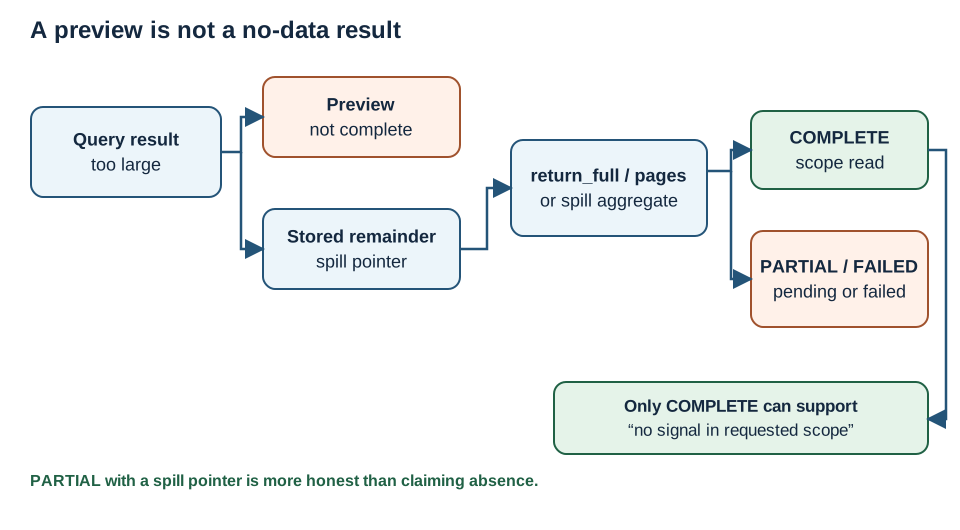
A preview is partial evidence; only a complete read of the requested scope supports a no-signal conclusion.
Related packing discipline: claim-aware evidence packing.
Retrieving and labeling the result
- A shared spill model that marks large tool outputs as previews and retains the full result
- A required
return_fullretrieval before searching the result for patterns - Paging when
return_fullhits byte caps; a single page is still only partial evidence - A
spill_pathpointer forjq-style aggregates over the stored result without stuffing the whole blob into chat - Completeness labels: COMPLETE only after the requested scope is read, PARTIAL when some pages remain, and FAILED when retrieval fails. These describe retrieval, not whether the underlying system is healthy
Reviewing an agent RCA
- Treat “Unavailable” without a completeness tag as a defect
- Ask “was this preview or full?” in review of agent RCAs
- Prefer PARTIAL with a spill pointer over a claim of no signal when retrieval is unfinished
Enforcing this in the platform
- Do not let models grep truncated previews as if they were complete
- Teach completeness vocabulary in the tool contract, not only in the system prompt
- Keep operator-visible, access-controlled paths to the spill for later verification
Related
- Sequel: Cursor paging for spilled agent tool output — opaque cursors beat grep-as-primary
- Previous: Correlate prior sessions
- Next: Deliver Findings at the Budget Cap
- Claim-aware evidence packing
Acknowledgments. Spill recovery lessons from shipping observability tools in Aiden. Patterns composite.
Building AI for incident triage without the demo theater? Find me on GitHub or LinkedIn.
FAQ
Why do AI SRE agents say no data when Grafana metrics exist?
Large tool outputs get preview-truncated for the context window. Agents answer from the snippet and invent Unavailable. The full series often still sits in a spill file on disk.
What is spill recovery for observability tool results?
A shared model that forces return_full before pattern greps, pages when byte caps hit, and exposes spill_path for compact aggregates — plus COMPLETE / PARTIAL / FAILED vocabulary.
How should AI agents report incomplete observability evidence?
Say PARTIAL or FAILED with what was retrieved. Never claim no signal when the preview was truncated.
Stay in the loop — production notes on AI agents, workflows, and SRE.
Low volume — new posts and curated reading lists. Unsubscribe anytime.