Cursor paging for spilled agent tool output
An incident-triage agent batched twelve PromQL queries (Prometheus metric queries) through Grafana. The resulting 345KB JSON exceeded the agent tool-result limit. The runtime stored the complete result on disk and returned only a preview and a spill_id, an identifier for retrieving the stored result.
The agent searched that stored result for "name": "cpu_usage". The text search matched metadata but missed series[], the arrays of timestamped measurements. It then marked every pod (Kubernetes workload instance) in the placeholder acme checkout fleet Unavailable and ended the investigation. In this case, “Unavailable” described what the agent had failed to retrieve, not the state of the pods.
A human retrieved subsequent pages and found healthy measurements for most pods. That comparison isolates the failure: the data was present, but the agent treated a partial retrieval as the whole result.
This post is the sequel to when truncated previews look like no data. Same failure class, sharper fix: opaque cursor paging as the primary path, grep as a backup.
Examples below are composite. Names like acme are placeholders.
What the evidence supports
- Oversized observability JSON gets preview + spill_id, not the full payload in chat
- Grep-as-primary on spilled JSON matches the wrong lines and invents empty planes
- Cursor paging:
spill_idonly on page 1, then passnext_cursorunchanged until gone - Originating tools should say
completeness: truncatedand point agents at paging - Pattern grep and capped
return_fullremain escape hatches, not the default loop - Builders: write-time manifest, small pages, opaque tokens, budget-aware cursors
Problem
Model Context Protocol (MCP) exposes external tools to an agent. Grafana may return complete JSON to an integration, but the agent runtime has a smaller limit on what it can put in a model-visible tool result. JSON escaping can enlarge that representation further. A complete upstream response can therefore become a partial agent observation.
The compromise is spill:
- Persist the full payload on disk
- Return a truncated preview in the tool envelope
- Attach a stable
spill_id(and often a completeness flag)
That works until the agent treats the preview as the universe, or treats grep on the spill as a cheap substitute for reading it.
In the acme-style incident, a multi-query metrics batch returned dozens of result objects. CPU, memory, and request-rate series for many pods lived in the spill. The preview showed structure and labels. The agent never walked the bytes where the numbers were.
The RCA sounded confident and wrong: every pod unavailable, plane empty. Operators re-ran one query manually and got green series. Trust in the agent dropped faster than error rates.
Related: claim-aware evidence packing explains why verifiers must not accuse agents of inventing what you truncated. This post is about getting the truncated data back before the verdict.
Why grep fails
Pattern search on a spilled file feels efficient. The model already knows the metric name from the alert. Why not search_query_spill with a regex?
Because JSON is not a flat log file.
| What the agent wanted | What grep often matched |
|---|---|
series[] values for cpu_usage |
"name": "cpu_usage" inside pod label objects |
| Numeric points for a time range | Header lines at the start of each result block |
| The pod that actually breached | Metadata "name": fields on unrelated keys |
In this 345KB case, metadata produced dozens of matches without returning the measurement arrays. A grep hit proves that a string exists somewhere in the file; it does not prove that the relevant values were delivered to the model. Targeted search is useful once the agent knows the result layout, but it cannot establish completeness.
Single-shot return_full with a byte cap fails the same way in practice: one window, still truncated, still interpreted as complete.
Adopt: treat grep and return_full as secondary tools when cursor paging cannot answer a narrow question.
Avoid: making regex the default recovery loop after completeness: truncated.
Cursor paging contract
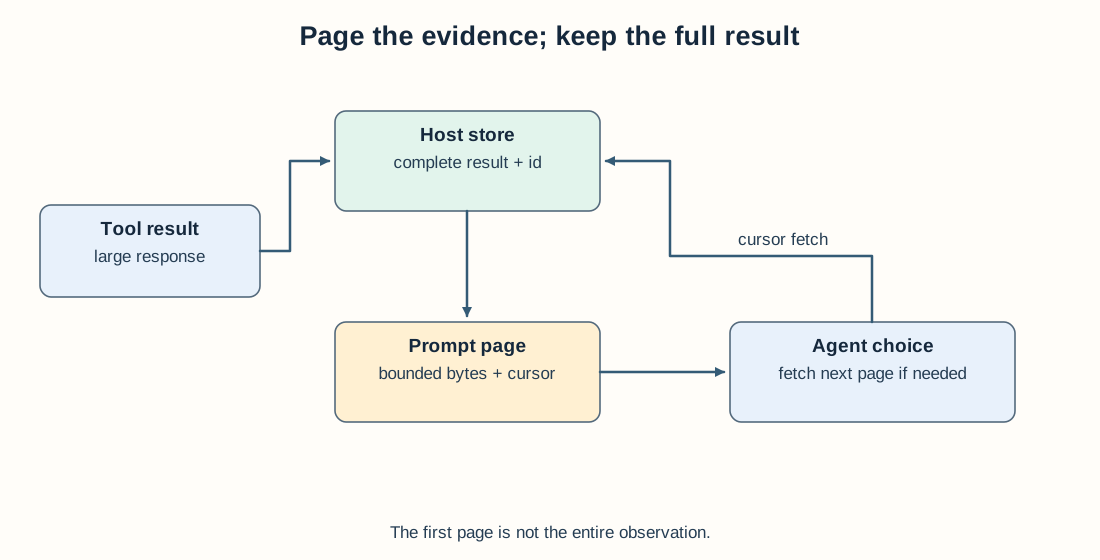
The model gets a bounded page; it can request the remaining source data when the first page is not enough.
A cursor is a continuation token supplied by the server. The agent passes it back rather than guessing file offsets. This makes it possible to retrieve a large result in bounded chunks, provided the spill remains stable for the paging session.
  ┌─────────────────────┐
  │ Observability tool  │
  │ (batched PromQL)    │
  └──────────┬──────────┘
             │ preview + spill_id + completeness: truncated
             v
  ┌─────────────────────┐     spill_id only
  │ search_query_spill  │◄────────────────────┐
  │  (or search_spill)  │                     │
  └──────────┬──────────┘                     │
             │ chunk + chunk_kind             │
             │ optional inventory             │
             │ next_cursor (if more)          │
             v                                  │
       Agent reads chunk ──────────────────────┘
             │ pass next_cursor unchanged
             v
       Repeat until next_cursor omitted
Page 1
- Input:
{ "spill_id": "<id>" }only - Output:
{ "chunk", "chunk_kind", "inventory?", "next_cursor?" }
Page 2+
- Input:
{ "spill_id": "<id>", "cursor": "<opaque token>" } - Pass the cursor exactly as returned. Do not parse, split, or invent offsets.
Done
- When
next_cursoris absent, the agent has walked the spill under the platform budget.
Optional inventory.result_names (or similar) lets the agent plan: twelve results spilled, I am on chunk four of nine. That reduces premature “no data” closes.
Honesty vocabulary still applies: COMPLETE / PARTIAL / FAILED. Paging halfway and declaring an empty plane is still a defect.
What agents should do
For operators and prompt authors, the playbook is short:
- Read the originating tool result. If
completenessistruncated, assume the preview is not the dataset. - Call the spill tool with only
spill_id. No regex on the first pass. - Consume each
chunkbefore requesting the next page. Extract labels, series, and timestamps from what arrived, not from what you hope grep will find. - Loop on
next_cursoruntil it disappears. If inventory lists result names, track which ones you have seen. - Use grep or
return_fullonly when paging is insufficient for a targeted follow-up (one metric name, one pod label), and say PARTIAL if you still did not walk the full spill.
Training beats hidden policy: tool descriptions should state that truncated observability results require cursor paging, not preview inference.
For SRE review: treat “Unavailable” on every series after a truncated tool return as a recovery bug, not a datasource bug.
Optional implementation notes for builders
If you ship MCP observability tools or a shared spill layer, these are implementation choices for this failure mode, not a guarantee that paging alone makes a diagnosis correct.
Write-time manifest. When the spill file is created, record byte slabs for byte-perfect paging and a lightweight JSON scan for named result inventory. The read path stays O(page) instead of re-parsing 300KB on every agent turn.
Small pages. Target a page size that still fits the agent tool envelope after JSON escaping. A few kilobytes per page beats one “full” slice that gets trimmed anyway.
Opaque cursor tokens. Encode {version}.{chunk}:{offset} (or equivalent) server-side. Agents pass the token back unchanged. They do not need to know the encoding.
Budget shrink safety. If the platform trims a page to satisfy a hard cap, compute the next cursor from the bytes actually delivered. Advancing past undelivered bytes skips evidence; failing to advance can repeat the same page forever.
Secondary paths. Keep pattern grep and bounded return_full for narrow questions. Document them as escape hatches in the tool schema, not step one.
Completeness on the origin tool. The batch query tool should say it truncated, name the spill id, and link to the paging tool in the hint text. Do not make the agent infer spill from a vague “output too large” string.
Related design references: cursor-based pagination (opaque tokens, stable iteration) and MCP’s tool-result model (structured payloads, explicit follow-up tools).
Related
- AI agents call truncated Grafana “no data” (the preview failure mode)
- Claim-aware evidence packing (do not accuse agents of inventing truncated receipts)
- LLM tokenomics for production agents (why spills exist in the first place)
- Web metrics to LLM metrics (tool payload size as a first-class metric)
Acknowledgments. Cursor paging for observability spills came out of shipping batched query tools in Aiden. Patterns are composite; thanks to teammates who debugged false “Unavailable” RCAs in the wild.
For implementation discussion, find me on GitHub or LinkedIn.
StackGen works on AI-assisted incident triage and diagnostic workflows. See ai.stackgen.com for the offering.
FAQ
Why do AI agents say no data when Grafana metrics exist?
Large batched PromQL or LogQL results exceed the tool envelope. The runtime returns a truncated preview plus a spill_id. Agents that grep the preview for series names often miss the actual values and falsely report Unavailable.
What is cursor paging for spilled tool output?
A contract where the agent calls a spill search tool with only spill_id, receives a small chunk plus next_cursor, and passes that cursor unchanged until it is omitted. Pattern grep and return_full stay secondary escape hatches.
Why does regex grep fail on spilled JSON?
A pattern like "name": "cpu_usage" matches header lines inside large objects (pod labels, metadata) but not the series[] block you need. The grep looks successful while the values never enter context.
What should agent builders ship for large MCP tool results?
Write-time spill manifest, completeness truncated on the originating tool, opaque cursor tokens, small pages that fit after JSON escaping, and inventory hints so the agent knows what exists before it finishes paging.
Stay in the loop — production notes on AI agents, workflows, and SRE.
Low volume — new posts and curated reading lists. Unsubscribe anytime.