What Is ReAcTree? Hierarchical Agent Trees for Long-Horizon Work
A single-agent ReAct loop uses one model trajectory: decide what to check, call a tool, read its result, and repeat. The entire sequence can be inspected in one trace. It can also accumulate a large prompt when a task requires many tool results.
ReAcTree organizes several such loops into a hierarchy. A parent can divide a goal into child tasks and specify whether they run in order, concurrently, or as fallbacks. The parent must then combine their reports. That structure can keep one noisy log search out of the parent prompt, but costs extra model calls and requires the runtime to preserve child evidence.
Paper (PDF · abs) · reference code · production scars: ReAcTree bugs we hit.
What the evidence supports
- Single-agent (ReAct): one trajectory, one context, reason→act→observe until done.
- Hierarchical (ReAcTree): parent plans subgoals; children dig; control flow stitches results.
- In the cited paper’s WAH-NL long-horizon household-task evaluation with Qwen 2.5 72B, the authors report ReAcTree ~61% vs ReAct ~31%. Those rates are task- and setup-specific, not incident-response results.
- For incident triage, a tree may help separate alert, log, and change investigations when those subgoals are independent. If one backend and one short query chain suffice, coordination can add unnecessary calls.
- Always A/B both shapes on the same frozen prompt. We did that here: six model×orchestration combos.
ReAct in thirty seconds
ReAct interleaves thought and tool use in one agent:
- Reason about the goal
- Act (tool call)
- Observe the result
- Repeat
For a bounded task such as reading an alert rule, then querying logs with LogQL (Loki’s query language), then writing a hypothesis and open questions, one loop may suffice. Its trace is linear; the tradeoff is that every tool result competes for the same model context.
ReAcTree: tree + control flow
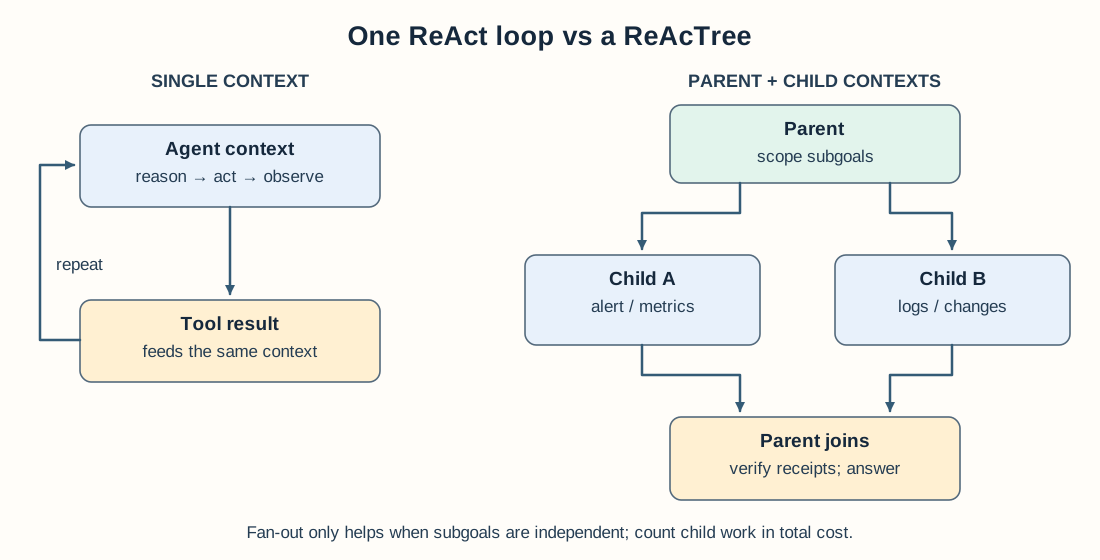
A tree can isolate parallel investigations, but the parent still owns the final answer.
From the paper: the parent does not only call leaf tools. It builds a tree of agent nodes. Children get scoped subgoals. The paper specifies three control-flow arrangements:
| Flow | Plain meaning |
|---|---|
| Sequence | Finish A, then B |
| Parallel | Fan out A∥B, join |
| Fallback | Try A; on failure try B |
The paper also describes shared working memory and stored lessons from previous episodes. A deployment still needs to enforce tool permissions, per-step timeouts, and session isolation across nodes (six bugs); the control-flow diagram does not supply those safeguards.
Short labels we use in benches:
| Label | Means |
|---|---|
| single-agent | Flat ReAct loop |
| hierarchical / ReAcTree | Parent + children + control flow |
Why ops / SRE people care
Some incident investigations span metrics, logs, deployments, and tickets. When independent queries can run concurrently, a tree may shorten elapsed time; when they depend on each other or all hit one contended server, parallel branches may add load instead. A single-agent loop can drown in catalog tools and megabyte tool dumps. A tree can:
- Isolate noisy LogQL into a child context
- Fan out falsifiers in parallel
- Keep the parent’s close structured (Part A / Part B) when the model cooperates
It can also:
- Pay orchestration tax (coordinator turns even when children barely dig)
- Collapse quality if the parent stops early with Undetermined and no receipts
- Hide measurement in child spans so a naive parent log looks “tool-empty”
We measured both shapes on one dual-part Grafana/Loki job. Merits and demerits with numbers: hierarchical vs single-agent on observability.
Merits
- Context packing. Workers can carry fat tool catalogs or large tool dumps while the parent keeps a smaller synthesis context.
- Multi-part errands. Alert triage plus a 24h/7d log compare matches “rooms,” not one paragraph.
- Parallel falsifiers. When the host allows true fan-out, wall can improve without stuffing every probe into one trajectory.
Demerits
- Orchestration tax. Coordinator tokens and latency even for a single tool plane.
- Fragility. A hierarchical run can finish “fast” with a stub Theory unless the host forces receipts and no-progress halts.
- Harder debug. You need merged session traces across parent and children, not only the root stream.
Two meters for cost (do not mix them)
A tree has two different token stories:
| Meter | What it answers |
|---|---|
| Peak prompt at one node | Did the parent (or a child) blow the context window on a turn? |
| Sum of tokens across the whole tree | What did the run cost end to end? |
A hierarchical run can look “small” on the parent gauge while the sum across nodes is larger than a single-agent ReAct loop. The reverse also happens: workers absorb bulk and the parent’s peak stays tidy while the total bill still drops versus one overloaded seat. Report both meters, plus wall clock. Numbers from our dual-part Grafana job: scorecard.
What to read next
- Six model×orchestration combos — scorecard
- Hierarchical vs single-agent merits — when the tax earns its keep
- ReAcTree production bugs — what the paper skipped
- Single-agent vs multi-agent — choosing a shape
If you only remember one line: ReAct is the loop; ReAcTree is the tree of loops. Measure both before you romanticize either.
FAQ
What is ReAcTree in one sentence?
A hierarchical agent pattern where a parent decomposes subgoals, may spawn child agent nodes, and coordinates them with sequence, parallel, or fallback control flow — instead of one flat ReAct loop doing everything.
How is ReAcTree different from ReAct?
ReAct is one agent: reason, call a tool, observe, repeat in a single trajectory. ReAcTree keeps that loop at each node, but the run is a tree: parents plan and compose children rather than stuffing every probe into one context.
When should I use a single-agent ReAct loop instead?
When one tool plane owns the dig, latency matters, and the model already closes with Theory/Unknowns without a coordinator. Hierarchical runs pay an orchestration tax; measure both shapes on the same prompt.
Does the paper claim ReAcTree always wins?
No. The authors report large gains on long-horizon household tasks (e.g. WAH-NL ~61% vs ReAct ~31% with Qwen 2.5 72B). That motivates trees for hard multi-step work; your SRE job still needs its own receipt.
Where do production bugs show up?
In the wiring: governance on child tools, parallel graph compile, per-step timeouts, session isolation. See our production bug notes after implementing ReAcTree.
Stay in the loop — production notes on AI agents, workflows, and SRE.
Low volume — new posts and curated reading lists. Unsubscribe anytime.