Single-Agent vs Multi-Agent Orchestration: How to Choose
For an AI agent that investigates incidents—software that uses a model to select tools and examine results—one design decision is single-agent vs multi-agent orchestration: one loop with tools, or a planner coordinating several loops. More loops can enable parallel work, but they also add handoffs and cost.
We compared the two shapes on one incident triage job for site reliability engineering (SRE): same prompt, models, tools, and budgets; the intended difference was execution shape. One path was a single parent-first agent. The other kept a ReAcTree-style planner that could spawn children.
This is not a takedown of either. Both paths produced the same class of findings in this single run. The comparison helps decide what to test next, not which architecture always wins.
What this comparison shows
- Single-agent and multi-agent are both legitimate production shapes — not a fashion contest.
- On our single-plane triage A/B, multi-agent took ~1.6× longer (~95s vs ~58s) and ~3.9× more tool calls (27 vs 7) — and still reached the same proposed explanation.
- On multi-plane / parallel work, the planner’s strengths — isolation, parallel digs, specialist context — are exactly why trees exist (ReAcTree in production).
- Choose by branching need and measured latency or isolation requirements.
The comparison tests a narrow, sequential cluster-health task. It does not measure whether parallel specialists would help on incidents spanning metrics, logs, and change history.
What people mean by single-agent vs multi-agent
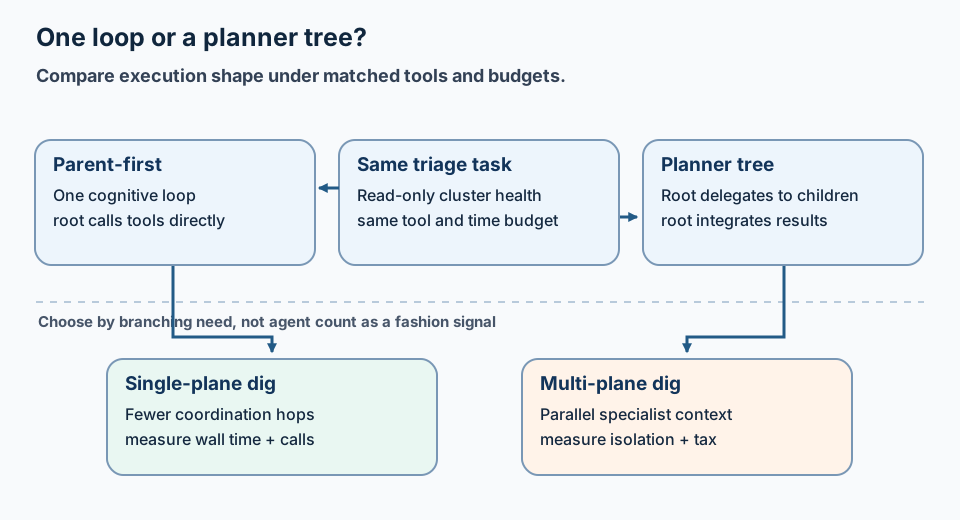
Use child loops when parallel digs justify their coordination cost.
| Shape | What it is | Good faith strength |
|---|---|---|
| Single-agent | One plan → tool → context loop. The root calls tools itself. | Simple to reason about, usually lower latency and token tax, one place to put budgets and human-in-the-loop (HITL) approval |
| Multi-agent orchestration | A planner (or foreman) coordinates child agents with handoffs | Parallelism, specialist personas, failure isolation, clearer audit of who did which dig |
Counting tools does not make a system multi-agent. Counting cognitive loops does. One loop with twenty tools is still single-agent. Two loops with a handoff is multi-agent.
The A/B job (kept deliberately narrow)
We used a read-only cluster health triage: inspect nodes and workloads, mark unavailable planes as not applicable, satisfy a completion gate, then write Theory / Impact / Do-this-now with concrete unhealthy names.
That is a single-plane job on purpose. It is where orchestration either proves useful — or shows up as pure coordination cost. It is not a claim that every SRE investigation looks like this. Multi-plane RCA (metrics + logs + change history) is a different beast (evidence-gated RCA, hypothesis ladder).
What both sides got right
Both paths named the same class of problems:
- A worker node stuck NotReady / unreachable
- A pod stuck creating because a required secret was missing
- A workload evicted after disk pressure
So the fair story is not “one architecture found the truth and the other failed.” Finding quality was a tie. The interesting differences were how each path spent its budget — and what that implies for other jobs.
The case for single-agent (parent-first)
Where it shone in this A/B
- ~58s end-to-end vs ~95s on the planner path (~1.6× faster)
- 7 tool-call starts vs 27 (~3.9× leaner) — collect → gate → summarize without child spawn
- 0 child agents (denied by design) vs 2 spawns on the planner path
- Cleaner completion at one altitude: gate closed without the root retry storm
- Easier operator story: one session to read, one place to steer (mid-run steer)
Why that is a real product win — not just “simpler is nicer”
On-call assist is a latency product. Every extra model hop is a second the human stares at a spinner. For jobs that fit one plane and one checklist, a capable root with the right tools is often enough. This run supports testing whether a single loop can complete a narrow job before adding a planner; it does not establish a general fleet-level result.
What single-agent is not claiming
It is not “never delegate.” It is “do not pay for a second cognitive loop until the first one is actually stuck or the work truly branches.”
The case for multi-agent orchestration (planner trees)
Where the planner is the honest choice
Even when this narrow A/B made the tree look expensive, the architecture exists for good reasons:
- Parallel falsifiers — metrics vs logs vs deploys should race, not queue. A single loop may serialize these digs; a tree can fan out when its tools and budgets permit (bring-up discipline).
- Specialist context — a worker can receive a narrower tool set and context, though specialization adds setup and handoff costs.
- Failure isolation — a bad dig can fail without poisoning the parent’s whole turn; partial progress is salvageable.
- Governance and audit — per-child budgets, HITL, and traces nest cleanly when specialists are first-class (observability for agents).
- Depth with hard limits — ReAcTree-style systems can allow structured delegation while still capping recursion (production tree bugs we fixed).
Why the tree looked “heavier” on this particular job
On a single-plane card, the planner still did planner things: spawn children, adaptive completion at the root, more note/search ceremony. In our numbers that showed up as ~1.6× wall time and ~3.9× tool calls for the same findings — not because the dig needed more shell probes (both paths did three inspection rounds), but because coordination and gate retries piled on. This suggests a mismatch between the branching design and this sequential task, not a defect in multi-agent orchestration overall.
Side-by-side (this A/B only)
One sequential fair run each after setup was honest. Same prompt, models, tools, and budgets; one sequential run per shape is too small to estimate typical latency or variance.
| Dimension | Single-agent | Multi-agent / ReAcTree | Multi-agent vs single |
|---|---|---|---|
| Wall time | 57.6 s | 94.7 s | ~1.6× higher |
| Tool-call starts | 7 | 27 | ~3.9× heavier |
| Child-agent spawns | 0 | 2 | — |
| Inspection rounds (shell) | 3 | 3 | tie |
| Completion-gate calls | 2 | 4 | 2× |
| Finding quality | Same loci | Same loci | tie |
| Best fit signal | One plane, short loop | Parallel / multi-skill / isolation | — |
Treat the table as evidence for a decision framework, not a global ranking. One A/B is not a latency SLA — it is a concrete “how much tax did orchestration add when branching was not required?”
A practical decision framework
Ask these before you pick a shape:
- Does the work branch? Competing hypotheses across planes → lean multi-agent. One plane, one checklist → lean single-agent.
- Is parallelism the product? Independent digs that should finish together → multi-agent. Strictly sequential collect → single-agent is fine.
- Do specialists need isolation? Different budgets, tools, or risk profiles per dig → multi-agent. Same tools for the whole turn → single-agent.
- What is the latency budget? Human waiting on chat → bias single-agent until branching forces otherwise.
- What must you audit? Step-level specialist trails → multi-agent. One session narrative → single-agent may be enough.
- Are you fair-testing? Mis-set budgets, over-redaction, HITL clarify stalls, or completion checks at the wrong altitude can fake a winner (PII for agents, completion loops, loop salvage).
Rule of thumb: start with the simpler shape that can complete the task; test orchestration when independent digs or isolation requirements justify the added coordination.
Fairness pitfalls (both sides get hurt)
Early runs lied until we fixed setup. Worth naming so your own A/Bs stay honest:
- Budgets that do not actually apply to the path under test
- Redaction that hides tool names and IDs the model must use
- HITL clarify on unattended benches (multi-agent especially)
- Completion at the wrong altitude (child done, root still retries)
- Loop detectors that punish legitimate batch inspection
If those are broken, you are not measuring single-agent vs multi-agent. You are measuring config debt.
The principle
Match execution shape to branching need.
- A single agent is a tool for decisive, same-plane work.
- A multi-agent tree is a tool for parallel uncertainty and specialist isolation.
We keep both shapes. This A/B supports using the simpler loop for narrow triage while evaluating a tree separately on tasks that actually require parallel digs.
Where to go next
- Fair Agent Evals: Tools Must Match — eval sequel: fix handoff before you compare modes
- ReAcTree production bugs — why trees need hard depth and shared governance
- Is the task actually done? — completion that is not prose
- What are SRE AI agents? — triage vs RCA vs remediation
- Hub: AI incident triage · AI agent workflows · AI agent runtime
Acknowledgments. Both execution shapes in our stack are team work across the Aiden / agent-runtime effort — parent-first paths and planner trees each exist because production pulled for them, not because one fashion won.
Choosing single-agent vs multi-agent for on-call triage? Find me on GitHub or LinkedIn.
StackGen develops AI tools for site reliability engineering (SRE), including incident triage and diagnostic workflows. Product details are at ai.stackgen.com.
FAQ
What is the difference between a single-agent and a multi-agent system?
A single-agent path is one cognitive loop with tools. A multi-agent path is two or more loops coordinated by a planner or orchestrator — specialists, handoffs, and often parallel digs.
When should you use a single agent instead of multi-agent orchestration?
When the work fits one tool plane and a short collect→verdict loop, and latency or cost matter more than parallel specialization. A capable root with tools often matches multi-agent quality with less coordination tax.
When is multi-agent orchestration worth it for incident triage?
When you need parallel falsifiers across planes or skills, isolated workers with their own budgets, failure isolation, or auditability of specialist steps — branching is the job, not overhead.
Is multi-agent always better for complex SRE work?
No. Complexity of the incident does not automatically require multiple agents. Use multi-agent when the work itself branches; use single-agent when one loop can own the dig end to end.
How much slower was multi-agent on a single-plane triage A/B?
On our fair run, multi-agent took about 1.6× the wall time (~95s vs ~58s) and about 3.9× the tool calls (27 vs 7), with the same findings — extra cost was coordination and gate retries, not more inspection depth.
Stay in the loop — production notes on AI agents, workflows, and SRE.
Low volume — new posts and curated reading lists. Unsubscribe anytime.