What Are SRE AI Agents?
A site reliability engineering (SRE) AI agent uses a model and tools to support incident triage: gather observability and change evidence, propose a hypothesis, and draft root cause analysis (RCA) for human review. Unlike a question-answering chat alone, it runs a bounded sequence of tool calls. Automatic remediation is a separate, higher-risk capability, not a prerequisite for triage.
Fast path: SRE on-call starter pack. A topic map is AI agents for SRE. For triage, see AI incident triage. A longer discussion of on-call use is on StackGen: AI Incident Triage for SREs.
What good looks like (and what does not)
Helps on-call
- Parallel context gathering with a budget (time, tools, tokens)
- Evidence from systems of record — metrics, logs, deploys — with source and time range
- Outputs a human can skim in under a minute: what was checked, what was not, what to do next
- Hard stops when required digs are missing (curiosity before confidence)
Sounds good in a demo
- A confident causal narrative without enough evidence
- “Root cause: the deploy” before identity and onset are established (hypothesis ladder)
- Unbounded remediation without approval or rollback controls
- Green HTTP while judgment quietly drifts (SRE for agentic systems)
A fluent explanation is not evidence that the proposed cause is correct.
Triage vs RCA vs remediation
| Mode | Job of the agent | Human role |
|---|---|---|
| Triage | Shrink blast radius; decide what to check next | Owns priority and customer impact |
| RCA | Eliminate causes with evidence; narrate last | Approves the write-up |
| Remediation | Propose or execute a bounded change | Approves mutations; needs receipts |
Triage can remain read-only. Remediation requires separate authorization, rollback planning, and evidence that a proposed action is appropriate; see demo-to-deploy failure modes.
Where the runtime fits
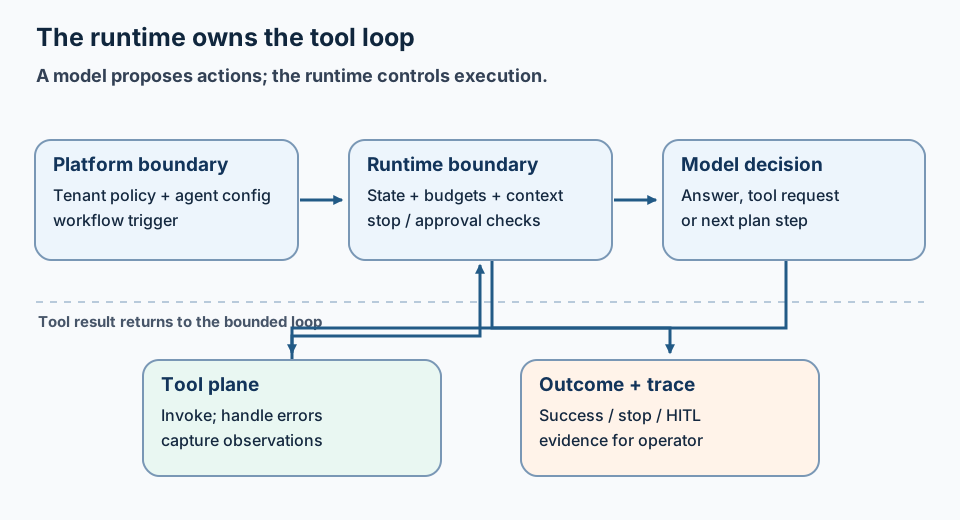
An SRE agent needs a bounded execution loop, not just a fluent model answer.
An SRE agent still needs an AI agent runtime — the loop that plans, calls tools, and stops. Enterprise packaging (tenancy, policy, many teams) is the platform layer. Keeping those layers separate helps locate budget enforcement and mid-run steering.
Where to go next
- Hub: AI agents for SRE
- Hub: AI incident triage
- Definition: What Is an AI Agent Runtime?
- Essay: What actually helps on-call
- Discipline: Hypothesis ladder · Evidence-gated RCA
Acknowledgments. On-call lessons here draw on the StackGen Aiden SRE work; deeper posts credit named teammates where git history supports it.
Building AI for incident triage without the demo theater? Find me on GitHub or LinkedIn.
StackGen develops AI tools for site reliability engineering (SRE), including incident triage and diagnostic workflows. Product details are at ai.stackgen.com.
FAQ
What are SRE AI agents?
Agents that help site reliability and on-call teams triage incidents, query observability and change planes, and draft evidence-backed next steps — with budgets and human review, not open-ended auto-remediation theater.
How is an SRE AI agent different from a chatbot?
A chatbot answers questions in a thread. An SRE agent runs a bounded tool loop against live systems, leaves an auditable trail, and stops when evidence or policy says stop.
Should SRE agents remediate automatically?
Not as the first milestone. Start with parallel context gathering and human-reviewable outputs. Remediations need fail-closed gates, receipts, and Judgment-style health checks — not demo confidence.
Stay in the loop — production notes on AI agents, workflows, and SRE.
Low volume — new posts and curated reading lists. Unsubscribe anytime.