Evidence-Gated RCA — Prove, Then Narrate
In our incident investigations, a free-form reasoning-and-tool-use loop (often called ReAct) sometimes ended with a convincing report before the required checks had run. A report-shaped answer is not evidence that its underlying queries were completed.
We hardened multi-stage agent workflows in Aiden, an incident-investigation agent, after seeing that failure. Site reliability engineering (SRE) work here spans metrics, logs, and warehouse data. The aim was to put checkable control flow around model-generated work, not to make the model deterministic.
We used a fixed directed acyclic graph (DAG): a workflow of dependent stages that does not loop back arbitrarily. The large language model (LLM) reasons within each stage; Go code manages state, validates outputs, and decides whether work can move to the next stage. This is a compound system—model plus ordinary software—not a claim that prompts have no role.
This follows AI-augmented incident triage and evidence-based verification. The examples describe our workflow design, not a controlled comparison of every agent architecture.
What a fluent report can hide
In the runs we examined, a free-form loop could:
- Stop at a narrow time window, find nothing, and report that everything looks fine
- Emit a report-shaped answer that passes a superficial completion check
- Summarize from plan notes without the evidence gathered later
- Call data unavailable before widening the time window or checking alternate names
- Spawn multiple helper agents, adding tokens and latency without clear evidence of better coverage
Operators and automated evaluations need checkable artifacts: identities, key performance indicators (KPIs), ruled-out branches, and next probes. These can establish that required evidence was recorded, although they cannot prove causality on their own.
Pattern 1: Fixed DAG Over Autonomous Loops
We chose a boring, reliable graph for several investigation families (streaming lag, HTTP error-rate, symptom reports):
| Node | Job |
|---|---|
| Plan / scope | Parse structured fields. Write a short plan. Forbid root-cause claims. |
| Gather evidence | Run diagnostic branches. Persist machine-checkable evidence tokens. |
| Present | Merge state. Draft the human summary. Format for the UI. |
In these workflows, one investigator persona across nodes was easier to manage than a mesh of hyper-specialized micro-agents (“metrics agent” talking to “logs agent”). More specialists add handoffs, duplicate tool discovery, and context overhead; they may still be useful where expertise or independent work justifies that cost.
Mid-graph outputs must say “node complete — handoff,” not “final answer.” Early nodes that emit a finished narrative poison the watch UI and train humans to distrust the system — the same failure mode as fabricated sub-agent reports (a topic for a future post).
The LLM still reasons inside a node. The graph decides when the node is allowed to finish.
Pattern 2: Structural Evals, Not Semantic Vibes
A gate that matches the phrase "investigation complete" will promote hollow runs. We learned this the hard way: English-fragment gates rejected correct answers that used a UUID; shape-only gates accepted empty shells that looked like finished reports.
Treat the model like an untrusted third-party API. Before promoting a payload, run deterministic guardrails — structural evals that ask:
- Did the primary branch emit a concrete identity (or an explicit “none found after full ladder”)?
- Did presentation include a numeric KPI, not just a heading?
- Did each required evidence key appear before the node claimed success?
Retries help only when the gate tests the right requirement. A bad structural check re-runs expensive tool work for no new information — pure token inflation. Treat gate fixtures like unit tests: golden pass and fail cases.
Related lesson from HalGuard: don’t trust self-report; check the artifact.
Pattern 3: State Merging Beats Gate-Only Handoffs
Navigation nodes that only emit “FINISH / GO_BACK” are great for control flow and terrible as the sole predecessor of presentation. When present depended only on the gate, the model saw a bare navigation payload, ignored the gather transcript, and produced a polished “inconclusive — missing evidence” narrative — while gather had already done excellent work.
That is a context-window / state-merging bug, not an intelligence bug.
We changed the graph so presentation receives gather output + gate. The gate decides whether to proceed; gather carries what to say. Control-flow JSON is not an investigation transcript.
The gate carries the decision; gathered evidence carries the facts the summary must use.
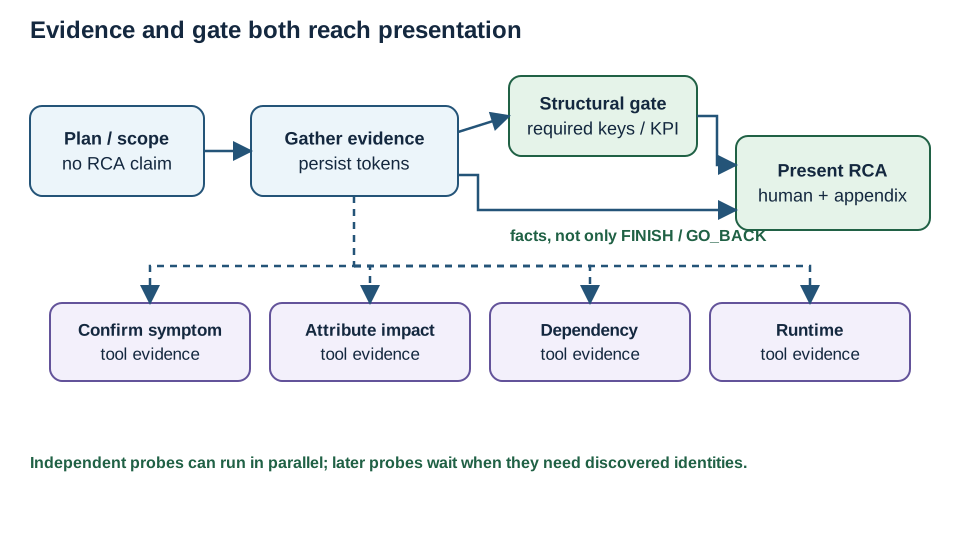
Presentation needs both the gate decision and the gathered evidence, not a navigation token alone.
Pattern 4: Parallel Tool Execution With Explicit Promotion
High-value investigations aren’t one tool call. They are branches in a mergeable subgraph:
- Confirm the symptom is real (timeseries, not a one-point spike)
- Attribute impact (which identity dominates)
- Probe the dependency layer
- Probe the runtime layer
Run independent branches in parallel when latency matters and tool limits permit it. Serialize only when a later branch needs identities from an earlier one. We added an explicit promotion step: the coordinator copies plaintext candidates into canonical notes before spawning the dependency probe — so workers never paste redacted placeholders into query filters (a common failure when memory redaction meets tool arguments).
Do not label an identity “none found” until the planned search ladder finishes; if a tool fails, say so instead. Sparse signals often appear only in wider ranges. Declaring absence after the first narrow window is how agents invent gaps — premature stopping dressed up as rigor.
In a Go runtime, this maps cleanly to bounded concurrency with cancellation: parallel lanes get timeouts so a runaway tool cannot hang the whole incident graph. The model proposes tool calls; the runtime owns fan-out and merge.
Pattern 5: Fight Context Bloat at the Tool Boundary
At high event volume, dumping raw warehouses or paginating noisy logs into the context window is how you turn an investigation into needle-in-a-haystack failure — and a bill.
Prefer pre-aggregated planes sized to the alert duration: fine grain for short windows, coarser rollups for days and weeks. Batch related queries when the tool supports it; on partial failure, retry only failed named queries.
For logs: if the first page is dominated by known noise, rewrite the query rather than paging through the same noise indefinitely. Application policy can bound query rewriting and sampling grain so a broad model request does not consume the whole context budget; operators still need access to uncompressed evidence.
Pattern 6: Dual-Audience Artifacts (Human Front, Machine Appendix)
Operators at 3 AM have zero patience for system-prompt archaeology. Agents need exact evidence keys and gate markers.
We split the playbook:
- Human body — numbered steps, tool plane, expected output, calm senior-engineer markdown (executable runbooks humans still want to edit)
- Machine appendix — tokens, note keys, spawn hygiene, gate phrases
One source of truth; two audiences. The UX pattern is underrated: it keeps humans editing the doc while the runtime still gets a parseable contract.
Pattern 7: Route on Schema, Not Keyword Coincidence
Wrong skill load is expensive: the agent diligently runs the wrong playbook and still looks busy. Route by required fields (structured intake), not keyword coincidence in free text:
| Input shape | Investigation family |
|---|---|
| Topic + consumer group + partition + timeframe | Streaming / lag |
| Environment + module + symptom + time period | Symptom / bug report |
| Service + env + API path + timeframe | HTTP error-rate / SLO |
This is classifier hygiene for compound systems: the router is cheap and deterministic; the expensive model only runs inside the chosen subgraph.
What We Deliberately Did Not Automate
- Closing the loop without a human — autonomy over incident state erodes trust (HITL paradox)
- Hardcoded identities in skills — discover from tools; never bake a customer into the prompt
- Unbounded sub-agent swarms — spawn only bounded parallel lanes with allowlists
- Confident narratives without receipts — every primary claim needs a signal row the gate can see
What this design buys—and does not
-
Compound beats clever prompts. Put reliability in the graph and the evals; let the model do synthesis and tool routing inside a node.
-
Structural evals beat semantic vibes. Promote payloads the way you’d accept an untrusted API response.
-
State merging is a first-class design problem. Navigation JSON is not memory.
-
Parallelism needs promotion rules. Fan-out without canonical notes pollutes tool arguments.
-
Token economics live at the tool boundary. Grain, batching, and query rewrite beat “just use a bigger context.”
-
Dual-audience docs scale. Humans edit prose; machines read the appendix.
-
Prove, then narrate. Narration is the last node — never the first.
The graph makes skipped steps visible, but a structural gate cannot prove a causal explanation is correct. It needs regression traces, checked evidence, and an operator who can contest the verdict.
Related reading
- Bring Up Agent Workflows Like Hardware — green one stage at a time before trusting the full DAG
- Evidence-Based Verification — verification from systems of record after investigation
- More on AI agent workflows · full series
Where does your agent still get to mark “done” on vibes? Find me on GitHub or LinkedIn.
We build incident-triage agents at StackGen; the SRE offering is at ai.stackgen.com.
FAQ
What is evidence-gated RCA for AI agents?
A fixed investigation DAG with structural evals and token-aware tool loops. Go owns pass/fail gates; the model narrates only after evidence is committed.
Why avoid unconstrained ReAct for production RCA?
Models are polite and excellent at the looks-right heuristic — marking stages complete from syntactic thought shape instead of earned evidence.
What does prove-then-narrate mean?
Require committed evidence from observability planes before allowing a fluent root-cause narrative. Narration without proof is a demo pattern, not a production one.
Stay in the loop — production notes on AI agents, workflows, and SRE.
Low volume — new posts and curated reading lists. Unsubscribe anytime.