Why One JSON Repair Pass Isn't Enough for Production Agent Tool Calls
A tool-calling agent can run normally until a handler parses its arguments and returns invalid character after top-level value. By then the run has already spent tokens, and the error may leave an investigation unfinished.
If you build production AI agents in Go — middleware pipelines, tool handlers, streaming model adapters — you’ve probably seen this. This post is for that crowd: AI backend and platform engineers shipping tool-calling agents to production, not prompt-engineering tutorials.
A large language model (LLM) may produce almost-valid JavaScript Object Notation (JSON), the structured format many tool handlers expect. Strict parsing rejects it even when the intended arguments are apparent.
Our layered governance work suggested a reliability analogue: different boundaries see different malformed payloads. Multiple repair points helped with streamed, truncated, fenced, or double-encoded arguments; none replaces validation.
The Failure Modes
Before layering fixes, name the ways tool JSON breaks in the wild:
| Symptom | Typical cause |
|---|---|
invalid character after top-level value |
Trailing prose after a JSON object, or two objects concatenated |
unexpected end of JSON input |
Streaming cut off mid-object; truncated tool argument blocks |
| Fence-wrapped JSON | Model wraps args in markdown code blocks despite the schema |
| Double-encoded strings | Model returns a JSON string containing JSON instead of a JSON object |
| Semantic garbage that parses | Valid JSON, wrong shape — goal text leaked into a structured field |
These are different failure classes. Streaming truncation needs different handling than fence stripping. A generic repair library cannot decide whether text belongs in a domain-specific field. That is why we retained multiple repair points.
Why One Layer Isn’t Enough
Think of repair happening at different boundaries in the stack, each catching a different class of failure:
Early in the execution path — before tool routing, so malformed arguments get fixed before they pollute logs, traces, or downstream middleware. Much of this belongs in the agent framework itself; we contributed generic fixes upstream as part of our open-source work rather than forking duplicate logic.
At the agent boundary — an opt-in repair step when agents and sub-agents are constructed, so broken args get fixed before they propagate through the system.
At the tool handler boundary — the last line of defense before application code sees bytes. A handler may recover a complete object followed by extraneous text, but it must reject ambiguous or unsafe arguments rather than guessing.
In domain-specific middleware — generic repair can’t fix meaning. Sometimes the model puts a user’s goal in the wrong field, or nests fields incorrectly for a tool that expects a specific envelope shape. That requires product logic, not a syntax repair library. Framework syntax repair alone cannot replace checks on the meaning and placement of fields.
In prose output parsers — a different job entirely. Aiden parses free-text model responses — navigation payloads, UI schemas, quality rubrics. That’s not tool-call JSON. It’s LLM prose that should contain JSON somewhere. Different input shape, different call sites, different failure modes. Prose parsers remain a separate concern even if tool-argument repair improves upstream.
The Bug Class: Repair After Validation
The ordering mistake we encountered was running strict validation before repair on paths intended to recover malformed syntax.
A middleware stack that validates tool arguments with a plain parse, then a separate middleware that fixes semantic issues for specific tools, means generic malformed JSON hits validation first and dies — technically correct error, operationally useless.
Meanwhile, earlier repair layers in the pipeline may have already fixed most problems. But anything that slips through — or any tool path that bypasses framework repair — still hits validation cold.
For recoverable syntax errors, attempt repair before schema validation: either add a generic step before the validator or let validation retry parsing after repair. Log the original and repaired forms for audit; reject payloads whose meaning cannot be recovered safely.
Don’t remove validation. It produces structured errors models can learn from. Fix the order.
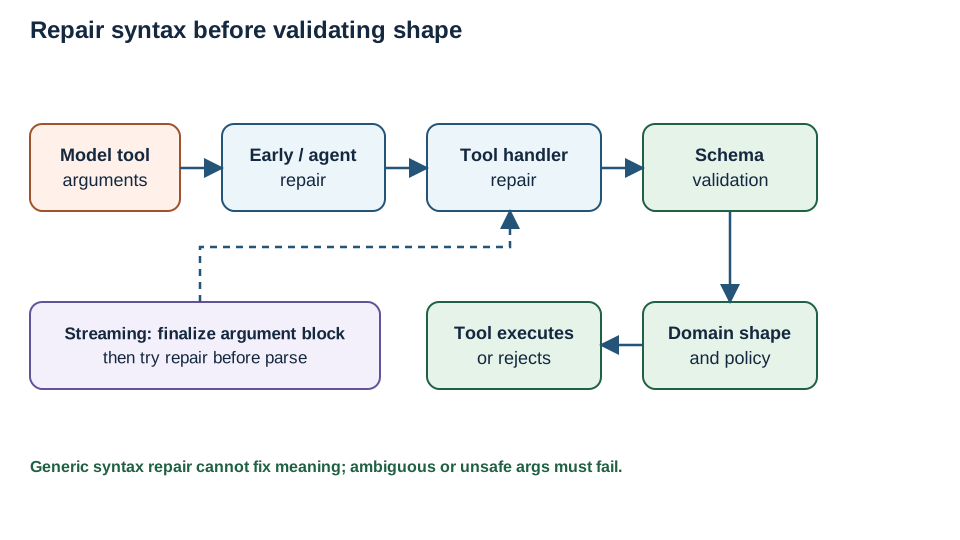
Repairing syntax first preserves validation while keeping domain meaning checks separate.
What’s Redundant vs What’s Not
| Repair point | Remove? | Verdict |
|---|---|---|
| Framework-level (early path) | No | Framework-owned; contribute upstream, don’t fork |
| Agent-boundary opt-in | Maybe after soak | Trial disable on paths well-covered below |
| Tool handler boundary | No | Core fix — keep |
| Domain semantic middleware | No | Product logic — not replaceable by generic repair |
| Prose output parsers | No | Different job than tool args |
Not worth doing yet: ripping out overlapping layers because “we have repair now.” Wait several weeks of production soak. Measure tool-call failure rates before and after.
Streaming: A Special Case
Standard repair handles complete-but-messy JSON. Streaming is worse: a tool argument block can arrive truncated — valid prefix, no closing brace.
The repair attempt belongs when the stream finalizes the argument block. An empty-object fallback when repair fails can preserve the run, but only if the tool schema permits empty arguments; otherwise fail explicitly. Repair closes unterminated strings, arrays, and objects so a truncated chunk becomes syntactically valid before parsing runs. Without this, agents using streaming models die mid-incident on long tool arguments — exactly when you need them most.
The empty-object fallback is a last resort. It preserves the run but drops args. Repair-first can recover some truncated payloads, depending on which fields were lost.
Where each check belongs
These checks address different risks at different boundaries:
- Repair early so traces and logs show clean args
- Repair at tool boundaries so handlers stay simple
- Repair semantically where domain shape matters
- Parse prose separately where output isn’t a tool call at all
- Validate after repair so models still get useful error feedback
A syntax-valid payload can still have missing or wrong fields, so the final schema and policy checks remain necessary.
What we would check before removing a layer
-
One repair library is not a strategy. It fixes syntax. It doesn’t fix streaming truncation at the right lifecycle hook, semantic field bleed, or prose-embedded JSON.
-
Ordering matters as much as repair. Validation before repair is a bug class. Audit your middleware chain.
-
Don’t consolidate layers you haven’t measured. Overlap between layers is fine during a soak. Removing a layer without failure-rate data risks reintroducing the same parse failures.
-
Keep framework fixes in the framework. Upstream generic repair so the community benefits and your fork shrinks. Product-specific semantic repair stays in the product.
-
Contribute the generic fix, keep the domain fix. Same pattern as our open-source contribution model — isolate what’s universal, merge it upstream, build what’s specific on top.
Related reading
- LLM Tokenomics for Production Agents — tool response compression at the boundary
- Go vs Python for AI Agents — why middleware chains live in Go
- More on AI agents for SRE · full series
How many JSON repair layers does your agent stack have? Genuinely curious whether teams hit the validation-before-repair trap too. Find me on GitHub or LinkedIn.
We build incident-triage agents at StackGen; the SRE offering is at ai.stackgen.com.
Stay in the loop — production notes on AI agents, workflows, and SRE.
Low volume — new posts and curated reading lists. Unsubscribe anytime.