The Hypothesis Ladder — Ruling Things Out Before You Narrate
A root-cause analysis (RCA) explains why an incident happened. An AI investigator can write one before it has checked alternatives. In our work on AI agents for site reliability engineering (SRE)—software operations and incident response—we saw the model favor a recent deployment even when the available measurements did not yet support that explanation.
We used a hypothesis ladder to structure the search: identify the affected system and start time, test competing explanations, then write a conclusion no stronger than the evidence. It does not make every cause discoverable; it makes an unresolved cause easier to report honestly.
This builds on AI incident triage and evidence-gated RCA: an investigation should test alternatives before presenting a causal story.
Start with the symptom
If a smoke alarm sounds, locate the smoke and establish when it appeared before naming the appliance. The equivalent for a service incident is to record the affected service, measurement, and onset. A workflow controller can require those fields before it accepts a causal claim; it cannot manufacture evidence that is missing.
The Failure Mode: First Plausible Story Wins
Human on-call teams know the trap. Alert fires. Someone says “probably the deploy.” Forty minutes later you are still arguing about that story while the real epicenter smolders — a shared dependency, a mis-scoped metric, a blast radius that does not match the ticket.
A large language model (LLM) can amplify that trap: a sentence naming a service, a change, and a dependency looks like an RCA even when none of those links has been tested.
The trap in action
Alert:
API 5xx spike on PaymentGatewayThe hasty conclusion: “Likely caused by the v2.4.1 deploy ten minutes ago. Recommend rollback.”
Illustrative alternative: Suppose the deploy only changed CSS, while connection logs showed an expired database certificate. Checking identity and onset would distinguish the two; the alert alone would not.
A useful cycle is theory, prediction, attempted disproof, repeat. During a live incident, complete understanding may be out of reach. The immediate goal is a testable explanation or a clear statement of what remains unknown and what to check next.
That discipline is old. Making an AI investigator obey it in production is the hard part.
What a Hypothesis Ladder Is (Without the Whiteboard)
SRE teams have sketched incident hypothesis trees for years: symptom at the root, broad categories branching out, leaves that must be tested or marked unknown — not skipped because someone already likes a story.
The ladder adds an order to those checks:
- Frame — what broke, for whom, according to which measurement, and starting when?
- Eliminate cheaply — rule out obvious branches with the smallest queries that could falsify them.
- Compete in parallel — keep multiple mechanisms alive until evidence kills them; do not collapse to one narrative for comfort.
- Grade the claim — events occurring together, moving together over time, and having a causal mechanism support different levels of certainty; the write-up should reflect that distinction.
- Stop or escalate honestly — unknown with ranked next probes beats a confident wrong answer.
The ladder is not a runbook replacement. Runbooks still teach what to query for Kafka lag or API error spikes. The ladder teaches when you are allowed to say “root cause” at all.
Climb the Boring Steps First (Identity Before Depth)
The recurring mistake was investigating deeply before identifying the fault. A team might open change histories and many monitoring queries before checking which service or instance appears in the measurement that triggered the alert, and when the symptom began.
We enforced a simple ordering rule, expressed in plain language:
- Who or what is actually failing? If a short search cannot identify the service or instance, report that gap and say what would resolve it rather than guessing a name.
- When did it start? A metric already bad at window open is not the same incident as a sharp step change mid-window.
- What else could explain it? Label each competing explanation supported, ruled out, or untestable with available data. “Untestable” is not “ruled out.”
- Only then examine recent changes: did one precede onset and offer a plausible mechanism, or does it merely coincide with the symptom?
Leading with “what changed?” before those steps is how you get deploy-shaped root causes for problems that live in a shared queue, a mis-tagged pool, or a dependency one hop away.
The order matters because a detailed query about the wrong service can be precise but irrelevant.
Parallel Branches, Not One Hero Narrative
Once framing is solid, the investigator should pursue competing mechanisms concurrently — dependency fault, capacity, regression, shared infrastructure when multiple services fail together — rather than one monolithic pass that burns time and tokens and still returns a single guessed story.
| The “hero narrative” (typical AI) | The hypothesis ladder (disciplined investigator) |
|---|---|
| Seeks the most plausible story immediately. | Seeks the cheapest falsifying evidence first. |
| Assumes recent changes are the root cause. | Establishes who and when before opening change timelines. |
| Merges competing ideas into one confident paragraph. | Keeps branches parallel until evidence kills them. |
| Outputs “confirmed root cause” with hedges buried at the bottom. | Outputs “unknown” or “leading hypothesis” with ranked next probes. |
Each branch should follow the same micro-loop:
- Probe one mechanism.
- Try to disprove it with a planned check when monitoring data can answer.
- Set aside a disproved explanation. Mark an untestable one as unknown rather than treating it as disproved.
When two explanations remain plausible, keep both visible and identify a low-cost test that could distinguish them. If the observability stack can run that test, run it. Handing the operator a homework assignment for data you could have fetched is how trust dies at 3 AM.
The AI-specific risk is that a model may combine unresolved alternatives into one tidy paragraph. Keeping a structured list of supported, rejected, and untested explanations outside the generated prose helps prevent that collapse. A controller should accept “unknown” when the necessary checks are unavailable.
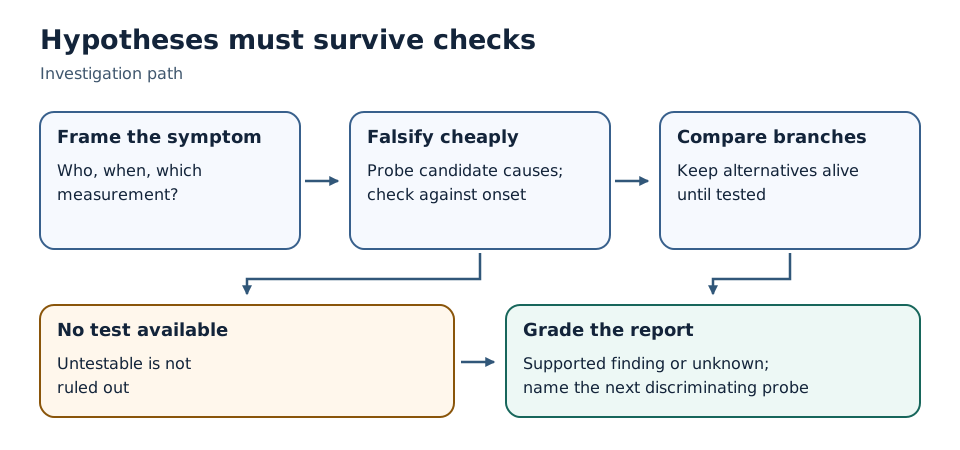
Diagram: The upper arrows follow framing, falsification, and competing explanations; the lower path keeps an untestable branch visible before wording a supported finding or an unknown with a next probe.
Prove First, Narrate Last
A summary written before the checks are complete can make an unsupported explanation look settled. “Telemetry” here means measurements and event records about the system, not a guarantee that all relevant data was captured.
We already wrote about structural gates for multi-stage workflows in Evidence-Gated RCA. The hypothesis ladder applies the same philosophy to epistemic claims:
- Durable investigation notes carry the receipts.
- The human-facing summary is downstream of what those receipts support.
- Strong language in chat cannot outrun weak evidence in the underlying artifacts.
If event logs or request traces that would confirm the initiating step are unavailable, the write-up stays at leading hypothesis or unknown — not “confirmed root cause” with a hedge paragraph buried at the bottom.
In practical terms, the software running the workflow checks the recorded results; the model writes within those limits.
What Operators Should Get Every Time
Whether an investigation stops early or runs deep, the human should leave with a consistent shape — not a novel every time:
- Graded certainty — what we think happened, without one flat confident sentence.
- Identified blind spots — retention gaps, missing identity, backends that returned nothing useful.
- Ranked next actions — a short list; read-only checks before destructive steps when cause is still unverified.
- Possible wider impact — which other users or services might be affected beyond the alert’s narrow label.
A branch marked “checked, nothing found” is useful when it names the check and its limits. It should not be confused with a branch that was never tested.
Lessons That Generalize Beyond Our Stack
1. Links are not evidence. Pointing at a dashboard is for humans. If a log row would confirm or refute the mechanism, fetch it or say you could not.
2. Challenge your leading explanation. Name the strongest alternative and a check that would change your mind; run it when data is available.
3. Check the pattern across services. Simultaneous failures may indicate a shared dependency, but could have other causes; compare affected and unaffected services before settling on one explanation.
4. Stop with a clear status. If the available records do not distinguish explanations, say “unknown” and list the next diagnostic checks.
5. Make checks visible. Instructions in a prompt can guide an investigation, but recorded checks and explicit stopping rules make it possible to inspect why a headline was allowed.
Related reading
- AI incident triage — parallel context before the model narrates
- Evidence-gated RCA — fixed stages and structural evals
- Your RCA agent needs a map — procedure as reference, not a single megaprompt
- From demo to deploy — why fluent output without receipts fails in production
- Topic hubs: AI agents for SRE · AI agent workflows
The ladder orders the investigation and keeps remaining uncertainty visible. It is most useful when the team can inspect the evidence behind each step.
Does your AI investigator stop at “probably the deploy” — or show what it ruled out first? Find me on GitHub or LinkedIn.
StackGen is building AI-assisted incident triage. Our offering aims to help teams run diagnostics and draft RCA reports; operators should still verify consequential findings. See ai.stackgen.com.
FAQ
What is the hypothesis ladder in AI RCA?
Identify the affected system and onset, test competing explanations with available data, and keep conclusions within what the checks support.
Why do agents latch onto the first plausible story?
Fluency is not evidence. Models often write an RCA-shaped paragraph around a recent deploy before elimination work finishes.
Is a longer prompt the fix for early narrating?
A longer prompt alone may not prevent early conclusions. Record competing explanations and check required evidence before accepting a strong claim.
Stay in the loop — production notes on AI agents, workflows, and SRE.
Low volume — new posts and curated reading lists. Unsubscribe anytime.