What Is an AI Agent Runtime?
An AI agent runtime is the software that owns an AI agent’s execution loop: the repeated model decision, optional tool call, and result-handling step. It plans the next step, calls tools, adds useful results to context, and decides when to stop. Everything else sits around that loop. That includes the chat UI, control plane, agent configuration, and notification channels.
A one-call wrapper can still be useful; it does not need the controls required by a long-running tool loop. The distinction is about which component owns execution and its limits.
This post gives the short definition and the practical boundaries. The longer engineering story explains why we split runtime from platform and why we chose Go. If you want a reading path, use the Go agent runtime starter pack or browse the runtime topic hub. Related SRE path: What Are SRE AI Agents?.
Why the distinction matters
“Agent” can refer to a one-call wrapper or a long-running tool user. Those designs have different failure modes in production.
A wrapper can send a request and print a response. A runtime must own what happens between the two. It needs to know which action is next, whether that action is allowed, and how much work remains. It also needs to preserve enough state for an operator to understand the run later.
This boundary changes how teams debug failures. A model can choose a poor action. A tool can return bad data. The runtime can also fail by repeating work, hiding errors, or carrying too much context. Calling all three problems “the AI was wrong” prevents useful diagnosis.
The distinction also keeps platform work honest. A polished catalog of agents is not a runtime. Neither is a workflow editor or a chat surface. Those products can be valuable, but something still has to execute each agent turn safely.
What it is not
Not a chatbot. A chat product may host a runtime. The runtime still decides which tools fire and when the turn ends. The same runtime may also serve an API, a scheduled job, or an event-driven workflow.
Not a notebook. Research agents that live in a REPL are valuable. They are not a production runtime until sessions and failures survive without someone babysitting the kernel.
Not the platform. Tenancy, organization policy, durable workflows, model catalogs, and notification channels are platform concerns. We put those in Aiden and kept the Go runtime embeddable in-process. The platform governs many agents. The runtime executes one agent loop.
Not the model. The model proposes an action. The runtime schedules, limits, observes, and stops the work. If the only “agent” logic is a system prompt, you have a prompt rather than a runtime.
Not a tool library. Tool definitions tell a model what it may call. They do not decide how retries, cancellation, context growth, or completion should behave.
What a runtime owns
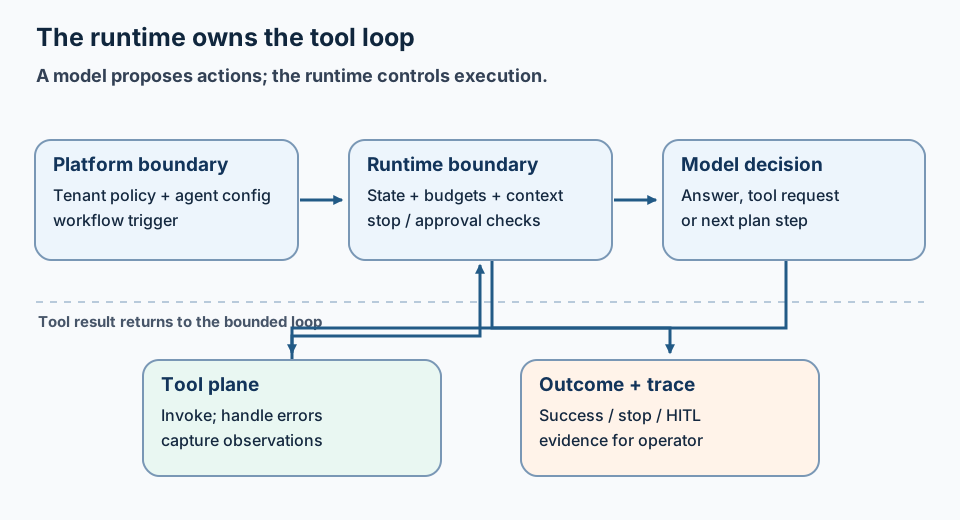
The runtime, not the model, owns tool execution and stopping rules.
A useful runtime has a small but demanding job. It turns an open-ended model conversation into bounded execution. At a high level, it owns:
- The current run state and the next action.
- Tool invocation, results, errors, and cancellation.
- Context selection so every old result does not live forever.
- Limits on time, model calls, tool calls, and other costly work.
- Stop conditions for success, failure, or human intervention.
- Trace data that explains how the run reached its answer.
The exact implementation varies. A local coding agent and an SRE investigation agent need different tools. They may have different safety rules too. The ownership boundary stays recognizable.
This is why a runtime is more than an SDK callback loop. The difficult part is not making the second model call. The difficult part is making the hundredth run predictable when tools are slow, context is messy, and a person changes the goal halfway through.
What production forces you to care about
When the loop runs for real on-call work, five failure modes to check are:
- Unbounded tools — the agent keeps calling until the bill or the pager burns. Budgets and stop conditions belong in the runtime. Wishful prompting is not a control.
- Invisible sessions — application performance monitoring (APM) can show healthy service metrics while the agent queries the wrong source. You need session-level traces and tool attribution. See observability for agents.
- Context collapse — every tool dump stays in the window until quality and cost fall over. Memory and compaction are runtime problems. The tokenomics guide explains why.
- No mid-run steer — operators need to add constraints without restarting from zero. A production loop must support steering during a run.
- Fluent wrong endings — the loop must refuse confidence when evidence is missing. This matters in SRE root cause analysis. The hypothesis ladder and evidence-first investigation guide cover that failure mode.
A product label alone does not provide those controls.
How to recognize one
Start with behavior rather than product labels. Give the system a task that requires more than one tool call. Then ask these questions:
- Can you inspect the run as a sequence of decisions and results?
- Can you stop it without killing the whole service?
- Does it enforce limits when the model keeps asking for more work?
- Can it recover from a tool error without inventing success?
- Can a person add a constraint while the run is active?
- Does the final answer show which evidence supports it?
A “no” does not always mean the product is useless. It may be a deliberate prototype. The answers reveal whether you are evaluating a model wrapper, a research harness, or a production runtime.
There is also a useful negative test. Remove the chat UI. If the agent loop can still run through another entry point, the runtime probably has a real boundary. If the loop disappears with the page component, the system is likely still a chat feature.
Runtime vs platform (one sentence each)
| Layer | Job |
|---|---|
| Runtime | Run one agent’s plan → tool → context loop safely |
| Platform | Run many agents for many teams with policy, tenancy, and durable orchestration |
The platform can choose a model, attach policy, and launch a workflow. The runtime then owns each active agent loop. Keeping those jobs distinct makes both layers easier to reason about.
We wrote up the split in AI Agent Runtime vs Platform. It also explains why a runtime does not need to become a remote microservice just to feel “enterprise.”
Where to go next
- Definition and related posts: AI runtime reading map
- Language: Go vs Python for AI agents
- On-call use: What Are SRE AI Agents? · AI incident triage
- Multi-stage pipelines: AI agent workflows
Acknowledgments. The StackGen Aiden team ships the platform layer around this runtime story. Named credits live on the deeper architecture posts.
Building a production agent loop — or stuck calling a chatbot a runtime? Find me on GitHub or LinkedIn.
StackGen develops AI tools for site reliability engineering (SRE), including incident triage and diagnostic workflows. Product details are at ai.stackgen.com.
FAQ
What is an AI agent runtime?
The long-running loop that plans, calls tools, manages context, and returns a result. It is the execution engine under chat UIs, platforms, and notebooks.
Is an agent runtime the same as a GenAI platform?
No. A runtime runs one agent's turn-taking. A platform adds tenancy, policy, durable workflows, and budgets for many teams.
What fails when teams skip a real runtime?
Unbounded tool loops, invisible sessions, context that blows the bill, and no place to put mid-run human steer or fail-closed gates.
Stay in the loop — production notes on AI agents, workflows, and SRE.
Low volume — new posts and curated reading lists. Unsubscribe anytime.