Debug AI Agent Failures: One Zip Per Conversation
Support hears, “this AI investigation went wrong.” A single conversation may have several separate agent runs. A debug zip containing the whole thread lets support see which run produced which claim; reviewing a week of such exports can reveal repeated failures worth fixing.
The incident patterns below are composite and anonymized. Counts are rounded. Names, IDs, and infrastructure details are fictionalized to protect customer confidentiality.
What the bundle needs to answer
Suppose an alert started more than one investigation and the final message says “no data.” Support needs to find the conversation by who started it and its Slack channel, then see the sequence of runs, the actual tool results, and the grading report in one download. A diagram of the execution dependencies (a directed acyclic graph, or DAG), an event-by-event replay, and the judge report are useful together: a shortened preview may hide data that the full tool result contained. A bundle makes diagnosis easier, but it must be access-controlled and redacted appropriately; it is not a reason to circulate raw customer traces.
Handoff as service
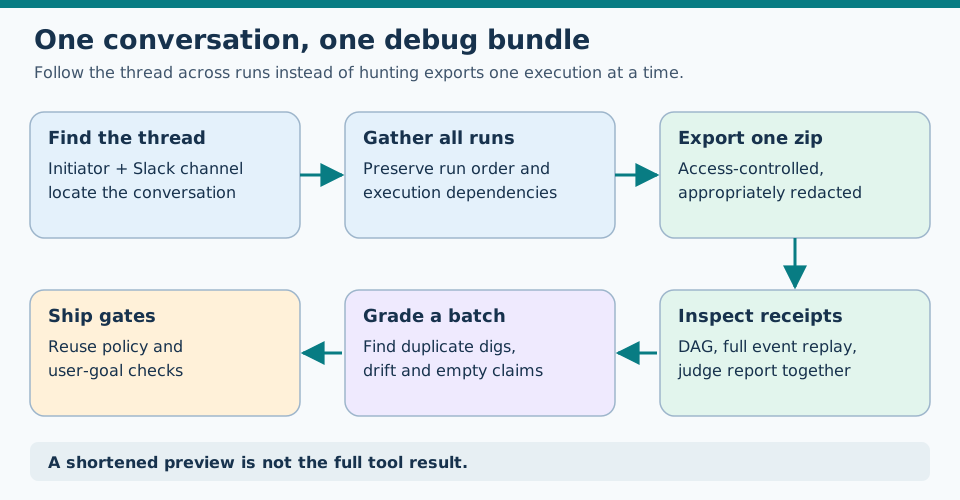
Caption: One protected conversation bundle connects execution history to reproducible support diagnosis and product gates.
Support and platform engineers talk in conversations. Debug export that only exists one execution at a time forces them to guess which step mattered. Conversation-scoped zip download (same bundle as the watch page: DAG, event replay, judge report) is the handoff artifact the service owed them.
Pair it with Activity rows that answer who started the thread and which channel it came from. Related honesty about agent observability: when agent observability lies.
How batch grading drove the product
Composite table from a 7-day anonymized export set (rounded). These examples show recurring patterns, not measured prevalence across customers:
| Pattern | What we saw | Product response |
|---|---|---|
| Duplicate digs | One alert with 20+ full investigates | Reuse-first launch policy |
| Verdict drift | High vs low impact on “same” alert | Document entry-path context; prefer Slack watch links |
| Missed correlate asks | Close without prior-session search | User-goal gates |
| Empty claims | “No data” on truncated previews | Honesty about truncated vs full tool output (return_full) |
The rubric was operator-facing: Did we serve the human who already had an RCA? Did we tell the truth about completeness? Could support reproduce the failure from one artifact?
That is Service Rendered Efficiently in reverse: measure what you made possible (or failed to), then ship product gates — not demo theater.
Canary evals still matter for live path health (canary-first consistency). Debug-zip grading answers a different question: what are we systematically doing to the teams we serve?
If you lead an SRE team
- Require one-zip handoff for any “conversation went wrong” ticket
- Consider regular export grading alongside incident review when support volume warrants it
- Prioritize backlog by recurring service failures (duplicates, dishonest empties), not by shiny agent demos
If you ship the agent platform
- Conversation-scoped debug download from Activity, with authorization and retention controls
- Qualifier search for initiator and channel
- Feed grading themes into gates; keep raw customer exports off the public internet and out of blog posts
Series wrap
You started with a culture frame: not what you built — what you made possible. The posts in between were receipts: reuse, Slack triage boards, entry path, correlation gates, honesty about truncated tool output, budget findings, hypothesis delivery, fallback digs for empty queries, measure the rule’s stored query first, cold start, and this handoff loop.
Archive: Service Rendered Efficiently. Checklist: SRE as service. Starter: SRE as service pack.
Acknowledgments. Debug export and Activity search lessons from shipping Aiden. Batch grading described without customer identifiers.
Building AI for incident triage without the demo theater? Find me on GitHub or LinkedIn.
FAQ
What should support get when an AI SRE investigation goes wrong?
One debug zip for the whole conversation — execution DAG, event replay, judge report — not one export per execution they have to hunt down.
How does batch grading of agent debug exports improve the product?
A week of anonymized exports showed duplicate investigates, verdict drift by entry path, and missing correlation. That grading prioritized reuse policy and user-goal gates over prompt tweaks.
How should you search Activity for a failed AI investigation thread?
Qualifier search for initiator and Slack channel so you can find the thread without opening every row.
Stay in the loop — production notes on AI agents, workflows, and SRE.
Low volume — new posts and curated reading lists. Unsubscribe anytime.