Why the Fix Didn't Fix It: Stopping a 16.8M-Request S3 API Storm in a ClickHouse Fleet
ClickHouse on AWS: Self-Managed from First Principles · Part 40
There is a specific kind of production humility that only arrives when you look at a billing dashboard after you think you fixed the bug.
Earlier that day, we had shipped what looked like a complete fix for our
S3 API request storm: a shared S3Queue keeper_path,
enable_hash_ring_filtering = 1 to stop writers from racing each other
for every file, a 15-minute persistent_processing_node_ttl_seconds, and
an automated disk-autoscale timer in chinit.
On paper, Tier-1 S3 requests (PUT/COPY/LIST at $0.005 per 1,000)
should have fallen from $45/day toward $6–$7/day (~$180–$220/month).
Then we queried Cost Explorer. In a single partial day, Tier-1 S3
requests hit $84.05 (16.8 million requests) — an annualized pace
north of $2,500/month.
So we stopped reading commit logs and probed the live AWS fleet
instance-by-instance: Launch Templates, attached EBS volumes, systemd
journals, lsblk, DynamoDB claims, and system.tables inside
ClickHouse. What we found wasn’t one broken flag. It was five
interlocking bugs across our Go bootstrapper, EBS lifecycle handling,
ClickHouse table settings, and Terraform rollout state — each hiding the
others.
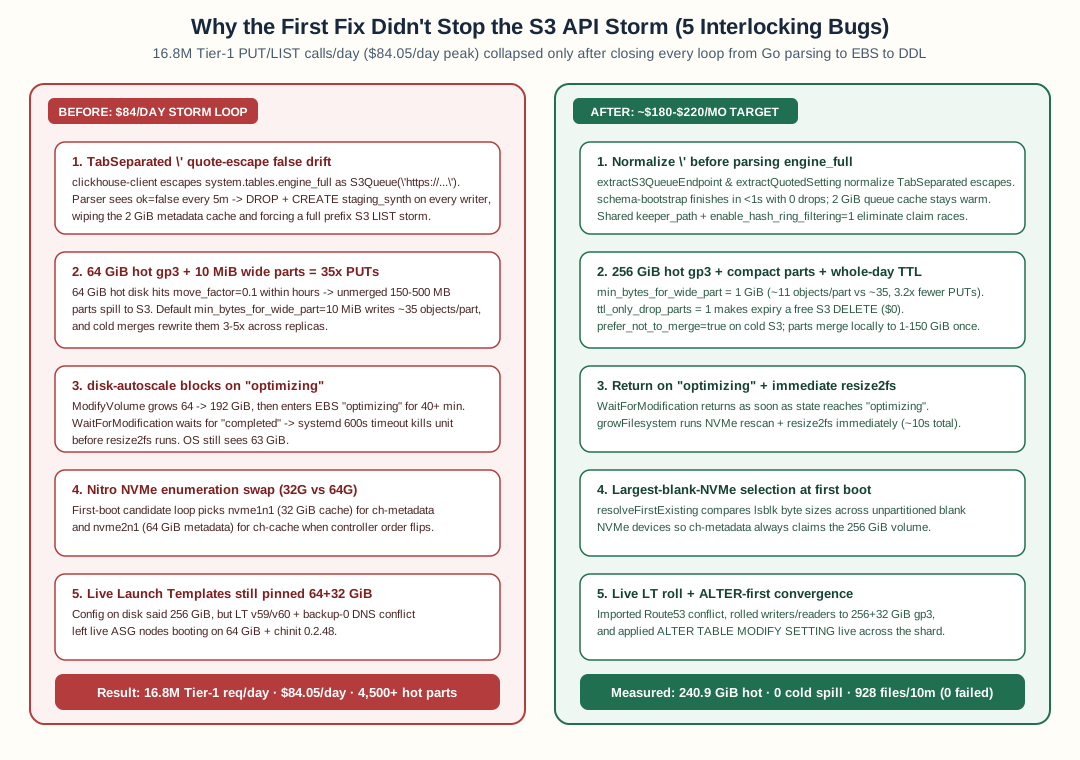
Bug 1: The false-drift loop dropping S3Queue every five minutes
When we tailed journalctl -u schema-bootstrap.service on the writers,
every single node was printing the exact same warning every five
minutes:
{"level":"WARN","msg":"schema bootstrap: S3Queue keeper_path/endpoint drift — re-creating the queue table on the declared URL and shared claim path","table":"staging_synth"}
Why? Earlier we had added endpoint-URL drift convergence to
chinit’s ApplyBootstrapDDL (s3QueueDrift in
render.go)
so changing the staging bucket in Terraform would automatically drop and
re-create the S3Queue table instead of silently no-oping behind
CREATE TABLE IF NOT EXISTS.
To detect drift, chinit ran:
SELECT engine_full FROM system.tables WHERE database = 'default' AND name = 'staging_synth'
And here is what non-interactive clickhouse-client actually printed in
TabSeparated format (its default output format):
S3Queue(\'https://example-raw-logs.s3.us-west-2.amazonaws.com/staging-synth/*/*\', \'NDJSON\', \'auto\') SETTINGS keeper_path = \'/clickhouse/s3queue/staging_synth\', ...
Notice the \' backslashes. TabSeparated escapes single quotes inside
column values. Meanwhile, extractS3QueueEndpoint checked
strings.HasPrefix(rest, "'") — saw \, returned liveURLOk = false,
and if !liveURLOk || liveURL != declaredURL treated a parse failure as
endpoint drift!
Every five minutes, on every writer, chinit dropped staging_synth
and re-created it. That wiped the engine’s 2 GiB in-memory metadata
cache, aborted in-flight file processing, and forced every writer to
re-LIST the entire staging prefix from scratch.
The fix in render.go was two lines plus a regression test with real
TabSeparated \'-escaped output in applyddl_test.go:
func extractS3QueueEndpoint(stmt string) (string, bool) {
	stmt = strings.ReplaceAll(stmt, `\'`, `'`)
	idx := strings.Index(stmt, "S3Queue(")
    ...
Once deployed, schema-bootstrap.service went from taking 8–10 seconds
to drop and rebuild the queue every 5 minutes to finishing in under
one second with zero drops.
Bug 2: 64 GiB hot gp3 + 10 MiB wide parts = 35× S3 PUT amplification
Even without the 5-minute LIST storm, the writers’ system.parts
revealed the second half of the bill: the live Launch Template still
pinned 64 GiB for /dev/sdb (hot default disk) + 32 GiB for
/dev/sdc (s3_cache), and default.edge_requests had active_parts
climbing past 4,500.
Why does a small hot disk blow up S3 API costs?
- Premature
move_factor = 0.1spill: With<keep_free_space_bytes>10 GiB</keep_free_space_bytes>on a64 GiBvolume,move_factor = 0.1triggers the moment free space dips under ~16 GiB. Under 30–60 TB/day of ingest, writers hit that threshold in a couple of hours and spill small, unmerged150–500 MBparts straight to S3 — where background merges then have toGETandPUTthem across S3 3–5 times. - Wide-part file explosion: Open-source ClickHouse defaults
min_bytes_for_wide_partto10 MiB. Any part larger than10 MiBis written in wide format — one separate S3 object per column and mark file (~35 S3 objects per part on our log schema, instead of ~11 in compact format). - Cold-tier merge churn and partial TTL rewrites: Without
<prefer_not_to_merge>true</prefer_not_to_merge>on the cold volume andttl_only_drop_parts = 1, ClickHouse both re-merged cold parts on S3 and rewrote partially expired parts on TTL expiry (GET+PUT) instead of dropping whole daily partitions (DELETE, which is free on S3).
The four-part fix:
- Resize hot
gp3from64 GiBto256 GiB(~$15/moper node in EBS, saving~$1,000+/moin S3 Tier-1 API calls). - Set
min_bytes_for_wide_part = 1073741824(1 GiB, the ClickHouse Cloud default) andttl_only_drop_parts = 1ondefault.edge_requests(bothALTER-first on the live cluster and inbootstrap-ddl.sql). - Set
<prefer_not_to_merge>false</prefer_not_to_merge>on<hot>and<prefer_not_to_merge>true</prefer_not_to_merge>on<cold>instorage.xml, so merges consolidate locally up to 1–150 GiB before parts TTL-move to S3 once.
Bug 3: disk-autoscale timed out waiting for EBS "completed"
If the live fleet still had 64 GiB hot disks, why hadn’t chinit’s
disk-autoscale timer rescued them cleanly?
Checking journalctl -u disk-autoscale.service on writer-1 and
writer-4 answered that in three lines:
Nov 17 22:10:29 writer-1 chinit[4764]: disk-autoscale: effective disk headroom probed unreserved_gib=4.47 floor_gib=12
Nov 17 22:20:29 writer-1 systemd[1]: disk-autoscale.service: start operation timed out. Terminating.
Nov 17 22:20:29 writer-1 systemd[1]: disk-autoscale.service: Failed with result 'timeout'.
ModifyVolume did grow the underlying EBS volume from 64 GiB to
192 GiB (3×). Then VolumeGrower.WaitForModification polled EC2
every 10 seconds waiting for ModificationState == "completed".
On AWS EBS, ModifyVolume transitions from "modifying" to
"optimizing" in ~5–10 seconds — at which point the new 192 GiB
capacity is already exposed to the guest kernel and ready for
resize2fs. The "optimizing" phase is background block migration and
routinely takes 30–60+ minutes. Waiting for "completed" guaranteed that
every grow hit systemd’s TimeoutStartSec=600 (10 minutes) and was
killed with SIGTERM before resize2fs could run.
In pkg/chinit/infra/aws/volumes.go and pkg/chinit/app/diskautoscale.go,
the fix was straightforward:
switch string(out.VolumesModifications[len(out.VolumesModifications)-1].ModificationState) {
case "completed", "optimizing":
    // New capacity is live for resize2fs once EBS enters optimizing.
    return nil
case "failed":
    return fmt.Errorf("volume modification failed for %s", volumeID)
}
Followed immediately by growFilesystem(ctx, cfg) in the same tick, so
volume growth and ext4 expansion finish in ~10 seconds instead of timing
out at 10 minutes.
Bug 4: Nitro NVMe order roulette swapped 32 GiB and 64 GiB
When we ran lsblk across every writer and reader, one freshly launched
reader (reader-2) showed something sneaky:
nvme0n1   50G   (root, GPT)
nvme1n1   32G   ch-metadata   /var/lib/clickhouse
nvme2n1   64G   ch-cache      /var/lib/clickhouse/disks
We had already added a partition-table guard in an earlier incident so
ch-metadata could never touch the 50G GPT root disk. But on
reader-2, Nitro enumerated the 32 GiB cache volume as nvme1n1 and
the 64 GiB metadata volume as nvme2n1. Because awsMetadataCandidates
checked /dev/nvme0n1 then /dev/nvme1n1, the first blank unpartitioned
candidate happened to be the 32 GiB cache disk — and ch-metadata
formatted and mounted it, leaving the 64 GiB metadata disk to
ch-cache.
On a 256 GiB metadata + 32 GiB cache fleet, that same flip would
quietly shrink the hot tier 8×.
In pkg/chinit/infra/system/disks.go, when resolveFirstExisting lands
on a blank unpartitioned NVMe disk on first boot, it now probes the full
blank NVMe pool (nvme0n1..nvme3n1) via lsblk -b -d -n -o SIZE and
picks the largest blank unpartitioned NVMe volume for ch-metadata
(leaving the smaller blank one for ch-cache).
Bug 5: The Terraform changes weren’t live in the Launch Templates
The final discovery was the simplest: vars/dev.tfvars in git said
256 GiB and c8g.xlarge readers, but aws ec2 describe-launch-template-versions
showed the live ASGs still pointing at v59 (64+32 GiB, r8g.2xlarge)
and v60 (64+32 GiB, t4g.xlarge). And when we ran tofu apply, it
tripped on a pre-existing backup-0 private Route 53 A record that
had been left in the zone when the backup replica was toggled earlier.
Importing that aws_route53_record into state let tofu apply complete
cleanly, bump the Launch Templates to 256+32 GiB (c8g.xlarge readers,
warning CloudWatch log level, 7-day log retention), and roll both ASGs
onto fresh instances.
What the live fleet looks like after all five fixes
Once chinit (v0.2.50) and the 256 GiB Launch Templates rolled across
every writer and reader, the live telemetry flipped immediately:
host      total_gib  unres_gib  ro  active_rep  active_parts  cold_parts
writer-0  240.9      189.8      0   5           1215          0
writer-2  240.9      190.3      0   5           1215          0
reader-0  240.9      203.8      0   5           152           0
reader-3  240.9      203.8      0   5           153           0
- Hot
gp3headroom: Every writer and reader sits at240.9 GiBusable (~190–204 GiBunreserved) withcold_parts = 0— active ingest consolidates locally ongp3instead of spilling small parts to S3. - Zero false S3Queue drops:
schema-bootstrap.servicecompletes in<1swith zeroDROPs. - Clean S3Queue drain: Over a 10-minute window,
writer-0alone processed928 files(89.2M rows) with0 Failed, and thestaging-synth/backlog drained continuously (75,434 -> 73,074objects during verification). - Table settings verified live:
default.edge_requestscarriesmin_bytes_for_wide_part = 1073741824,ttl_only_drop_parts = 1, andmax_parts_to_merge_at_once = 100.
The operational checklist
When a “fixed” cost storm keeps billing, check the gap between your PR and the running machines in this order:
- Query the live artifact, not the git repo. Check the actual Launch
Template versions, EBS volume sizes (
DescribeVolumes),lsblkon the host, andSHOW CREATE TABLEon the database. - Watch for periodic drop/recreate loops in bootstrap timers.
Non-interactive CLI output formats (
TabSeparated\'escaping) can turn a drift detector into a 5-minute wrecking ball. - Never wait on EBS
"completed"for online resize."optimizing"is already resizable; waiting for"completed"will time out your healer every single time. - Never trust Nitro NVMe order on multi-volume first boot. Skip partitioned disks and disambiguate blank data disks by byte size.
- Pair
256+ GiBhot disks withmin_bytes_for_wide_part = 1 GiBandttl_only_drop_parts = 1. Big hot disks stop premature spills; compact parts and whole-partition drops cut the S3 request multiplier once parts actually move.
FAQ
Why did an S3Queue drift detector drop and recreate the queue table every five minutes?
Non-interactive clickhouse-client outputs TabSeparated by default, which escapes single quotes inside system.tables.engine_full as \'. Our bootstrapper's extractS3QueueEndpoint parser expected raw ' quotes, returned ok=false on every 5-minute schema-bootstrap tick, and treated a failed parse as endpoint drift — dropping and recreating the S3Queue table on every writer, wiping its 2 GiB metadata cache, and triggering repeated full-prefix S3 LIST storms.
Why do 64 GiB hot gp3 volumes amplify S3 PUT costs in ClickHouse?
ClickHouse's multi-volume tiered policy triggers move_factor = 0.1 whenever free space on the hot volume drops below 10% (plus the keep_free_space reservation). At 30–60 TB/day of ingest, a 64 GiB hot disk hits that floor within hours and spills unmerged 150–500 MB parts onto S3, where background merges re-read and re-upload them multiple times. Sizing hot gp3 to 256+ GiB lets merges consolidate parts locally to 1–150 GiB before a single TTL move to S3.
What does min_bytes_for_wide_part = 1073741824 (1 GiB) save on S3?
Open-source ClickHouse defaults min_bytes_for_wide_part to 10 MiB, which writes a separate S3 object for every column and mark file (~35 objects per part). Raising it to 1 GiB (the ClickHouse Cloud default) keeps smaller parts in compact format (~11 objects per part), cutting S3 Tier-1 PUT requests per part by ~3.2x.
Why did disk-autoscale time out after ModifyVolume succeeded?
AWS EBS ModifyVolume transitions from "modifying" to "optimizing" within seconds — at which point the new capacity is already exposed to the guest kernel and ready for resize2fs — and stays in "optimizing" for 30–60+ minutes of background block migration. Polling for ModificationState == "completed" blocked the systemd oneshot for its full 10-minute timeout and killed the process before resizing the filesystem.
How do you prevent Nitro NVMe reordering from swapping metadata and cache disks?
On first boot, before filesystem labels exist, never pick blindly by device name order. After skipping devices with partition tables (OS disks), compare block-device sizes across blank NVMe candidates via lsblk so the metadata role (256 GiB) always claims the larger volume and never formats the smaller cache disk (32 GiB) as ch-metadata.
Stay in the loop — production notes on AI agents, workflows, and SRE.
Low volume — new posts and curated reading lists. Unsubscribe anytime.