The Roster, the Journal, and the Bookmarks: What Actually Happens When You CREATE a Replicated ClickHouse Table
ClickHouse on AWS: Self-Managed from First Principles · Part 34
A confession: the last debugging story I published — five rounds of trying to make schema setup automatic — is only tough to read if you’re missing one thing. Not experience, not ClickHouse trivia. One picture.
The story is full of sentences like “the CREATE refused because a registration for that name already exists in Keeper” and “the recovery command rejected the macro” and “a re-run converges instead of double-applying.” If you can already see what those mean, the story is just a good yarn. If you can’t, every paragraph is a new thing to take on faith.
So this is the picture. Not another war story — the five minutes of fundamentals that make the war stories read themselves. Three objects, one habit, and you’ll have the mental model for most of what goes wrong with replicated ClickHouse tables.
The three objects:
- A roster — who’s a member of this table
- A journal — what operations members are supposed to have done
- A bookmark — how far each member has read
And the habit: make every change repeatable, then repeat it forever.
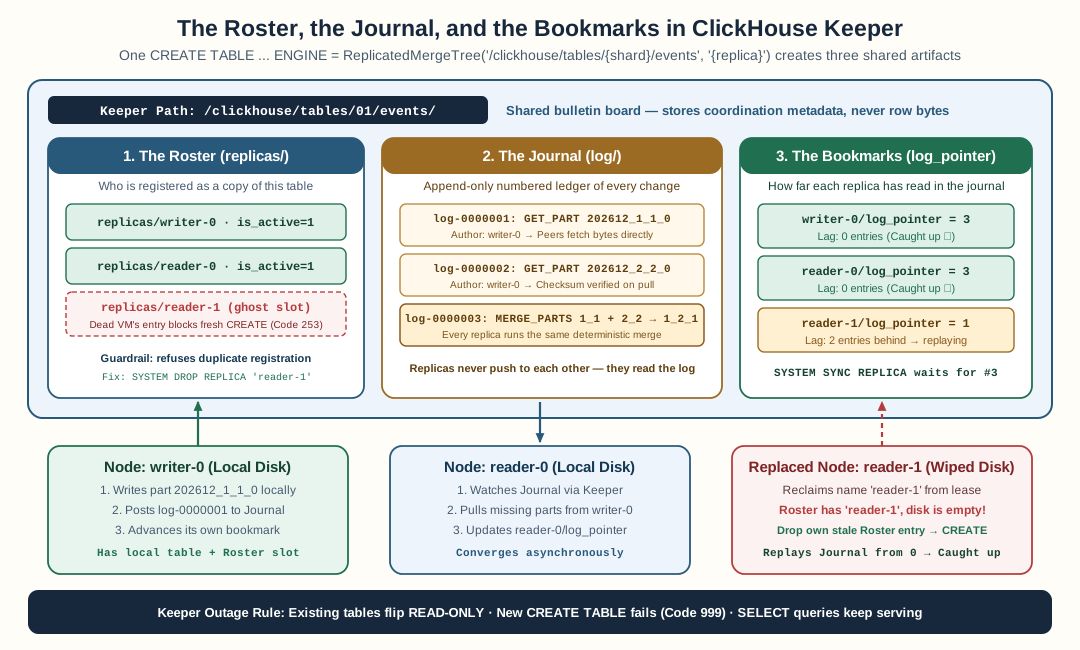
Inside Keeper’s /clickhouse/tables/01/events/ folder: the Roster (replicas/) guards membership, the Journal (log/) orders every part and merge, and the Bookmarks (log_pointer) track each replica’s progress.
flowchart LR
    create["CREATE TABLE ... ENGINE = ReplicatedMergeTree"] --> local["1. Local skeleton<br/>(empty folders, no data)"]
    create --> roster["2. Sign the roster<br/>in Keeper"]
    create --> bookmark["3. Start reading the journal<br/>from your bookmark"]
    bookmark --> fetch["4. Missing a part?<br/>Fetch the box from a peer"]
Let’s build each one from a single CREATE statement, because — and this is the fun part — one line of SQL creates all three.
One CREATE, three artifacts
Here’s a replicated table definition. This exact shape shows up in every ClickHouse cluster:
CREATE TABLE IF NOT EXISTS events
(
    timestamp DateTime64(9),
    ...
)
ENGINE = ReplicatedMergeTree(
    '/clickhouse/tables/{shard}/events',  -- the shared path
    '{replica}'                           -- my name
);
Two strings in the engine arguments do all the work. The first is a path — where this table lives in the coordination service. The second is a name — who this copy of the table is. Run this on two machines and you don’t get two unrelated tables; you get two members of one table, because they share the path and use different names.
What does “share the path” mean concretely? Time for object one.
Object 1: the roster (or: why “already exists” is the system working)
ClickHouse’s coordination service — ClickHouse Keeper, a ZooKeeper-compatible quorum of nodes — is a shared tree of small record-files called znodes. It behaves like a filing cabinet every database node can see: drawers, folders, one-page files, and — this is the important part — strictly one writer per name. Create a file that already exists, and the cabinet says no.
The moment your CREATE runs, the server reaches into the cabinet and writes a folder structure like this:
/clickhouse/tables/01/events/            ← the table's drawer
├── replicas/                            ← the roster
│   ├── reader-0/                        ← one member: me
│   │   ├── host          (which machine)
│   │   ├── log_pointer   (bookmark — object 3)
│   │   ├── parts/        (which boxes I hold)
│   │   ├── queue/        (my to-do list of journal entries)
│   │   └── ...
└── log/                                 ← the journal — object 2
    ├── 0000000001   (operation)
    ├── 0000000002   (operation)
    └── ...
The replicas/ folder is the roster. Each subfolder is one member’s
membership record, keyed by the name from the engine argument. And the
cabinet’s one-writer-per-name rule becomes a feature: a name can
only appear on the roster once, which is exactly what stops a second
node from silently replacing a live one.
Now — the single most common replicated-ClickHouse confusion, decoded.
An ephemeral fleet (autoscaling, spot, whatever) reuses names: a
replacement machine boots as reader-0 because the previous
reader-0 died. The new machine finds the old roster entry still
sitting there — dead nodes don’t file paperwork on their way out — and
the cabinet refuses the new registration:
Code: 253. DB::Exception: Replica /clickhouse/tables/01/events/replicas/reader-0
already exists
This is not corruption. It’s the protection working on the wrong timeline. The roster is supposed to refuse duplicate names — it’s just that the name’s real owner is dead, so the entry pointing at it is garbage. The sanctioned cleanup is to remove your own entry —
SYSTEM DROP REPLICA 'reader-0' FROM ZKPATH '/clickhouse/tables/01/events';
— and retry the CREATE. Drop your own name, never anyone else’s, and the refusal pattern becomes a non-event. (Who does this cleanup, and when, is precisely the thing my earlier post spent five rounds automating.)
Object 2: the journal (or: how replicas copy each other without talking)
So we have a roster. But how does the second node get the first
node’s data? You never copy a bucket over; nobody streams a database
dump. The answer is the log/ folder — the journal.
Every operation that changes the table gets appended to the journal as an entry: merge parts A and B into C, drop this expired range, fetch part D from replica reader-0. The journal is the table’s official minutes book. And each replica works through it like a clerk works through a to-do pile:
flowchart TD
    log["Journal: entry #1041<br/>'merge parts → 20260101_5_7'"]
    me["My bookmark: log_pointer = 1039"]
    me --> read["Read entries 1040, 1041"]
    read --> have{"Do I already have<br/>the resulting part?"}
    have -- no --> fetch["GET_PART: fetch the sealed box<br/>from the peer who made it"]
    have -- yes --> done["Mark done, advance bookmark"]
    fetch --> done
This is why a fresh node with an empty disk converges at all: it doesn’t “sync” in any bulk sense. It starts reading the journal from the beginning, and every time an entry says merge parts 1..200 into one, it skips the merging (someone did that already) and simply fetches the finished part — a sealed, compressed, sorted box of rows — from a peer that holds it. The journal tells you what should exist; parts move peer-to-peer; the bookmark records your progress.
Which is object three, and the last one:
Object 3: the bookmark (or: what “replication delay” actually measures)
Each replica’s log_pointer — you saw it in the roster tree — is the
journal position it has processed through. It’s a bookmark. And almost
every “is replication healthy?” number derives from it:
- Behind the journal head? The gap in entries is your replication queue.
- The oldest unfetched entry is from forty minutes ago? Your absolute delay is forty minutes — that’s the number people put on dashboards.
- Can’t reach the cabinet at all? You can’t prove you’re current, so (for quorum-safety reasons) the table flips read-only — this is the famous “keeper down → inserts fail” behavior, and it’s the bookmark system being pessimistic on purpose, not a crash.
When my debugging story said “the CREATEs failed because the coordination service was restarting,” the concrete failure was: the new node tried to reach the cabinet, the cabinet was closed for renovation, and both signing the roster and reading the journal were impossible. Everything in that story is one of the three objects misbehaving — nothing else.
Two fine prints worth carrying
Fine print one: the macros. That CREATE statement contains
{shard} and {replica} — squiggly-brace placeholders. The server
substitutes them at execution time, using the <macros> section of
that node’s configuration: {shard} → 01, {replica} → whatever
name this node carries. That’s how one statement, shipped to every
machine, registers every machine under its own identity: each node
reads the same text and resolves it as itself. Macros are the
mechanism behind the roster’s per-name uniqueness.
The catch: macros are resolved at statement time, only. Some commands want a literal path — the roster-cleanup command above is one — and if you feed them the unresolved macro text, they reject it outright (“does not look like a table path”). If you’re ever automating a recovery command, resolve the macros yourself first, exactly as the server would. This exact trap cost us a day once; now you know it exists.
Fine print two: the IF NOT EXISTS. Every statement in our shipped
DDL ends with IF NOT EXISTS. That’s not decoration — it’s what makes
the DDL idempotent: running it twice behaves exactly like running it
once, the way pressing a light switch that’s already on does
nothing, unlike shouting a toggle command twice and undoing
yourself. CREATE IF NOT EXISTS on an existing table: no-op.
Registration conflict: a defined remedy. Nothing in the sequence
misbehaves under repetition.
The habit: describe, then repeat forever
Take the three objects plus idempotent DDL, and the punchline of the whole mental model falls out for free.
If the schema is described once — a file of CREATE ... IF NOT
EXISTS statements that travels with every machine’s configuration —
and applying that file is safe to repeat, then you no longer have
to answer “when should the schema be applied?” You apply it:
- at boot (the obvious time),
- when a replacement node arrives (churn happens at its own schedule),
- when a coordination outage made the last pass fail (it came back; retry),
- and, simplest of all, on a timer, forever.
A clean pass changes nothing. A failed pass reports. A node that missed its moment heals on the next tick. This is convergence: the schema stops being an event you deploy and becomes a steady state you maintain by construction. It’s the same idea as Kubernetes controllers, Terraform, or a thermostat — describe the desired state, apply the delta, repeat — except the delta here is “run the DDL file,” and the repetition is a systemd timer rather than a control loop.
flowchart LR
    desc["Desired schema<br/>(one DDL file)"] --> apply["Apply, idempotently<br/>IF NOT EXISTS everywhere"]
    apply --> verdict{"Clean pass?"}
    verdict -- yes --> rest["Do nothing.<br/>Next tick: same result"]
    verdict -- no --> report["Report + retry<br/>on the next tick"]
    report --> apply
Why the debugging stories read easier now
Go back and skim the five rounds with these three objects in hand:
- Round 2 (“CREATE refuses, by design”) is the roster refusing a recycled name, and the remedy is roster cleanup for your own entry.
- Round 3 (“failure dressed as success”) is the journal and roster being unreachable — nothing could be signed or read — while one non-replicated statement sneaked through and let the step report health.
- Round 4 (“the recovery command broke on a macro”) is fine print one: the cleanup command got the unresolved placeholder instead of the literal path.
- Round 5 (“converge forever”) is the habit: stop treating the apply as a boot moment; timer it.
Four of five rounds, decoded by three objects and one habit. The fifth round — which tables belong on which nodes at all — is the same question one level up: the roster of the whole fleet, not just the table. That’s a story for another day.
If you carry away only one sentence: a replicated table is a shared folder in a filing cabinet (roster + journal) that each member works through from their own bookmark, and everything you ship to the fleet should be a light switch, never a toggle. The rest — the error codes, the drop commands, the timers — is just the cabinet’s paperwork.
FAQ
What does CREATE TABLE ... ENGINE = ReplicatedMergeTree actually do?
Three things, in order. One: it creates the local table structure on that node (the empty folder skeleton, no data). Two: it signs the membership roster — it writes a registration under a predictable path in the coordination service (Keeper), something like /clickhouse/tables/01/events/replicas/reader-0, claiming 'I am a replica of this table and my name is reader-0.' Three: it starts reading the table's shared journal from the coordination service and executing the operations it finds there — creates, merges, and 'fetch this part from that peer' entries — from its own bookmark position onward. The data arrives later, as parts fetched from whoever already has them.
What is the 'replica already exists' error about?
The roster. Each replica name can appear on it exactly once — that's how the system protects a real, live replica from being clobbered by a second node claiming the same name. If a fresh node boots with a recycled name whose previous holder died without checking out, the old roster entry is still there, and the CREATE refuses with Code 253. The registration exists, so nothing is created; the local table doesn't exist, so there's nothing to attach to. The sanctioned remedy is to remove your own stale entry (SYSTEM DROP REPLICA 'your-name' FROM ZKPATH 'path') and retry — never anyone else's.
What are the replication log and log_pointer?
The journal and the bookmark. Every replicated table keeps a shared, ordered journal in the coordination service: each entry is an operation (merge these parts, drop that range, fetch this part from that replica). Each replica keeps a bookmark — the log_pointer — recording how far it has read. When a replica is behind, it reads the entries after its bookmark and executes them; if it doesn't have the resulting part locally, it fetches the part from a peer that does. 'Replication delay' is just: how old is the journal entry my bookmark hasn't reached yet.
What are {shard} and {replica} in the CREATE statement?
Macros — placeholders the server substitutes at execution time using values from that node's own
Why is it safe to apply the same CREATE statements over and over?
Because the statements are idempotent — 'IF NOT EXISTS' makes running them a no-op when the thing already exists, like a light switch you can press again without breaking anything (unlike a toggle command, where repeating it undoes itself). A CREATE that already exists does nothing; a registration conflict has a defined remedy. That's what makes the convergence pattern possible: hold one description of the desired schema, apply it on a schedule, and let every pass pull reality toward the description. Re-running can't double-create, can't double-register, and any node that fell behind heals on the next pass.
What does 'convergence' mean for a database fleet?
That the schema stops being an event and becomes a steady state. Instead of 'we deployed the schema once and hope every node got it,' the fleet holds a description of what should exist, and every node periodically applies that description idempotently. Nodes that boot mid-outage, replacements that arrive after the fleet rolled, stragglers that lost their coordination service mid-start — they all converge on the next pass, without a human deciding when to re-run anything. The health question stops being 'did the deploy work?' and becomes 'is any node's latest pass clean?' — a question a timer can answer.
Stay in the loop — production notes on AI agents, workflows, and SRE.
Low volume — new posts and curated reading lists. Unsubscribe anytime.