The Five-Round Brawl to Make Schema Convergence Automatic: Bootstrapping ClickHouse Tables That Refuse to Converge
ClickHouse on AWS: Self-Managed from First Principles · Part 35
The promise of a self-managing cluster is that you never think about its schema. Nodes churn, replacements boot, tables appear, replication catches up. The reality we lived through last month was five straight days of a fleet boots with no tables, and every fix reveals the next layer of why.
This is the anatomy of that saga — not because the individual bugs are exotic (they aren’t), but because together they explain what “convergence” actually has to mean when the thing converging is a schema, the actors are ephemeral machines reusing each other’s names, and the coordinator itself is being restarted underneath you.
Reading this story cold? It leans on one mental model throughout: a replicated table is a roster (membership in Keeper), a journal (the shared operations log), and a per-replica bookmark — plus the habit of shipping idempotent DDL. If any of that is new, spend five minutes with the primer: the Roster, the Journal, and the Bookmarks first; every round below then reads as one of those three objects misbehaving, and the story gets a lot shorter.
Round by round. Each one fixed something real, and each one uncovered the next.
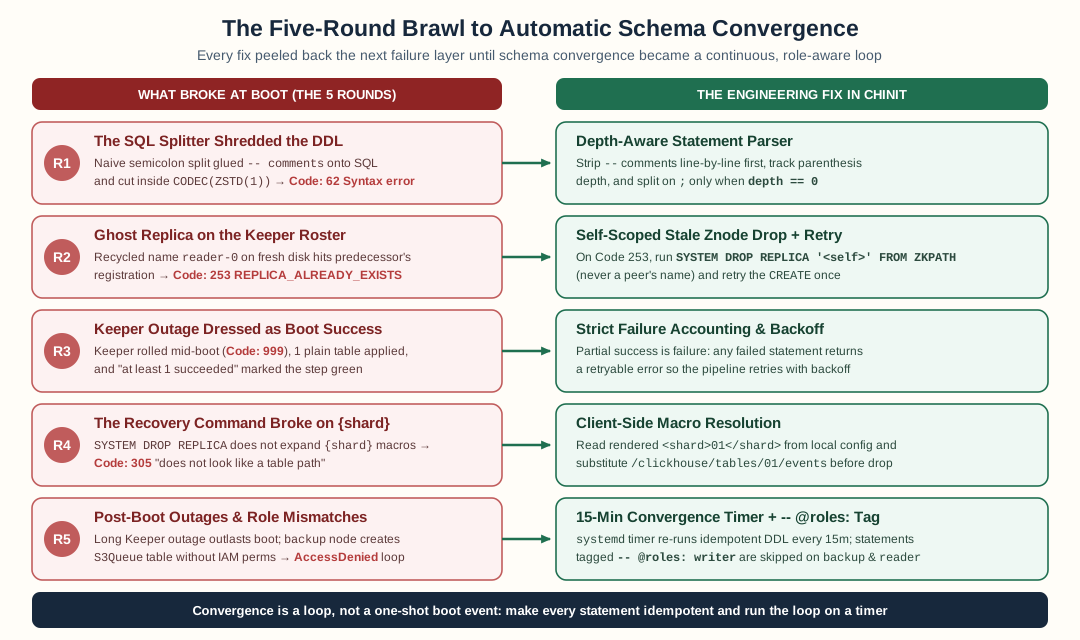
Five layers of schema bootstrap failure across ephemeral ClickHouse nodes — and the parser, self-drop, strict accounting, macro resolution, and timer/role-tag fixes that made convergence automatic.
timeline
    title Five rounds to automatic schema convergence
    Round 1 : The DDL arrives shredded : comments become syntax errors
    Round 2 : CREATE refuses by design : the recycled name's ghost registration
    Round 3 : Failure dressed as success : a Keeper outage mid-roll
    Round 4 : The fix breaks the fix : macros in the recovery command
    Round 5 : Converge forever : the timer, then role-scoped DDL
The setup: one DDL file, one promise
The design is simple enough to fit in a sentence: ship the cluster’s
CREATE TABLE statements alongside the configuration bundle, and have
every server node apply them idempotently at boot. Every statement is
IF NOT EXISTS. Tables that exist are untouched; tables that don’t,
appear. Replication does the rest.
Why ship the DDL at all? Because of a failure we hit during a full fleet replacement: when every peer churns at once, there is no peer to learn the schema from. ClickHouse nodes can propagate DDL to each other, but that’s a pull from someone who knows — and in a rolling restart that someone may be nobody. The schema has to travel with the machines, the same way their configuration does.
So far, so reasonable. Then the fleet rolled, and the boot logs said things like:
schema bootstrap: 1 statement(s) applied
…while nine tables were expected and one table existed. Round one.
Round 1: the DDL that shredded itself
The first suspect was the code that split the DDL file into statements. It split on semicolons. And the DDL file — like any DDL file written by humans — contained semicolons in places that are not statement terminators:
- Every explanatory comment before a table ended in prose, and the
splitter didn’t strip comments first — so a phrase like
-- this step executes it idempotentlyglued itself onto the front of a CREATE statement and arrived at the server as part of the SQL. - Column defaults like
CODEC(ZSTD(1))andTTL timestamp + toIntervalDay(7)contain semicolons’ neighbors — parentheses — and naive splitting happily cut inside expressions.
The server’s response to SQL that starts with English prose is exactly what you’d expect:
Code: 62. DB::Exception: Syntax error: failed at position 1
Five of nine statements failed this way. The boot printed “1 applied,” which was true and useless.
The fix is a splitting function that behaves like a parser instead of
like grep: strip -- comments line by line first, then track
parenthesis depth and only treat a semicolon as a terminator when the
depth is zero. Comments can no longer contain SQL, and expressions
with parens can no longer be severed. Boring, correct, and the kind
of function you should absolutely have in whatever applies DDL on your
fleet — because the failure it prevents is invisible right up until
you count tables.
Round 2: CREATE refuses, by design
With statements arriving intact, the fleet rolled again — and again booted mostly schemaless. But the error had changed character:
Code: 253. DB::Exception: Replica /clickhouse/tables/01/events/replicas/reader-0
already exists
This is my favorite ClickHouse error, because it is the system working as designed while your fleet fails anyway.
Replicated tables register themselves in Keeper under a path that
includes the replica’s name. An autoscaling fleet reuses names — that’s
the point of stable identity, and we’ve written before about
how a node claims its name.
When a replacement node boots as reader-0 and runs CREATE
REPLICATED MERGE TREE ... ('...', 'reader-0'), Keeper sees a
registration for reader-0 already sitting there — left behind by the
previous reader-0, which died without draining.
And so the create refuses. This is not a bug: refusing to stack a second replica onto an existing registration protects real replicas from being clobbered. But the calling code treated “refused” as “skip this statement,” and skipped is how you get nine expected tables and two actual ones.
The remedy is the one an operator types by hand in this situation: drop your own stale registration, then retry.
SYSTEM DROP REPLICA 'reader-0' FROM ZKPATH '/clickhouse/tables/01/events';
-- then: the same CREATE, retried once
Two properties make this safe to automate. First, you only ever drop
the name this node claims — never a peer’s, never a pattern, just
the identity the boot already settled. Second, a fresh disk has no
parts, so the ghost registration points at nothing; clearing it costs
nothing but the log entry. (On a disk with parts you must think
harder — that’s a different recovery.) The drop-and-retry lives in the
bootstrap step now, and the boot log says
re-created after dropping stale znode, which is the exact sentence
you want to see at 3 a.m.
Round 3: failure dressed as success
Round three didn’t announce itself in the logs at all. That was the problem.
During a rolling restart, the coordination quorum (Keeper) was being replaced in the same wave as the data nodes. A fresh writer would apply its DDL, and every replicated CREATE would fail:
Code: 999. DB::Exception: All connection tries failed while connecting
to ZooKeeper
Except — one statement in the bundle doesn’t need Keeper: a plain MergeTree or an S3Queue table. That one applied. And the step’s code returned success if any statement applied, because the step was written to be best-effort: a schema conflict shouldn’t kill a boot.
Best-effort, meet your blind spot. The step reported success, the boot reported healthy, and the node sat there schemaless — with a Keeper that came back thirty seconds later and a schema step that had already decided it was done.
The fix is unglamorous accounting: count the failures. Any statement that failed makes the step return a retryable error; the statement set is idempotent, so a retry converges instead of double-applying. The final “best-effort” classification stays — one exhausted retry pass still doesn’t kill the boot — but the retry now happens, and the pass that gave up says so loudly in the log instead of whispering success.
The general lesson deserves bold text: when a multi-item operation can be partially successful, “at least one worked” is not a success signal. Partial success is a shape of failure with better manners. Count, and report the count.
Round 4: the recovery command broke on a macro
Now the drop-and-retry from round two was in place, the failure count from round three was in place, and we watched a reader boot against a Keeper full of its own ghosts. The step tried the drop — and the drop itself failed:
Code: 305. DB::Exception: Specified path /clickhouse/tables/{shard}/events
does not look like a table path
Look closely at the path: it still contains the literal text
{shard}.
Here’s the trap. The DDL’s engine arguments are written with
ClickHouse macros — ReplicatedMergeTree('/clickhouse/tables/{shard}/events',
'{replica}') — and the server substitutes those macros at statement
execution time. That’s why the CREATE works with macros in it. But
SYSTEM DROP REPLICA ... FROM ZKPATH takes a literal path. The
recovery code extracted the path straight from the CREATE text, where
it was still {shard}, and handed a macro to a command that accepts
none.
The result: the drop failed with a path-format error, the retry never happened, and the Code 253 conflict stayed — the remedy for round two silently no-op’d against any DDL written in the idiomatic macro style.
The fix is to resolve the macros client-side, the way the server
would: read the node’s rendered <shard> macro from its own macros
configuration and substitute it into the path before building the drop
command. ({replica} is easier — it’s the node’s own name, which the
bootstrapper already knows.) It’s a two-line fix. It took a
production error to find, because in every hand-typed recovery, the
operator naturally writes the resolved path — the un-resolved form
only exists in the code path that feeds an automated command.
Automation lesson, also bold: automated recovery must reproduce the operator’s implicit normalization steps. Anything a human does without thinking — resolving a variable, trimming a space, picking the resolved path — is a step your code doesn’t have yet.
Round 5: converge forever, then scope by role
Two rounds closed the loop.
The timer. Everything above fixed the boot. But a boot is one moment, and the failure shapes in rounds 1–4 are precisely the ones that strike during fleet churn — when a node boots mid-rollback, against a Keeper that’s itself mid-restart. If the boot’s DDL pass exhausts its retries, nothing else ran the DDL again — and we watched a reader serve reads for hours with an empty database because of exactly that.
The answer is to stop treating the schema apply as a boot-time event at all. The same idempotent pass now runs on a systemd timer every fifteen minutes: every pass either converges or reports, a clean pass changes nothing, and a node that lost the Keeper race at boot heals itself on the next tick. Convergence stopped being a moment; it’s a steady state.
The role scope. The last surprise came from the opposite direction: a table that converged too eagerly. The bundle’s DDL included the S3Queue ingest table — the one that drains a staging prefix into the main log table, claiming files through Keeper so several nodes can share the drain. Every node applied every statement. Including the node whose IAM role holds no read permissions at all on the staging bucket: a dedicated backup replica, deliberately data-empty by security design.
Its queue table materialized, its poll loop started, and every poll
cycle threw AccessDenied into the logs, forever. Nothing was wrong
with the node; the object simply had no business existing there.
The ingest queue is an ingest-node object, by IAM design and by its
own DDL comment.
The fix moved the decision into the DDL itself — role-scoped statements:
--    chinit:roles=writer,reader
CREATE TABLE IF NOT EXISTS staging_synth (...)
A marker comment tags the statements that follow as belonging to certain roles; the bootstrapper drops statements this node doesn’t hold before they reach the server. The replicated tables stay role-universal (everyone needs them), the ingest pipeline is writer/reader-only, and the backup boots with exactly the seven tables it can actually serve. The error class doesn’t just get handled — it stops being constructible.
What would have prevented three of the five rounds
Rounds two, four, and five share a shape: invalid input reached the database, and the database’s only complaint mechanism was to fail.
Round two fed a CREATE onto an existing registration — the server refused. Round four fed a macro path to a literal-path command — the server refused. Round five fed an object to a node that couldn’t serve it — the server didn’t even refuse, it just ran the poll loop into a permission wall every thirty seconds. And a sibling failure from the same week — a config fragment with a server-level setting nested in the wrong section, or a pool-size threshold above the pool itself — made the server refuse to start, which is crash-loop-shaped, which is the worst shape of all: the same error, at machine speed, until a human reads it.
The prevention shape is an install-time validator: before any config fragment or DDL statement reaches the database, check the placement rules the database will check anyway —
- user-level settings must not sit at the top level of a server config fragment (they belong in profile sections);
- server-level pool settings must not sit inside merge-tree sections;
- free-entry thresholds must stay below the pool they gate;
- a recovery command must not carry unresolved macros;
- an object must not materialize on a role that cannot serve it.
None of this is exotic knowledge. It’s exactly what the error messages taught us — captured once, as rules, so the next bad template fails one boot with a pointed message instead of a restart storm or an error-spam loop. And the rule set applies to the bootstrapper’s own built-in defaults too: the built-in backup-replica configuration must pass every rule the validator enforces on everything else. The day it doesn’t, a test fails, not a fleet.
The whole chain, in one picture
flowchart TD
    boot[Node boots with bundle DDL] --> split[Split statements<br/>comment-aware, depth-aware]
    split --> role{Statement tagged<br/>for this role?}
    role -- no --> skip[Drop before the server<br/>never materialized]
    role -- yes --> apply[Apply CREATE ... IF NOT EXISTS]
    apply --> conflict{Code 253?<br/>ghost registration}
    conflict -- yes --> drop["SYSTEM DROP REPLICA 'own-name'<br/>FROM ZKPATH (macros resolved)"]
    drop --> retry[Retry CREATE once]
    conflict -- no --> ok[Statement applied]
    retry --> ok
    apply -- any failure --> count[Count failures<br/>return retryable error]
    count --> timer[15-min systemd timer<br/>re-runs until a clean pass]
    ok --> timer
Every arrow in that diagram is a scar from a specific afternoon. The timer is the outer loop that makes the whole thing a steady state instead of a lucky boot. And the validator is the layer that — we hope — makes the next round of this particular brawl never start.
The takeaways, stripped of ClickHouse
- A multi-item apply is successful when zero items failed — not when at least one succeeded. Count and report the count.
- Refusals by design still need a convergence path. If a system legitimately rejects a state you need, your automation needs the sanctioned way to clear it — restricted to your own resources.
- Automated recovery must reproduce the operator’s implicit normalizations. Macros, defaults, paths — resolve them exactly as the human would, or the remedy no-ops.
- Boot-time convergence isn’t enough. Anything that can fail because of a transient dependency (a coordinator restarting, a peer mid-roll) needs a periodic re-convergence, and the pass must be idempotent so the loop can run forever.
- Validate placement before the system does. The server’s “unknown setting” and “wrong section” errors are documentation — encode them as install-time rules so the failure is one loud boot, not a crash loop or an error fountain.
- Converge only what the node can serve. Schema, config, and permissions are three views of one contract; apply objects where the IAM/policy side of the contract holds, and nowhere else.
The schema now converges the way it should have from the start: machines churn, tables appear, nobody pages. Getting there was five rounds. Making it durable was the sixth — writing the whole chain down, with the error codes in it, so the next person (probably me) starts at round zero with the scars pre-installed.
FAQ
Why can't a fresh ClickHouse node just create its tables on boot?
It can — until four things go wrong. The DDL file must be split into statements correctly (a naive semicolon split turns comments and CODEC expressions into syntax errors). A node reusing a recycled name hits Code 253 REPLICA_ALREADY_EXISTS because its predecessor's registration still sits in Keeper. A coordination outage during the same rolling restart makes every replicated CREATE fail with a connection error. And none of it retries after the boot gives up, because a boot step that 'mostly worked' reports success. Convergence means all four failure shapes must be handled by design, not by luck.
What is Code 253 REPLICA_ALREADY_EXISTS telling you?
That a replica registration with your node's name already exists in Keeper — almost always left by the previous instance that held your name and died without draining. IF NOT EXISTS does not help: the registration exists, so CREATE does nothing; the local table doesn't exist, so there is nothing to attach to. The remedy is SYSTEM DROP REPLICA '
Why did the recovery command itself fail with 'does not look like a table path'?
Because the CREATE statement stores its Keeper path with ClickHouse macros — '/clickhouse/tables/{shard}/events' — and the server substitutes {shard} at statement time. But SYSTEM DROP REPLICA takes a literal path. Feed it the unresolved macro and it rejects the path outright (Code 305). The fix is to resolve the macros yourself before building the drop command — read the node's rendered
How do you make schema converge after the boot already gave up?
Run the same idempotent apply on a timer. Every statement is IF NOT EXISTS and the conflict path drops only the node's own stale registration, so a re-run can never double-apply or wedge. A systemd timer re-runs the DDL every fifteen minutes until one pass comes back clean; a failed pass exits non-zero so the failure is visible in the journal instead of silently absorbed.
Why would a table refuse to converge on only some nodes?
Because some objects in the bundle only make sense for some roles. An S3Queue ingest table needs ListBucket and DeleteObject permissions on the staging bucket — permissions the ingest nodes hold and a dedicated backup replica deliberately does not. Materialize that table on the backup and its poll loop spews AccessDenied forever. The fix is role-scoped DDL: tag statements with which roles may apply them, and have the bootstrapper drop statements that are not for this node before they ever reach the server.
Should you validate configuration at install time instead of letting the server crash-loop?
Yes. A config fragment with a user-level setting at the top level, a server-level setting inside
Stay in the loop — production notes on AI agents, workflows, and SRE.
Low volume — new posts and curated reading lists. Unsubscribe anytime.