Postgres Was a Filing Cabinet. ClickHouse Is a Warehouse: From Zero to SharedMergeTree for SQL People
ClickHouse on AWS: Self-Managed from First Principles · Part 36
If you already write SQL, you are 30 minutes away from understanding ClickHouse. Not because it’s small — because almost everything about it is a rational answer to one question, and once you know the question, the weird parts stop being weird.
The question: what does storage look like when reads are a thousand times rarer than writes, each read touches a billion rows, and the data never changes once it lands?
Postgres answers a different question — “what does storage look like when any row might be fetched or updated at any moment?” — and answers it brilliantly. This post walks from zero to ClickHouse’s answer, with a Postgres translator at every step, and ends at the design that ClickHouse Cloud runs: SharedMergeTree.
Step 0: the five-year-old’s question
Before any SQL, one picture — the one that survives even after you forget everything else.
ELI5: Imagine you write down every event that happens in your day, each on its own card. A Postgres database is a filing cabinet: each drawer is a row, holding that event’s time, its name, and everything about it, all together in one folder. To ask “how many events happened before noon?” you must open every folder and check.
A ClickHouse database is a warehouse: every piece of information goes into its own labeled box. All the times in one box, sorted. All the names in another box, sorted. To ask “how many before noon?” you open only the time box, run your finger down the sorted stack, and stop when you pass noon. You never touched the other boxes.
That’s the whole religion: store by column so reading less means opening less. Everything else in this post is machinery to make that warehouse stay fast while trucks dump a million cards per second at the loading dock.
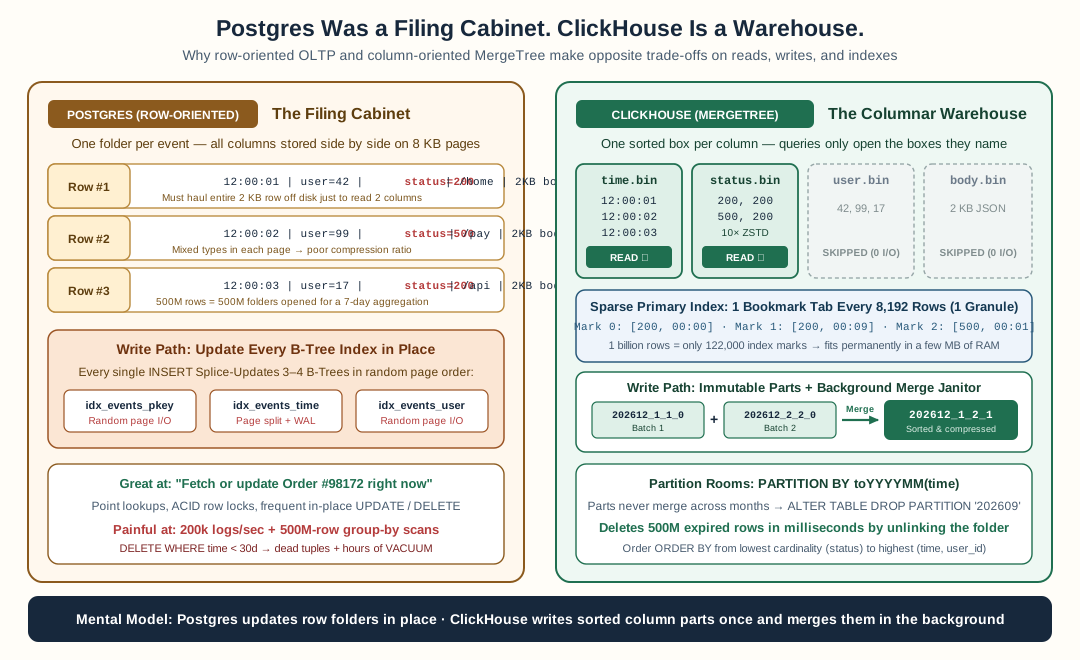
Postgres stores all columns of a row in one folder and updates B-Tree indexes on every write; ClickHouse stores each column in its own sorted box with a sparse 8,192-row granule index and merges immutable parts in the background.
Step 1: the read-side difference (why columns at all)
You know this SQL:
SELECT status, count(*)
FROM events
WHERE timestamp >= now() - INTERVAL 1 DAY
GROUP BY status;
In Postgres, even with an index on timestamp, the executor fetches
rows — every matching row’s full heap tuple (all 40 columns)
or at minimum index-then-heap lookups for the two columns you named.
In ClickHouse, that query opens two column files — timestamp and
status — inside each data block it can’t skip. The other 38 columns
are never read from disk at all. On a billion-row day, that’s the
difference between “read everything” and “read ~5% of the bytes.”
The Postgres translator: a heap page stores rows together; a
column file stores one field of many rows together. Postgres does have
columnar options (the zed extension), but the point stands — Postgres
chose row layout for point-lookups and writes; ClickHouse chose column
layout for scans and compression. Sorted, similar values next to each
other also compress ~10× better, which compounds: less disk, less
bandwidth, faster scans.
When is the row layout right? When you need WHERE id = 42 to return
one row in a millisecond, and you want to UPDATE it a moment later.
Keep Postgres for that. These systems are not enemies; most real
architectures run both.
Step 2: the write-side trick — there is no index to update
Here’s the first thing that feels wrong to a Postgres person, and it’s actually the source of ClickHouse’s insert speed.
In Postgres, an INSERT touches: the heap page, every index on the
table (b-tree insert with possible page splits), the WAL, and MVCC
bookkeeping. Write amplification: one logical insert, maybe a dozen
physical writes. You pay this because a moment later someone might
SELECT by any indexed column and must find the row instantly.
ClickHouse’s bet: nobody is going to fetch this row by ID in a millisecond. They’re going to aggregate it next week. So an INSERT pays zero index maintenance:
flowchart LR
    ins["INSERT batch<br/>(your one statement)"] --> sort["Sort by ORDER BY key<br/>in memory"]
    sort --> part["Write ONE immutable part<br/>(its own set of sorted column files)"]
    part --> done["Done. No index update.<br/>No WAL entry per row."]
    part -.->|"later, in the background"| merge["Merge small parts<br/>into bigger parts"]
Each INSERT writes a self-contained mini-table — a part — with every column sorted by the table’s ORDER BY key inside it. No part is ever modified after it’s written. That’s the whole write path.
The Postgres translator: a part is like a frozen, perfectly sorted slice of the heap plus its own tiny index — written in one burst, never vacuumed in place. Write amplification: one.
Step 3: the index — ORDER BY, and “the table IS the index”
In Postgres you declare a PRIMARY KEY and the engine builds a b-tree pointing into the heap. Index and table are separate things.
In ClickHouse you declare an ORDER BY and the data itself is sorted by it — the index isn’t beside the table, the table is the index. How can you search sorted data without a per-row index? The sparse index: rows are grouped into blocks (granules) of 8,192 rows, and ClickHouse records only each granule’s key range.
ELI5: a phone book doesn’t have an index card for every name. It has tab labels every ~50 pages: “K–M starts here.” To find “Kumar,” you jump to the K–M tab, then flip through a handful of pages. One tab per 50 pages instead of one card per name — that’s why the index is a few kilobytes per million rows and lives entirely in RAM.
CREATE TABLE events
(
    timestamp DateTime64(9),
    service   LowCardinality(String),
    status    LowCardinality(String),
    ...
)
ENGINE = MergeTree
PARTITION BY toYYYYMMDD(timestamp)
ORDER BY (timestamp, service);
WHERE timestamp BETWEEN ...— granule skipping kicks in, reads a fraction of the table. Fast.WHERE service = 'auth'(no timestamp) — can’t use the sort order of a(timestamp, service)key any more than Postgres can use a composite b-tree’s second column without the first. You scan.
The Postgres translator: ORDER BY’s prefix rule is exactly a
composite b-tree’s leftmost-prefix rule. And the ClickHouse fix for
“query a non-leading column” is the same shape as a secondary index,
but built for the block world: a bloom-filter skip index — a
per-granule checklist that says “trace IDs starting with 4a are
definitely not in this block.” It can’t point to rows; it only lets
scans skip blocks. That’s the entire index vocabulary.
Step 4: partitions — the DROP PARTITION superpower
PARTITION BY toYYYYMMDD(timestamp)
Partitions are like Postgres’ declarative partitioning (each is a separate directory tree), but they interact with the immutable-part design in a way that gives you two superpowers:
- DROP PARTITION is instant. Deleting yesterday is one metadata operation, not a query that marks rows dead and vacuums later.
- TTL is a first-class rule.
TTL timestamp + INTERVAL 30 DAYmakes retention part of the table definition — background merges drop expired partitions without any cron job.
ELI5: retention in Postgres is shredding old documents out of folders, page by page, then paying someone (autovacuum) to sweep the shreds. Retention in ClickHouse is wheeling yesterday’s whole cabinet out of the warehouse in one trip.
Step 5: merges — the background janitor (and the one way to break it)
Immutable sorted parts are great until you have a million of them. So a background worker continuously folds small parts into bigger ones: merges. Merges never change contents — same rows, same sort order, just repackaged into fewer, larger parts.
- The Postgres translator: merges are ClickHouse’s autovacuum — a background process that keeps storage healthy, whose failure mode is a count you can watch. Except the metric isn’t dead tuples, it’s parts per partition: at 1,000 active parts per partition inserts start being delayed (the server protects itself); at 3,000 they’re rejected with “Too many parts.”
The cause is always the same: tiny inserts. Each INSERT = one part, so 10 inserts/second = 36,000 parts/hour — the janitor can’t keep up. This is the one failure mode every new ClickHouse operator personally triggers, and it’s why the culture says never insert row-by-row:
- Batch in the app (aim for at most ~1 insert per second per table, as large as you can), or
- turn on asynchronous inserts
(
async_insert = 1): the server buffers small sends from many clients and makes one part per flush — the loading dock consolidates many small trucks into one pallet before shelving.
Step 6: mutations — the honest “UPDATE”
So rows are immutable. What about UPDATE and DELETE?
- UPDATE in ClickHouse is a batch job. A
ALTER TABLE ... UPDATE(a mutation) rewrites the affected parts — new versions of the files, old ones dropped after. Right tool: backfilling a column for a million rows. Wrong tool: changing one user’s email — that’s a full-part rewrite for a one-row change. - DELETE is the same: batch mutations, or lightweight deletes (tombstones — small markers that hide rows; the underlying data is cleaned up by later merges).
- ReplacingMergeTree is the idiomatic “upsert”: insert the new
version as a new row, and merges eventually keep only the highest
version per key. The catch — and this is the cultural adjustment:
merges are eventual. Until a merge happens, two versions coexist,
so queries must
GROUP BY(pick the winner themselves) or useFINAL.
ELI5: Postgres edits the card in the folder. ClickHouse writes a new card, drops it in the “newer” tray, and the janitor eventually files it over the old one. Your queries have to know there may be a moment when both cards exist.
If your workload is transactional (read-modify-write, single-row consistency), that’s Postgres’ job, full stop. The standard production shape is both: mutable state in Postgres, immutable events in ClickHouse.
Step 7: replication — two ways to copy a warehouse
You now hold the whole single-node model: sorted column files in immutable parts, sparse index, background merges. Both production replication designs build directly on it.
ReplicatedMergeTree (open source). Every node holds a full copy of the data. A shared log (in Keeper, the coordination service) records operations — “insert this part,” “merge those parts” — and each replica executes them; a replica that fell behind fetches finished parts from a peer instead of redoing merges.
ELI5: three warehouses keep identical stock, and they share a bulletin board. Every delivery gets posted to the board; each warehouse packs the same boxes. A warehouse that was closed for a day doesn’t re-pack anything — it just collects the finished boxes its neighbors already made.
The Postgres translator: the log is logical replication; part
fetching is physical; and each node is its own independent copy, so
you pay replicas × data in storage and each copy merges locally.
SharedMergeTree (ClickHouse Cloud). The design asks: why copy at all? Put the parts themselves on object storage (S3) and let compute nodes read/write them directly, using a Keeper-tracked catalog of who holds which block in local NVMe cache. Now compute is stateless — you can scale it to zero and pay only for storage when idle.
flowchart TB
    subgraph RM["ReplicatedMergeTree (open source)"]
        r1["Replica 1<br/>(full copy)"] --- logk["Shared log<br/>(Keeper)"]
        r2["Replica 2<br/>(full copy)"] --- logk
        r2 -.->|"fetch finished parts"| r1
    end
    subgraph SM["SharedMergeTree (ClickHouse Cloud)"]
        c1["Compute 1"] --> s3["Parts on object storage<br/>(one home for data)"]
        c2["Compute 2"] --> s3
        c1 -.-> cache["local NVMe cache<br/>(catalog in Keeper)"]
        c2 -.-> cache
    end
The Postgres translator: ReplicatedMergeTree is like streaming replication with N independent standby copies; SharedMergeTree is more like a shared-disk architecture — except the “disk” is S3, so there’s no SAN’s single-point-of-failure or IO bottleneck, and scale-to-zero becomes an economic feature instead of an impossibility.
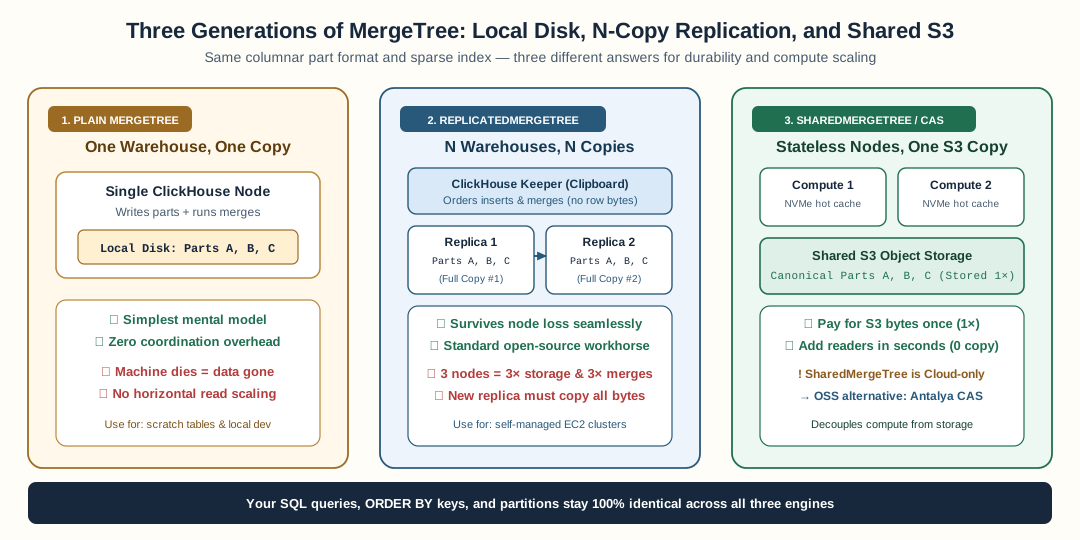
From one local disk (MergeTree) to N copies coordinated by Keeper (ReplicatedMergeTree) to one canonical copy in S3 with stateless compute caches (SharedMergeTree and Antalya CAS).
This engine is not in open-source clickhouse-server — running its
DDL fails with Unknown table engine SharedMergeTree. The
self-managed world runs ReplicatedMergeTree, which is exactly why the
comparison matters when you’re deciding between Cloud and self-managed:
you’re choosing between N copies with peer fetch and one copy with a
shared catalog. (The deeper tradeoffs — consistency, cost at different
replica counts, the zero-copy replication deprecation — deserve their
own post: the engine
choice.)
The whole model in one table
| Postgres concept | ClickHouse counterpart | The twist |
|---|---|---|
| Heap (rows together) | Column files per part | Reading 2 columns never touches the other 38 |
| PRIMARY KEY b-tree | ORDER BY + sparse index |
The table IS the index; 1 entry per 8,192 rows |
| Composite index prefix | ORDER BY prefix rule | Same leftmost-prefix logic |
| Secondary index | Bloom-filter skip index | Can only skip blocks, never locate rows |
| Declarative partitions | PARTITION BY |
DROP PARTITION is metadata-instant |
DELETE ... WHERE + vacuum |
Mutations / lightweight deletes | Batch-shaped; tombstones hide rows until merge |
INSERT + index maintenance + WAL |
One INSERT → one immutable part | Zero index maintenance at write time |
| autovacuum | Background merges | Health metric = parts per partition (1,000/3,000) |
| MVCC (rows can change) | Eventual consistency + GROUP BY |
Merges collapse versions; queries express intent |
| Streaming/logical replication | ReplicatedMergeTree | Log in Keeper; parts fetched peer-to-peer |
| Shared-disk cluster | SharedMergeTree (Cloud-only) | Parts on S3; stateless compute; scale-to-zero |
If you made it this far, the deeper MergeTree walkthrough (part 1 of this series, written before this gentler on-ramp existed) covers the same machinery with more operational depth — part explosions, TTL mechanics, async-insert tuning. And when you’re ready for the fleet-level picture — how a billion-row warehouse gets copied and coordinated across machines — the roster, journal, and bookmarks post picks up exactly where this one ends.
The one-sentence model: ClickHouse trades “edit any row at any time” for “sort everything once, never touch it again, and read only the columns you asked for” — and every strange behavior is a consequence of honoring that trade.
FAQ
How is ClickHouse different from Postgres for a SQL person?
The query language is familiar, but the storage model is built for a different job. Postgres stores rows together (a filing cabinet: every document in one folder, easy to fetch one, painful to scan all), and answers point-lookups and transactions in milliseconds. ClickHouse stores columns together (a warehouse: every field type in its own sorted boxes, painful to fetch one row, glorious to aggregate a billion) and answers analytical scans in seconds. Same SQL SELECT; a completely different machine underneath.
Why can't ClickHouse UPDATE or DELETE a row cheaply?
Because its storage files are immutable — written once, never edited, like a sealed box you never reopen. Changing a row would mean rewriting whole sorted blocks. Instead ClickHouse appends and fixes up later: ReplacingMergeTree lets the newest version win during a background merge (eventual consistency — your queries must GROUP BY or use FINAL to collapse duplicates), and DELETEs are heavyweight batch 'mutations' or lightweight tombstones that hide rows. If your workload updates rows in place per transaction, that's Postgres' job; if it appends immutable events and queries them in bulk, that's ClickHouse' job.
What is the ClickHouse equivalent of Postgres' primary key index?
The ORDER BY key. In Postgres a b-tree index is a side-file pointing INTO the heap; in ClickHouse the table IS the index — rows are physically sorted by the ORDER BY key inside every data part, and a tiny sparse index (one entry per 8192-row granule) records each block's key range so scans can skip blocks. Filtering on a prefix of the ORDER BY key is fast; filtering on anything else scans, unless you add bloom-filter skip indexes (the ClickHouse analog of a partial or secondary index — a per-block checklist that says 'definitely not in here').
What are parts and merges, in Postgres terms?
Each INSERT writes one immutable, self-contained 'part' — think of it as a mini table, sorted by the ORDER BY key. Parts are like Postgres' heap pages frozen in amber: never vacuumed in place, never edited. Background merges fold small parts into big ones — the nearest Postgres analogy is autovacuum, except it rewrites sorted blocks instead of reclaiming space, and its health metric is part count per partition: 1000 parts starts throttling inserts, 3000 rejects them. That's why batched inserts matter: one INSERT = one part.
How do the two ClickHouse replication designs differ?
ReplicatedMergeTree (open source): every replica keeps its own copy of the data; a shared log in Keeper coordinates them, and replicas fetch merged data parts from each other to catch up. Data volume = replicas × data size. SharedMergeTree (ClickHouse Cloud): compute nodes share the data on object storage (S3) directly, with a Keeper-tracked catalog of who's holding which block in a local cache — nodes can scale to zero, and capacity is one copy plus cache, not N copies. The tradeoffs (consistency guarantees, cost, scale-to-zero) are the real Cloud-vs-self-managed decision.
Do I lose transactional guarantees moving from Postgres to ClickHouse?
For analytics workloads, what you actually lose is single-row ACID mutability, and you get atomic multi-part INSERT batches in exchange. Each INSERT is all-or-nothing and immediately visible (it's a new part); there is no interactive BEGIN/COMMIT around row updates. Multi-table consistency is per-table eventual: parts merge in the background, ReplacingMergeTree collapses versions eventually, and queries express intent with GROUP BY. Most log/event pipelines need none of what they're giving up — and keep Postgres beside ClickHouse for the mutable, transactional half of the system, which is a very common pairing.
Stay in the loop — production notes on AI agents, workflows, and SRE.
Low volume — new posts and curated reading lists. Unsubscribe anytime.