Who Decides What a Node Is Called? Lease Identity for an Ephemeral Stateful Fleet
ClickHouse on AWS: Self-Managed from First Principles · Part 19
Every fleet that mixes stateful replicas with a horizontal scaling
group eventually hits the same contradiction. The scaling group’s whole
value is that it replaces instances freely — unhealthy ones, outdated
ones, spot-reclaimed ones. But stateful replication keys on names that
must outlive the instance: replica registrations in the coordination
service, per-replica prefixes in shared storage, configuration macros
rendered once and baked in. An
ephemeral reader that
boots as ip-10-0-1-97 and registers under that name is a fleet with
an identity leak — every replacement strands data and registrations
under a name that will never come back.
This post is the pattern that resolves the contradiction for our self-managed ClickHouse fleet — lease-based identity, as chinit implements it — and the five production findings that shaped each part. It is written cloud-neutral on purpose: the primitives are a conditional write and a time-to-live (TTL), and every cloud has both.
The identity that a stateful replica actually needs
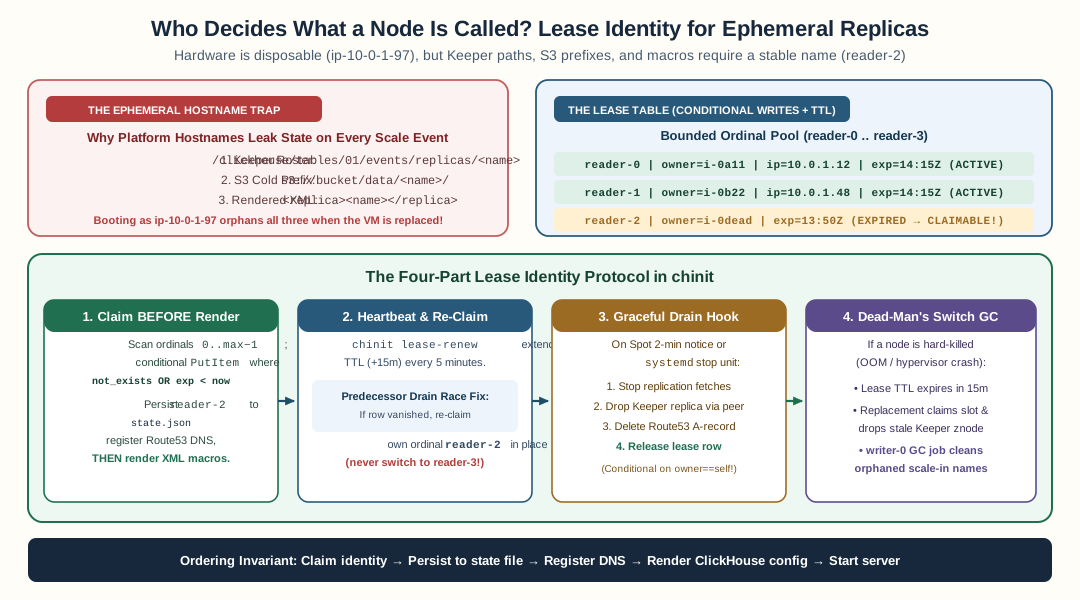
A conditional-write lease table bridges disposable ASG instances (ip-10-0-1-97) and durable replica names (reader-2) by enforcing claim-before-render, heartbeat renewal with self-reclaim fallback, and graceful shutdown drain.
Three things key on a stable name. Get them wrong and the failures are silent until the third replacement:
- Replication paths. Every replicated table registers under a
path like
/clickhouse/tables/{shard}/<table>/replicas/<name>. The<name>is the node’s identity. A node that boots under its platform hostname registers under an address that means nothing after replacement — and the data filed under it is stranded. - Per-replica object-storage prefixes. With zero-copy replication
deprecated upstream,
each replica physically copies parts, and each replica’s parts live
under its own prefix expanded from the
{replica}macro. The macro renders from identity — claim order matters before the render. - Configuration macros. The rendered config carries the identity into every macro the database expands. Render first, and the ephemeral name is baked into durable paths.
So the identity must satisfy a hard constraint: it must be settled before anything renders, and it must survive instance replacement. The scaling group supplies neither; the platform hostname is exactly the wrong identity — available instantly, valid forever after nothing.
The pattern: one conditional write, one lease, one heartbeat
The fix is a tiny protocol, not a service. A coordination table with conditional writes (any cloud’s table store has them), four operations, and the bootstrapper enforcing the ordering:
sequenceDiagram
    participant N as New node (boot)
    participant L as Lease table (conditional writes)
    participant D as DNS (private zone)
    participant K as Coordination (Keeper)
    Note over N: boot step: identity
    N->>L: conditional put: name=replica-2, lease=now+15m
    L-->>N: ok (free) OR retry (holder live) OR ok (lease expired)
    N->>N: identity settled - persist IMMEDIATELY
    N->>D: register A record (name → this IP)
    Note over N: boot step: render - AFTER identity
    N->>N: config renders with<br/>the settled name in macros
    Note over N: recurring jobs
    loop every 5 minutes
        N->>L: renew lease (+15m)
    end
    Note over N: graceful shutdown (drain)
    N->>N: stop replication queues
    N->>K: drop own replica registration via a LIVE peer
    N->>D: deregister A record
    N->>L: release lease (name returns to pool)
The four operations, each with a reason it exists:
Claim — one conditional put: the write succeeds only if the name is unclaimed or the previous holder’s lease has expired. The conditional write is the entire concurrency story; no locks, no leader election, no coordination service beyond the table itself.
Renew — the heartbeat. The claim’s TTL is the dead-man’s switch: a node that dies hard stops renewing, and within one lease window its name is back in the pool. The renewal cadence tolerates two missed heartbeats by design — five-minute renewal against a fifteen-minute lease. And the renewer self-heals: a renewal that fails against a vanished or re-assigned row re-claims the node’s own ordinal rather than failing every tick (a race we hit live — the drain of a dying predecessor deleted the replacement’s fresh claim — previously a manual table edit was the only recovery).
Release — the graceful path. A draining node deletes its own claim so the replacement can claim the name immediately instead of waiting out the lease.
List — the discovery read. Every node’s operations that need the cluster inventory — health fan-outs, schema propagation, peer selection — enumerate active claims only. A reserved-but-vacant slot never appears in a cluster query, which is the difference between a degraded answer and a wrong one.
Five production findings, each one a design constraint
We did not design this protocol on paper first. The paper version and the production version differ in exactly five places, each taught by a failure:
1. The claim must sweep, not fail. An instance-refresh replacement boots while its predecessor’s lease is still live — the old node renews until the second it dies. A single failed claim would wedge the replacement. The claim loop sweeps the ordinal range and retries within one lease window; a replacement always lands.
2. Identity persists before the pipeline continues. The first implementation recorded identity at boot completion. A crash after claiming but before completing left an orphaned lease and a half-configured node. The fix: the settled identity persists to the state file immediately — later steps, not at the end — and every later step and subcommand reads it from there, never re-deriving it.
3. The drain protocol needs a live peer, and the live peer must not be hardcoded. Dropping a replica registration is a peer-side operation — the dying node cannot do it alone. The first version hardcoded “ask node-0,” which fails exactly when node-0 is the node being replaced. The production drain picks the peer from live claims: prefer the zero ordinal, fall back to any live peer of the same role, fall back to the local best-effort drop. The weekly garbage collector catches whatever the drain misses.
4. The garbage collector’s safety gate is the live-lease set. The periodic sweep that drops stale registrations runs over a name pattern — but a pattern alone would happily drop a mid-boot replacement’s fresh registration. The production gate: the sweep enumerates active leases and excludes every live name from its drop set. A node that is merely young is never mistaken for a dead one.
5. The renewal must be a claim against its own ordinal, not a one-way heartbeat. The replacement-race finding: a dying node’s drain deletes its claim after the replacement has already claimed the same name — and the sequence that deletes “the predecessor’s row” can take the successor’s fresh one with it. The renewer then fails its conditional write on every tick, forever, while the node keeps serving under an identity no table believes it holds. Recovery was a manual table write. The production answer: a failed renewal re-claims the node’s own ordinal — the conditional write either takes the now-free seat back (the common race outcome) or answers taken (a replacement owns the name and this node must re-image). A different ordinal answering is Fatal: the hostname, the DNS record, and the Keeper registrations all key on the name, and a timer cannot converge an identity change.
Together these five make the pattern self-healing in the hard cases — not just the happy path:
flowchart TB
    subgraph FATES["Node fates and what the identity survives"]
        direction TB
        G["Graceful scale-in<br/>drain: stop queues →<br/>peer drop → DNS → release"]
        H["Hard kill (spot reclaim, host failure)<br/>lease expires ≤15m<br/>weekly GC drops registration"]
        R["Instance-refresh replacement<br/>claims sweep during<br/>predecessor's live lease"]
        X["Drain/replacement race<br/>deletes the successor's fresh claim<br/>renewal fails every tick"]
    end
    G --> OK["Name returns to pool<br/>replacement reclaims it<br/>replica re-syncs from peers"]
    H --> OK
    R --> OK2["Same name, new instance,<br/>stateless catalog rebuilds,<br/>replication catches up"]
    X --> OK3["Failed renewal re-claims<br/>its own ordinal — seat retaken<br/>or loudly taken (re-image)"]
    style OK fill:#2d5a27,color:#fff
    style OK2 fill:#2d5a27,color:#fff
    style OK3 fill:#2d5a27,color:#fff
What this unlocks: stateless replacement as the design goal
The pattern’s payoff is bigger than stable names. Once identity is a lease, replacement becomes the repair strategy: a node carries no state a peer cannot rebuild. The parts catalog is a pointer map to shared object storage; durability lives in the object store and in replication itself. A replacement claims its name, renders its config, and the replica fetches parts from peers until caught up.
That is a deliberate shape, and it is not free — a replacement pays a re-warm (part fetches, cache cold) measured in minutes. The trade:
| Persistent catalog (pre-lease) | Stateless + lease identity | |
|---|---|---|
| Replacement cost | Catalog survives — fast rejoin | Re-warm from peers — minutes |
| Failure surface | State must be migrated, reattached, versioned | No state to lose or orphan |
| Fleet scaling | Identity coupled to instance lifecycle | Identity decoupled — ordinals claimable |
| Worst case | Orphaned volume, stranded registration | One lease window of absence |
For a replicated hot tier — where every part exists on peers and in object storage — the stateless shape wins: the failure modes are all self-healing, and self-healing is what a horizontal scaling group is for. (Keepers and other coordination members are the exception that proves the rule — they are not part of the replicated data plane, their state is a Raft log that cannot be rebuilt from peers, and they belong outside the scaling group entirely.)
Adopting the pattern elsewhere
The requirements list is short, which is why this generalizes:
- A store with conditional writes and a TTL. Every cloud’s table service has both; on-prem, any database with compare-and-set semantics works.
- A name range with an explicit ceiling. Ordinals 0..N-1 where N is the scaling group’s maximum — and the ceiling must be reserved elsewhere (slot arithmetic) so names never shift when the fleet resizes.
- A bootstrapper that enforces claim-before-render. This is the constraint the whole pattern hangs on; it wants to be a typed pipeline step, not a convention in a script.
- A drain hook on the scaling group’s termination path. Graceful release is an optimization — the lease TTL is the correctness floor — but it turns a fifteen-minute absence into an instant one.
- A periodic garbage collector with the live-lease gate. The safety net that catches every drain failure; never drop a name whose lease is live.
The next post closes the arc with the adoption view: how to take this whole pattern — the bootstrapper, the in-process operations, the lease identity — to your own fleet, what to port first, and the order the migration wants.
Related in this series: stable identity for spot readers, the boot sequence as a contract, and dissolving the second binary.
FAQ
Why does an ephemeral stateful node need a stable identity at all?
Because three things key on a name that outlives the instance: replication paths and replica registrations in the coordination service, per-replica prefixes in shared object storage, and the configuration macros rendered into the node. If those carry an ephemeral platform hostname — an ip-* name — every replacement registers under a fresh identity, and data filed under the old name is orphaned.
What is lease-based identity?
At boot, a node claims a name from a small ordinal range using one conditional write: the write succeeds only if the name is free or the previous holder's lease has expired. The claim carries a time-to-live lease, renewed on a heartbeat, and released on graceful shutdown. A crashed node's lease expires and its name returns to the pool — the dead-man's switch that keeps a fleet from leaking identities forever.
Why does the claim happen before configuration is rendered?
The rendered configuration embeds the identity: replication macros carry the replica name, and per-replica storage paths expand from it. If the render happens first, the node's ephemeral platform hostname gets baked into paths that must be durable. Claim-then-render makes identity a property of the fleet, not of the instance — the ordering is a contract, not a preference.
How does the pattern handle scale-in without leaving ghost identities?
Two layers. The graceful path: an interruption or termination hook drains the node — stop replication queues, drop the replica registration via a live peer, release DNS and the lease — before shutdown. The safety net: a periodic garbage collector detects registrations for names gone from the live-claims set and drops them, and every lease has a TTL so a hard-killed node's name is reclaimable after one lease window.
What happens when a renewal fails?
The renewer falls back to re-claiming its own ordinal. The race that motivates it: a dying predecessor's drain deletes its claim after the replacement has already taken the same name, and the deletion can take the successor's fresh row instead — after which every renewal tick fails against a vanished record while the node keeps serving its identity. The re-claim either takes the now-free seat back or answers taken, meaning a replacement owns the name and the node needs a re-image. A different ordinal answering is fatal: hostname, DNS, and Keeper registrations all key on the name, and a background timer cannot converge an identity change.
Why is a stateless node the right shape for a replicated hot tier?
Because durability lives elsewhere — in shared object storage with per-replica prefixes and in the replication itself. If the parts catalog can be rebuilt by re-fetching from peers, replacement is self-healing by construction: the node claims its name, re-renders, and the replica re-syncs. Persistent local state that survives replacement is a liability for anything a peer can rebuild.
Does this pattern need a specific coordination service?
No. The primitives are a conditional write (compare-and-set) and a time-to-live on the record — any table store with conditional puts works, and any cloud has one. The pattern is the claim-renew-release-drain protocol; the backing store is an implementation detail. On another cloud or on-prem, the same protocol runs over a different store with the bootstrapper's provider factory hiding the difference.
Stay in the loop — production notes on AI agents, workflows, and SRE.
Low volume — new posts and curated reading lists. Unsubscribe anytime.