One Binary to Bootstrap a Node: Why chinit Replaced 3,600 Lines of Bash
ClickHouse on AWS: Self-Managed from First Principles · Part 17
This is a story about the least-reviewed production code in any self-managed fleet. The data definition language (DDL) gets reviewed. The dashboards get reviewed. The thing that runs between an instance launching and the first successful query — the boot script — gets templated by the infrastructure-as-code (IaC) tool, grown to three thousand lines, and read by no one until it fails at 3 a.m.
We ended up with one, like everyone does. And then we replaced it with chinit — a single Go binary that treats node bootstrap as a typed spec, a state file, and a retry engine. This post is about why that boundary — bash to binary — was the single highest-leverage change in the whole self-managed ClickHouse migration, and how to know when your fleet is ready for the same move.
The series has walked the pieces before: the boot sequence as a contract, the operator’s brain reused off Kubernetes. This post is the design view: what chinit is, the problem class it exists to kill, and the shape of the solution — written so you can apply the pattern to any self-managed fleet, on any cloud.
The problem nobody owns
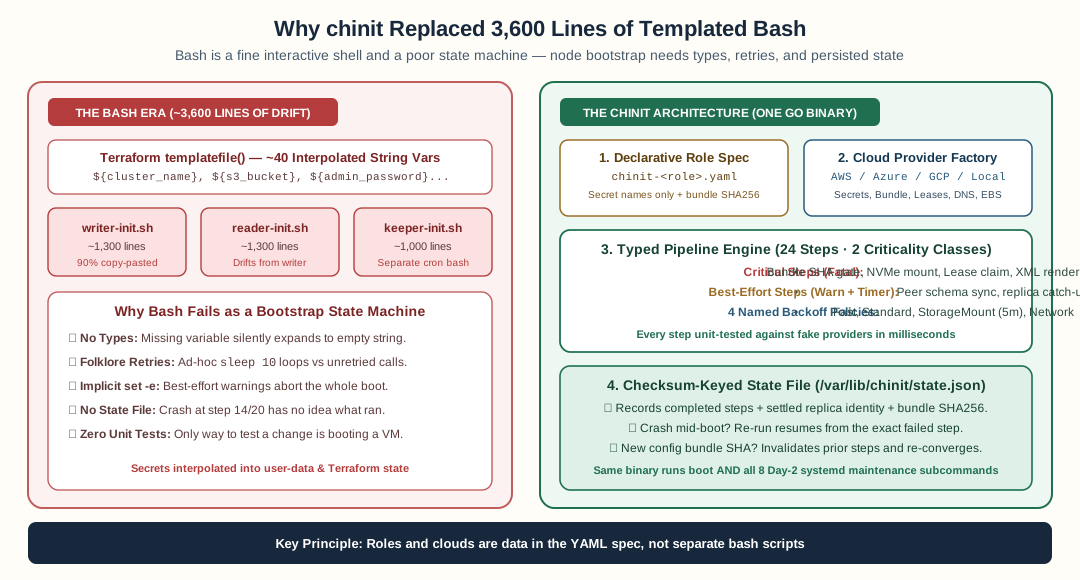
Replacing 3,600 lines of Terraform-templated bash with chinit turns node bootstrap into a validated YAML role spec, a cloud provider factory, a typed 24-step retry engine, and a checksum-keyed state file.
A self-managed database node’s boot is not one job. It is about twenty: fetch configuration, detect the platform, mount and label disks, derive identity, resolve secrets, render configuration, start the database, verify health, install recurring maintenance. The bash implementation of those twenty jobs converges on the same shape everywhere:
- The IaC tool templates the script. Every cluster variable arrives as an interpolated string. The script’s real type system is the template’s escape discipline.
- Each role gets its own copy. Writer, reader, keeper — three scripts, ninety percent shared, drifting independently. A fix lands in one; the others learn about it in production.
- Retry policy is folklore. One step sleeps ten seconds and hopes; the next polls with a timeout; the third has no loop at all because “it always works.” Transient cloud API failures behave differently in each.
- There is no state. A script that crashes at step fourteen of twenty has no idea, on re-run, what it already did. The safe move is to make every step idempotent by hand — which works until a step is only mostly idempotent.
- It cannot be tested. The only way to exercise the script is to launch a node. So nobody exercises it until a node launches.
None of this is a bash bug. Bash is a fine shell and a poor state machine. The problem is that boot is a state machine — steps with ordering constraints, retry policies, and failure semantics — expressed in a language whose unit of composition is a string.
flowchart TB
    subgraph BASH["The bash era: what a boot script actually is"]
        direction TB
        T["IaC templates<br/>~40 interpolated variables"] --> S1["writer script<br/>~3,000 lines"]
        T --> S2["reader script<br/>~3,000 lines"]
        T --> S3["keeper script<br/>~3,000 lines"]
        S1 --> P1["Folkloric retries<br/>sleep-loops, hope"]
        S2 --> P1
        S3 --> P1
        P1 --> F["No state, no tests<br/>verified only at 3 a.m."]
    end
    style F fill:#5c1f1f,color:#fff
The deepest issue is the last one. An untestable boot path means every fleet roll is a live experiment — and the fixes are written in the same untestable medium that failed.
The shape of the solution
The fix is not “write the bash in Go.” The fix is to recognize what the boot actually is and give each part its natural representation:
flowchart LR
    subgraph IN["Inputs (data, not code)"]
        SPEC["Role spec<br/>small YAML: role, identity,<br/>disks, secret NAMES"]
        BUNDLE["Config bundle<br/>checksummed in object storage"]
    end
    subgraph BIN["One binary: chinit"]
        direction TB
        D["Detect cloud<br/>(flag → env → firmware → metadata)"]
        F["Provider factory<br/>builds capabilities"]
        E["Retry engine<br/>named policies per step"]
        ST["State file<br/>steps × bundle SHA"]
        R["Render<br/>the database's own<br/>generator code"]
        U["Install units<br/>chinit subcommands"]
    end
    subgraph OUT["Converged node"]
        N["Services up, identity<br/>settled, jobs scheduled"]
    end
    SPEC --> D --> F --> E --> R --> N
    BUNDLE --> F
    E <--> ST
    R --> U
    style SPEC fill:#1f3a5c,color:#fff
    style BIN fill:#2d5a27,color:#fff
    style OUT fill:#1f3a5c,color:#fff
The spec is data. One YAML Ain’t Markup Language (YAML) document per role, declaring intent: the role, how identity is derived, which disk labels to mount, which secret names to resolve, where the config bundle lives. The same binary serves every role because the role is a field, not a fork. The same binary serves every cloud because the cloud is detected and dispatched through a factory.
Secrets stay references. The spec names secrets; the boot resolves them through the provider’s secret capability and writes values to 0600 files. Plaintext never enters the spec, the IaC state, the rendered config, or the log.
Steps carry their failure semantics. Each step declares whether it is critical (abort the boot — let the fleet’s own replacement machinery handle it) or best-effort (log loudly, continue). The health gate is deliberately best-effort: a reader booting mid-fleet-roll with a peer down must still join, or the boot loop wedges the whole Auto Scaling Group (ASG).
Retry is a policy, not folklore. Four named policies — fast for transient API calls, patient for waiting on disks and services, one shot for config-class failures where a retry masks a bug, and a sweep bounded by one lease window for identity claims.
State makes re-runs safe. Every completed step is recorded with the config-bundle checksum it ran against. Re-run with the same hash: done steps skip. Crash mid-pipeline: resume where you stopped. New bundle hash: prior records are invalidated and the pipeline re-runs — deliberately, because the installed configs are not what the new release vouches for.
The maintenance jobs are the same binary. The recurring work — schema propagation, replica sync, lease renewal — are subcommands. The systemd unit’s entire content is one ExecStart line. There is no second script to drift.
The payoff isn’t elegance; it is the failure classes that vanish:
| Bash era | chinit |
|---|---|
| Spec arrives as ~40 template variables | One typed, validated spec file |
| Three role scripts, shared by copy-paste | One binary; roles are data |
| Per-step ad-hoc retry loops | Four named policies, applied per step |
| No memory between runs | State file keyed to the bundle checksum |
| Untestable without a live node | A unit-testable engine; spec logic is Go |
| Secrets interpolated into templates | References resolved at runtime, to files |
| Job scripts drift from boot scripts | Jobs are the same binary’s subcommands |
What live cutovers taught us
We ran the cutover the honest way: bake the binary into the golden image, roll real nodes, and let production findings drive the design. Three findings shaped it more than any plan:
1. Identity must settle before anything renders. The first reader
cut over booted, rendered its configuration, and registered itself
under the platform-assigned hostname — an ephemeral ip-* name. The
replication paths and macros had the instance’s identity baked into
them, and every subsequent replacement inherited a stranger’s state.
The fix was structural: the identity step (claim or derive the node’s
stable name) became a hard prerequisite of the render step. Order is
load-bearing.
2. A spec is not converged until a node can crash mid-boot. The first version of the state file recorded identity but not steps. A node that crashed after claiming identity but before rendering left orphaned leases and half-configured services. The fix: persist the settled identity immediately — later steps, not the pipeline’s conclusion — and record each step as it completes.
3. The health gate must never be fatal. The first fleet roll with a fatal health check wedged: node boots, peer is mid-replacement, health fails, boot aborts, fleet replaces the node, the new node sees the same peer down, loop. The gate is a warning now — loud in the log, never blocking the boot-finished marker.
Each of these is a general lesson about state machines at boot, and each cost less than it would have in the bash era, because the fix was a change to a typed step in a reviewable pipeline — not a sed across three three-thousand-line scripts.
How to know you are ready for this move
The migration is worth it when the boot script is doing real work — identity, secrets, platform detection, service orchestration — not just apt installs. The signals we would look for in any fleet:
- The script has branches per role. Role-forked scripts are the clearest tell: the design wants roles to be data.
- You template the script from your IaC tool. The moment the IaC tool is writing your runtime logic, the boundary has blurred.
- A fleet roll has ever failed on a boot-script bug and the fix shipped in the same untestable medium.
- You have steps that only sometimes need retries — cloud API calls next to disk waits — and the retry discipline is inconsistent between them.
- You cannot answer “what does a re-run do?” in one sentence.
If three of five are true, the boot path has crossed from setup script into state machine — and state machines want types, policies, and state files.
The next post in this arc walks the hardest boundary we crossed after the bash cutover: the second binary that chinit originally shipped beside — and why dissolving it made the whole system smaller.
Related in this series: the boot sequence as a contract, teaching an operator’s code to work without Kubernetes, and stable identity for ephemeral readers.
FAQ
What is chinit?
A single compiled Go binary that boots and maintains a self-managed database node. You give it a role spec (a small YAML document declaring the node's role, identity mode, disks, and secret references) and it detects the cloud it runs on, fetches a checksum-gated config bundle, claims the node's identity, renders configuration through the database's own generator code, starts services, and installs its own recurring jobs as subcommands. It replaced roughly 3,600 lines of bash templated by Terraform.
Why is bash a poor choice for node bootstrap?
Bash is a fine shell and a poor state machine. It has no typed structures, so specs arrive as dozens of interpolated variables; it has no retry policies, so every transient failure needs a hand-rolled loop; it cannot test its own business logic without a live machine; and set -e semantics make step criticality implicit and inconsistent. Most boot-script bugs are bash's absence of data structures, not operator error.
What is a role spec?
A small YAML document — one per node role — that declares intent: role, identity mode (static or lease), hostname prefix and ordinal ceiling, disk labels, secret names, and the config bundle to fetch. It is data, not code: the binary is identical across roles and clouds, and a spec edit is reviewable as a diff rather than hiding inside a template.
How does chinit handle cloud differences?
A provider factory: a mandatory metadata provider (probes the platform), a secret resolver, a config-bundle fetcher, and optional capabilities — ordinal leases, DNS registration, spot-interruption watching. A cloud implements the capabilities it has; the boot steps probe once and degrade loudly when one is missing. Adding a cloud is one constructor plus one infrastructure package, with nothing else in the pipeline changing.
Why keep a state file if each boot is idempotent?
Two reasons: convergence and crash recovery. Completed steps are recorded with the config-bundle SHA they ran against, so a re-run skips done work and a node that crashed mid-pipeline resumes where it stopped. And when the bundle hash changes, the prior step records are invalidated — the configs they installed are not what the new release vouches for, so the pipeline re-runs deliberately.
How do secrets reach a booting node without entering the spec?
The spec carries references — secret names, never values. The boot resolves each reference through the provider's secret capability at runtime, writes the value to a mode-0600 file, and everything downstream reads the file. Plaintext never touches the spec, the infrastructure state, the rendered config, or the boot log.
Stay in the loop — production notes on AI agents, workflows, and SRE.
Low volume — new posts and curated reading lists. Unsubscribe anytime.