Destroy, Then Create: The Ordering Rule That Keeps Static-IP ClickHouse Replaceable
ClickHouse on AWS: Self-Managed from First Principles · Part 16
The error message was almost polite:
Error: creating EC2 Instance: ... api error InvalidIPAddress.InUse:
Address 10.0.1.10 is in use.
The apply was a routine one: roll the golden
image on the
ClickHouse writer and keeper — two machines that, between them, hold every
ingested row and the coordination state that keeps the replicas honest.
A new image had been built; the instances needed to be replaced; the
plan said two resources would be
replaced. It did not say the apply would fail before touching either
node, then fail the same way an hour later after I “fixed” it.
This post is about what InvalidIPAddress.InUse was really telling me:
the replacement was being run in the wrong order. Not the wrong
plan — the ordering rule buried in it. Getting there meant reading
Terraform’s dependency graph the way the graph itself reads it, which
is a genuinely entertaining place to spend an afternoon. Along the way
we’ll meet the ForcedCBDTransformer (real name, real
code),
learn why a create_before_destroy flag on a resource that did not
exist could still break a database rollout, and pin down exactly when
destroy-then-create is a design decision rather than a default.
Key takeaways
- Replacement ordering — destroy-then-create (D-T-C) vs create-before-destroy (CBD) — is a data-plane decision with correctness consequences, not a style preference. Exclusive resources (static IPs, EBS attachments, quorum seats) require D-T-C.
- Terraform propagates CBD through the dependency graph: a flag on one resource flips the ordering of every resource it (transitively) depends on — by design, because mixed ordering would cycle the graph.
- A CBD flag poisons the graph even when the flagged resource has
count = 0and never exists at runtime. The plan graph keeps the expand node; the transformer keeps the flag. - You can read the intended ordering before applying: in the plan
JSON,
["delete","create"]is D-T-C and["create","delete"]is CBD. When it’s wrong,TF_LOG=TRACEshows the transformer naming its reasons, one line per flip.
The anatomy of a replaceable node
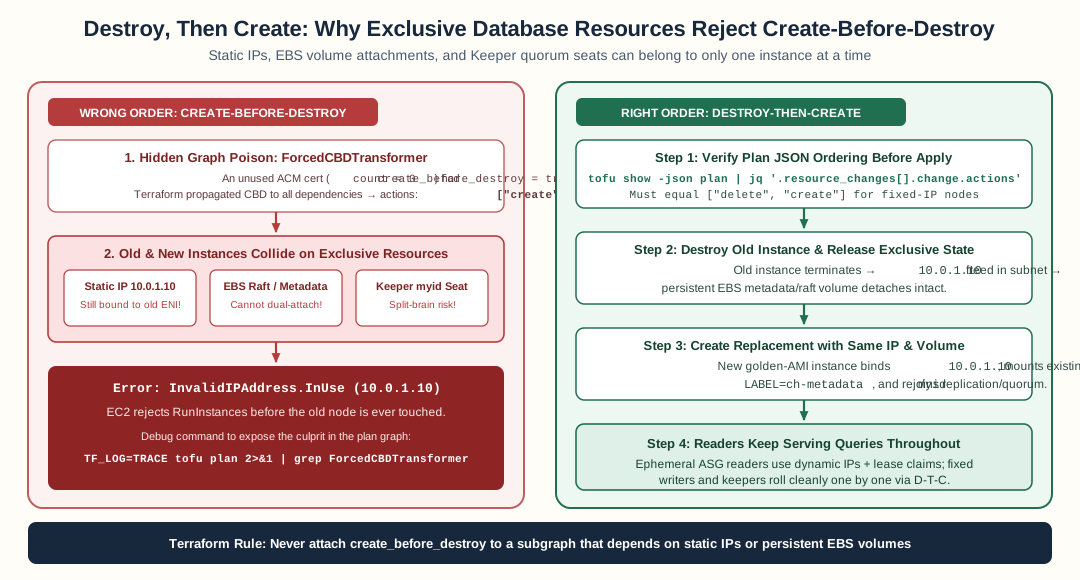
Exclusive resources (static private IPs, persistent EBS volumes, and Keeper myid quorum seats) cannot belong to two instances simultaneously; Terraform’s ForcedCBDTransformer must not flip their replacement actions from ["delete","create"] to ["create","delete"].
First, why these nodes are different from the average web server.
In a self-managed ClickHouse cluster on EC2, the writer and the keepers
are fixed-identity machines. Each one gets a static private IP
carved out of the node subnet — the writer at 10.0.1.10, the first
keeper at 10.0.1.20. The address is not a convenience. It is wired
into everything:
- DNS — Route 53 private-zone A records map
writer-0to the address; the cluster’sremote_serversconfig resolves peers by name into those records. - Replication — nodes fetch parts from each other over the interserver port at those addresses.
- Coordination — ClickHouse Keeper, the ZooKeeper-compatible coordination service, runs a raft configuration whose members address each other by exactly these names.
- Volume identity — each node’s EBS volumes (the S3 metadata catalog for the writer, the raft log for the keeper) reattach to whatever instance claims the static identity after a swap.
So an image roll means: destroy the old instance, and create its successor at the same address, with the same volumes, taking over the same name. The stack even documents the discipline, in a comment:
# NOTE: replacements are destroy-then-create (no create_before_destroy):
# the static private_ip cannot be bound while the old instance holds it,
# so CBD would always fail with InvalidIPAddress.InUse.
resource "aws_instance" "writer" {
  # ...
  private_ip = local.writer_ips[count.index]
}
That comment had been true for months. Then one day the plan quietly stopped honoring it.
The tell is in the plan JSON
After the first failed apply, I did what the error suggested: waited, retried. Second apply, same error. The old instances were still running, still holding their addresses — both failed applies had created nothing and destroyed nothing, which was the first real clue: Terraform was trying to make the new nodes before retiring the old ones.
You can see replacement ordering explicitly in the plan’s JSON form. Save a plan and inspect it:
$ tofu plan -out=roll.tfplan
$ tofu show -json roll.tfplan | jq -r '.resource_changes[]
    | select(.address | contains("aws_instance"))
    | "\(.address) \(.change.actions)"'
module.compute.aws_instance.writer[0]  ["create","delete"]
module.compute.aws_instance.keeper[0]  ["create","delete"]
That array is the ordering. Two actions, two possible sequences:
| Actions array | Ordering | Meaning |
|---|---|---|
["delete","create"] |
destroy-then-create | default; old node dies, then the replacement is made |
["create","delete"] |
create-before-destroy | the replacement is made first, then the old node dies |
My instances — the ones whose config said “no create_before_destroy”
— were planning ["create","delete"]. The writer and keeper had been
silently upgraded to CBD, and every apply was dying on the one
guaranteed consequence of it: two instances contending for one IP.
The plan doesn’t print why. For that, you go to the trace log.
The transformer that decides, in its own words
Terraform’s plan phase builds a graph of every resource and edge, then
runs a series of transformers over it. One of them exists purely to
decide this question. From
internal/tofu/transform_destroy_cbd.go
(same file in Terraform
itself):
// ForcedCBDTransformer detects when a particular CBD-able graph node has
// dependencies with another that has create_before_destroy set that require
// it to be forced on, and forces it on.
func (t *ForcedCBDTransformer) Transform(_ context.Context, g *Graph) error {
	for _, v := range g.Vertices() {
		// ...
		if !dn.CreateBeforeDestroy() {
			// If there are no CBD descendent (dependent nodes), then we
			// do nothing here.
			if !t.hasCBDDescendent(g, v) {
				continue
			}
			// ... we need to auto-upgrade this node to CBD.
			if err := dn.ModifyCreateBeforeDestroy(true); err != nil {
Read the shape of that walk: for every node, look at everything that depends on it (the code calls them descendants). If any descendant is CBD, flip this node to CBD too. And the reason is not a heuristic about what’s safer — it’s graph theory. If node B depends on node A, B’s replacement cannot be created before A’s while also being destroyed after A’s — mixed orderings between a node and its dependencies produce cycles. The transformer’s cure for the cycle is to make the flag uniform across the chain.
The official lifecycle
reference
says the same thing in one sentence, in a section literally titled
“create_before_destroy and resource dependencies”:
Terraform propagates and applies
create_before_destroybehavior to all resource dependencies.
Now run the plan with the trace enabled and let the transformer confess:
$ TF_LOG=TRACE tofu plan -out=roll.tfplan 2>&1 | grep ForcedCBD
... ForcedCBDTransformer: "module.compute.aws_instance.writer (expand)"
    has CBD descendent "module.dns_tls.aws_acm_certificate.nlb (expand)"
... ForcedCBDTransformer: forcing create_before_destroy on for
    "module.compute.aws_instance.writer (expand)"
... ForcedCBDTransformer: "module.compute.aws_instance.keeper (expand)"
    has CBD descendent "module.compute.aws_volume_attachment.keeper_raft (expand)"
... ForcedCBDTransformer: forcing create_before_destroy on for
    "module.compute.aws_instance.keeper (expand)"
Two different descendants, two different vectors, one broken roll.
Vector one: a certificate that wasn’t even there
The writer’s CBD descendant was an ACM certificate:
resource "aws_acm_certificate" "nlb" {
  count = var.nlb_tls_mode == "acm" && var.acm_certificate_arn == null ? 1 : 0
  # ...
  lifecycle {
    create_before_destroy = true
  }
}
Look at that count. In this cluster’s current mode, a pre-provisioned
certificate ARN is passed in, so the expression evaluates to zero. The
certificate does not exist. No ACM resource is created, renewed, or
destroyed by any apply.
It doesn’t matter. The plan graph contains the expand node for
count = 0 resources — the node exists, carrying its lifecycle flag,
with edges to the rest of the stack. The transformer walks it, sees CBD
on it, and everything upstream — through the DNS/TLS module, through
the load balancer records, all the way to the database instance — gets
“auto-upgraded” to a replacement ordering that cannot work.
That’s the part I’d gotten wrong for months of reading that lifecycle block: I evaluated it as runtime config. It’s graph config. A flag you never “use” still gets a vote.
Vector two: the volume that must not be in two places
The keeper’s descendant was its own raft volume attachment:
resource "aws_volume_attachment" "keeper_raft" {
  device_name = "/dev/sdf"
  volume_id   = aws_ebs_volume.keeper_raft[count.index].id
  instance_id = aws_instance.keeper[count.index].id
}
This one has no lifecycle block at all — which meant it inherited a
provider default of create-before-destroy (sensible for the AWS
provider’s own reasons), and the transformer enforced the same
uniformity upward: an attachment being CBD implies the keeper instance
is CBD.
Here the domain stakes are the clearest, because an EBS volume is the
definition of an exclusive resource. A volume may briefly be attached
to no one — that’s a normal moment during a node swap. It may never
be attached to two instances; the API will not allow it, and even if
it did, two writers on one raft log is the definition of split-brain.
The keeper’s whole identity — its server_id, its log entries, the
raft term history — lives on that volume
(the myid file,
then the log itself). The only sane choreography is:
- detach the volume from the old keeper,
- destroy the old keeper (releasing its IP and its quorum seat),
- create the new keeper at the same IP,
- attach the volume — identity rides the disk into the new instance.
Each of those steps must strictly follow the previous one. That is destroy-then-create, four times in a row.
The fix is subtraction
Here’s the part that makes this a good story: both bugs were removed lines.
For the ACM certificate, the flag went away entirely. Certificates are ARN-addressed — a replacement has no name collision to avoid, so there is nothing CBD is for there:
resource "aws_acm_certificate" "nlb" {
  count = var.nlb_tls_mode == "acm" && var.acm_certificate_arn == null ? 1 : 0
  # ...
  # NO create_before_destroy here, deliberately: the ForcedCBDTransformer
  # propagates the flag to every transitive dependency, and this node's
  # flag poisons the graph even when count = 0.
}
For the attachments, the fix was the explicit negative:
resource "aws_volume_attachment" "keeper_raft" {
  # ...
  lifecycle {
    create_before_destroy = false
  }
}
And for the writer there was a third, sneakier subtraction. Somewhere in the stack the instance block carried:
depends_on = [aws_lb.writers]
The load balancer in front of the writers is legitimately CBD — it’s
renamed per generation to dodge the region-unique name collision, the
classic pattern the lifecycle docs recommend CBD for. But depends_on
is an edge, and an edge is all the transformer needs: writer depends on
LB, LB is CBD, therefore writer is CBD. The edge had been added years
back for a greenfield-ordering concern that had long since been
solved another way (target registration goes through the static IPs,
not the instance IDs). Deleting the depends_on removed the last edge
the poison could travel on.
After the three changes:
$ tofu plan -out=roll.tfplan
$ tofu show -json roll.tfplan | jq -r '.resource_changes[]
    | select(.address | contains("aws_instance"))
    | "\(.address) \(.change.actions)"'
module.compute.aws_instance.writer[0]  ["delete","create"]
module.compute.aws_instance.keeper[0]  ["delete","create"]
["delete","create"]. The apply rolled: attachments detached and
destroyed, both instances destroyed, both replacements created at
their addresses on the first attempt, volumes reattached, keeper
rejoined its own raft log, writer re-registered under its existing
replica name. No address contention, because contention had become
impossible.
flowchart TB
    subgraph DTC["destroy-then-create (what the data plane needs)"]
        direction LR
        D1["1. detach volumes<br/>destroy old instance<br/>(IP + quorum seat released)"] --> C1["2. create new instance<br/>binds the same IP<br/>cleanly"]
        C1 --> A1["3. reattach volumes<br/>identity rides the disk"]
    end
    subgraph CBD["create-before-destroy (what the graph demanded)"]
        direction LR
        C2["1. create new instance<br/>at the same IP..."] --> X["InvalidIPAddress.InUse<br/>the old node still holds it"]
        C2 -.->|"impossible"| D2["2. destroy old instance"]
    end
    DTC ~~~ CBD
    style X fill:#f8d7da,stroke:#721c24
    style C1 fill:#d4edda,stroke:#155724
Why ClickHouse makes you care
None of this is ClickHouse-specific — any quorum member, any static-IP service, any reattachable volume hits the same wall. But ClickHouse concentrates all three exclusivities into one replacement window:
- The address is identity. Everything from
remote_serversto the keeper’s raft configuration resolves the node by its address. An address held by two instances during a swap isn’t downtime; it’s ambiguous identity, which is how you get parts fetched from a node that believes it’s someone else. - The volume is memory. The raft log is the keeper’s continuity — its term history, its membership. The myid file on it pins the server ID; a keeper that boots with the right disk is the same member it always was, and a keeper that boots without it is a stranger the ensemble will refuse to re-admit.
- The quorum seat is shared state. Replace a keeper in a three-node ensemble with CBD and for the duration you have four members; replace it D-T-C and you briefly have two — under quorum, by design, for seconds, the way every rolling restart of every distributed system works.
So the “default” ordering — destroy, then create — isn’t a fallback you tolerate. For this class of resource it’s the specification, and the graph’s job is to keep from overriding it.
A checklist for the next static-IP rollout
- Read ordering, not just actions. When a plan says
must be
replaced
for anything with an exclusive resource inside it, check the JSON’s actions array.["create","delete"]on a fixed-address node is a stopped-clock finding. - Give CBD a job description. The flag earns its keep exactly when the old and new object must briefly coexist to hand off something the platform tracks — name-based DNS cutover, a load balancer’s target list. It has no business on resources that are themselves exclusive.
- Audit
depends_onlike it’s a security group rule. Every edge is a path the transformer can propagate flags along. Edges added for ordering reasons years ago are the usual culprits. - Remember
count = 0is notabsent. The node is in the graph; its flags vote. If a mode toggle disables a resource entirely, ask whether its lifecycle block should be behind the same toggle. - When confused, read the engine’s trace.
TF_LOG=TRACEon a plan costs minutes and prints the transformer’s decisions with each descendant named. It is the most underused debugging tool in the Terraform ecosystem. - Let failed CBD applies teach you. The failure mode is clean: creates fail, destroys never run, old nodes keep serving. That’s why this story ends well — the data plane was never actually at risk, only the rollout was. Fix the graph, re-plan, re-apply.
Destroy, then create. For exclusive resources it’s not the default because it’s easy — it’s the default because it’s the only sequence the resources themselves will permit. The graph is powerful; the data plane is honest; and every so often the two of them disagree in a log line that names exactly where.
Related in this series: why replica identity must survive instance replacement, what a config re-render can silently re-key, and treating the boot sequence as a contract.
FAQ
Why can't a static-IP instance be created before its predecessor is destroyed?
A private IP address is an exclusive resource: the subnet cannot bind it to two network interfaces at once. Create-before-destroy asks the cloud API to run the replacement's RunInstances call while the old instance still holds the address, and the API rejects it with InvalidIPAddress.InUse. Destroy-then-create releases the address first, so the replacement binds it cleanly.
How does a create_before_destroy flag on one resource affect another?
Terraform's plan graph runs a ForcedCBDTransformer: when any node that can create-before-destroy has ancestors in the dependency graph, the transformer flips those ancestors to create-before-destroy too, because mixed ordering between a node and its dependencies would create graph cycles. The official lifecycle reference states it plainly: create_before_destroy is propagated to all resource dependencies.
How do you check replacement ordering before applying?
Export the plan with tofu plan -out and read the JSON: tofu show -json gives each resource change an actions array. Replace ordered destroy-then-create reads ["delete","create"]; create-before-destroy reads ["create","delete"]. When the order surprises you, TF_LOG=TRACE on the plan prints the ForcedCBDTransformer's decisions verbatim, naming the descendant that forced each flip.
Why is replacement ordering a bigger deal for ClickHouse than for stateless services?
Three exclusive resources are in play at once: the static IP that replication and DNS key on, the EBS volumes holding the metadata catalog and the Keeper raft log, and the Keeper quorum seat itself. A volume can briefly be attached to no one but never to two instances; a Keeper ensemble loses quorum for the replacement window; and the replica identity that data is filed under must move with the volume, not be re-derived. Destroy-then-create is the only ordering that respects all three constraints.
Stay in the loop — production notes on AI agents, workflows, and SRE.
Low volume — new posts and curated reading lists. Unsubscribe anytime.