A Field Map of ClickHouse Storage: Disks, Object Stores, and Metadata in the Source
ClickHouse on AWS: Self-Managed from First Principles · Part 15
Two posts ago I wrote about the config element that parses, validates, and does
nothing: <key_prefix> on an Amazon Simple Storage Service (S3) disk, silently ignored, every tenant’s parts
landing in the bucket root under flat three-character prefixes. I fixed it by
reading the bucket, not the docs. That fix worked, but I was left with a
question I didn’t have a clean answer to: if key_prefix isn’t real, what
exactly are the fields ClickHouse’s storage configuration accepts — and how
does the server turn the <disks> section into something it can read and
write?
So this time I read the registry itself. Not the documentation pages, the
actual registration code, at
commit bb6fa8b5d156
of the ClickHouse source. My fleet runs 26.8.36.3 and every behavior cited here
matches what it does live; the links below are pinned to the master tree I
read, and where the two could diverge I say so.
The result is a much smaller system than the documentation implies. Four
families get registered. Everything else — s3, web, hdfs,
azure_blob_storage, s3_plain, the lot — is an alias. And the mystery of the
flat bucket-root keys turns out to be, literally, a one-line default template
in the source: [a-z]{3}/[a-z]{29}.
Key takeaways
- Start a ClickHouse server and the disk registry contains exactly three
unconditional families: local, cache, object-storage — plus
encryptedwhen built with Secure Sockets Layer (SSL). Every other disk name is a compatibility alias of the object-storage family. - A “disk” in the config is really three choices stacked: a wrapper chain
(
cache,encrypted), an object storage type (S3, Azure, Hadoop Distributed File System (HDFS), Web, local blob storage), and a metadata storage type (Local, Plain, PlainRewritable, Keeper). The legacy aliases imply a metadata type for free. - The default S3 key layout is
[a-z]{3}/[a-z]{29}appended to whatever survived the uniform resource locator (URL) parsing. The bucket-root 3-character directories from the previous post are this template with an empty prefix.key_prefixis never read;endpoint_subpathandkey_templateare. perform_ttl_move_on_insertdefaults to true — my tiered policy’sfalseon the cold volume is load-bearing.move_factordefaults to 0.1 but only exists when a policy has more than one volume, and it gates only the disk-pressure move, never the time-to-live (TTL) move.- Zero-copy replication is still not a viable escape from per-replica S3 prefixes: the capability flag exists, the gate that would use it defaults to false and is documented upstream as “not ready.”
The registry is smaller than the docs suggest
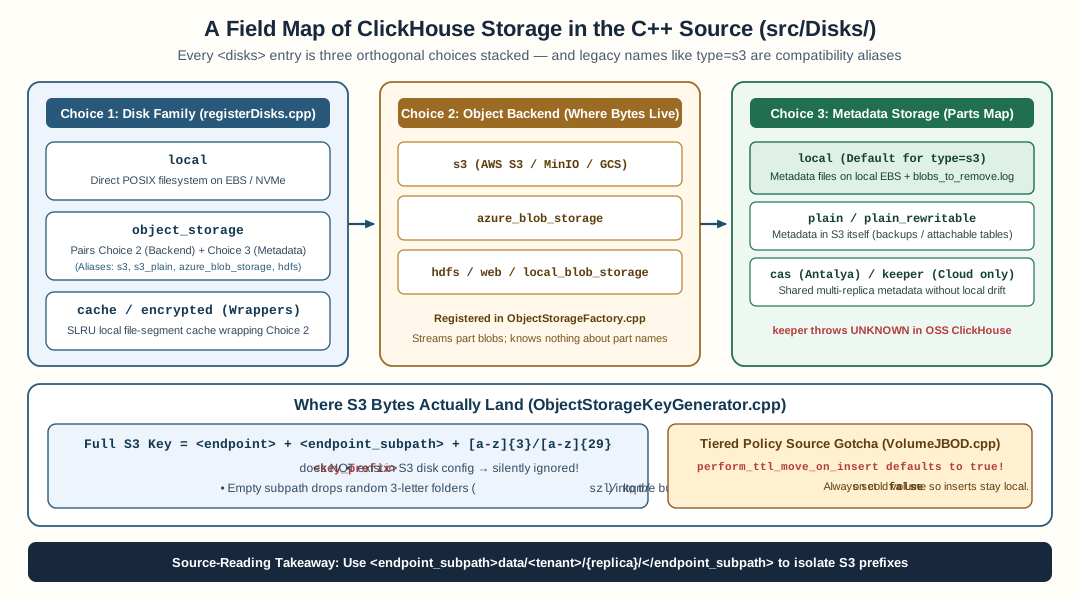
Every ClickHouse <disks> definition stacks three orthogonal choices — Disk Family, Object Backend, and Metadata Storage — while S3 object keys expand from <endpoint> + <endpoint_subpath> + [a-z]{3}/[a-z]{29}.
Everything starts in
src/Disks/registerDisks.cpp.
At server startup the disk factory is populated by exactly four calls: local,
cache, object-storage, and — behind an #if USE_SSL — encrypted.
Web, HDFS, and Azure are not separate families;
they enter the world as object-storage backends registered inside the same
factory that knows s3.
When the server walks
<storage_configuration><disks>,
each child element is checked for one thing hard: the disk name must be
alphanumeric plus underscore. Everything else about the disk is deferred to
DiskFactory::create,
which reads <type> and looks it up in the registry — with local as the
default, which is why my <default> disk entry consisting of nothing but
<keep_free_space_bytes> is a plain DiskLocal without saying so. An unknown
type throws:
DiskFactory: the disk '...' has unknown disk type: ...
An unknown child element throws nothing, ever — the factory only reads the
keys it knows about, and nothing enumerates what it didn’t read. That silence
is precisely the hole key_prefix fell through two posts ago.
A disk is three choices, not one
The actual classification lives in one header,
src/Disks/DiskType.h:
ObjectStorageType:S3,Azure,HDFS,Web,Local— where the bytes go.MetadataStorageType:Local,Keeper,Plain,PlainRewritable,StaticWeb,WebIndex,Memory— where the list of parts goes.DataSourceType:Local,RAM,ObjectStorage— the coarse family.
And on top of any of these, two wrapper disks: cache and encrypted. So the
honest mental model:
flowchart LR
CFG["<disks><your_disk>"] --> T["<type> lookup in DiskFactory"]
T -->|type = local| L["DiskLocal<br/>plain filesystem"]
T -->|type = cache / encrypted| W["wrapper"]
T -->|type = object_storage<br/>or an alias| OS["DiskObjectStorage"]
W -->|wraps| L
W -->|wraps| OS
OS --> OST["<object_storage_type><br/>s3 / azure_blob_storage / hdfs /<br/>web / local"]
OS --> MST["<metadata_type><br/>local / plain / plain_rewritable /<br/>web / keeper(Cloud only)"]
OST --> K["object keys = template<br/>under the URI key"]
A local disk is one choice. An object-storage disk is two. A wrapper is a disk
plus a chain. That’s the whole classification — and the config grammar in the
source makes it explicit: the canonical form registered in
RegisterDiskObjectStorage.cpp
is
disk(type = object_storage, object_storage_type = s3, metadata_type = local, endpoint = '...')
object_storage_type and metadata_type are real, orthogonal config elements.
The familiar names are shortcuts.
The aliases: why your s3 disk is secretly object_storage
Here’s a detail I got wrong in my head for a long time. The registration block
at
RegisterDiskObjectStorage.cpp#L126-L165
registers s3, s3_plain, s3_with_keeper, s3_plain_rewritable, hdfs,
azure_blob_storage, local_blob_storage, and web as separate disk type
names — but every single one points at the same creator lambda as
object_storage. Each alias exists so that two resolution steps can be
short-circuited:
-
Backend resolution. In
ObjectStorageFactory::create,<object_storage_type>wins if present, otherwise<type>is re-read. Yourtype = s3inside a disk section therefore does double duty: it picks the object-storage creator at the top level, and the same string picks the S3 backend inside it. -
Metadata inference. If the config omits
<metadata_type>entirely,RegisterDiskObjectStorage.cpp#L82-L98derives a hint by substrings: a type containingwith_keeperhintskeeper, something containingplainandrewritablehintsplain_rewritable,plainhintsplain. Anything else falls through to asking the object storage type: S3, HDFS, local, or Azure answerlocal; Web answersweb.
So the shorthand names map to the real matrix like this:
| you write | object storage | metadata (inferred) |
|---|---|---|
s3 |
S3 | local |
s3_plain |
S3 | plain |
s3_plain_rewritable |
S3 | plain_rewritable |
s3_with_keeper |
S3 | keeper — Cloud-only |
azure_blob_storage |
Azure | local |
hdfs |
HDFS | local (endpoint must end in / — enforced, throw otherwise) |
web |
Web | web (read-only static site of parts) |
local_blob_storage |
Local | local |
The s3_with_keeper row is worth pausing on. Its registration
description
says it outright: the keeper metadata storage is registered only in
ClickHouse Cloud builds — the registration is behind
#if CLICKHOUSE_CLOUD
— and an open-source server attempting it fails with
unknown metadata storage type: keeper (the factory’s
registry-miss throw).
If you’ve ever wondered why self-managed ClickHouse can’t keep S3 disk
metadata in the Keeper it already runs: the answer is that the code path is
compiled out of the open-source build. My Keeper member is load-bearing for
replicated-table state, but the disk metadata lives on Elastic Block Store (EBS) next to the
parts, exactly as the matrix predicts.
One more silent-empty-prefix incident in the same family — different backend:
the Azure factory carries
a comment
confessing that getCommonKeyPrefix() “was not implemented previously by
mistake and was always returning an empty string,” so every
azure-with-keeper instance shared one root path until a
common_key_prefix_for_azure escape hatch was added. Silent empty prefixes
bugging people is apparently a genre.
Where the bytes actually land: uniform resource identifier (URI) key plus one-line default template
For an S3 disk, the object key starts from the URL. The factory builds it in
getS3URI:
it reads endpoint, macro-expands endpoint_subpath, joins them, and then
enforces one thing — the key must end in / — appending the slash if you
forgot. Whatever survives that is uri.key. That is the only path element
S3 disks have; key_prefix is never in the read list.
The key generator then comes from
DiskS3Utils.cpp#L18-L52
and it has exactly three branches:
key_templateset → template generator, and a hard error if the URI key is non-empty (the two are mutually exclusive by design).key_compatibility_prefixwithoutkey_template→ hard error.- Neither →
createObjectStorageKeyGeneratorByPrefix(uri.key).
And that third branch lands in
src/Common/ObjectStorageKeyGenerator.cpp#L36-L40:
ObjectStorageKeyGeneratorPtr createObjectStorageKeyGeneratorByPrefix(String key_prefix)
{
    return std::make_shared<GeneratorWithTemplate>(std::filesystem::path(RE2::QuoteMeta(key_prefix)) / "[a-z]{3}/[a-z]{29}");
}
There it is. The flat bucket-root layout from the previous post was never a
mystery at the storage layer — it’s this default template, with an empty
prefix. <uri.key><3 random chars>/<29 random chars>, one directory per part.
With my old broken config the URI key was empty, so parts landed at the root
as abc/defghij... exactly, and with the fixed config the URI key is
data/<tenant>/{replica}/, so they land at
data/tenant_a/writer-0/abc/defghij.... Same template, different prefix. When
I listed the bucket and saw two-then-three-character directories, I was
looking at this regex rendered in S3.
Two macro notes, both confirmed in the source:
endpoint_subpathgoes through the standard macro expansion, which is how{replica}resolves per node frommacros.xmlin my fleet.key_templateexpands macros too, but through a restricted expansion mode (special macros +{replica}only,info.ignore_unknown = true).
The metadata half: where the parts list lives
If the object storage is where bytes live, the metadata storage is what the
server believes lives there. Four registered types in the open-source tree
(local, plain, plain_rewritable, plus the Cloud-only keeper; web and
web_index round out the
registry):
-
local(the default for S3 disks, via the hint above) — the parts list is a smallDiskLocalnext to your data (default path:<ch-data>/disks/<disk-name>/). It’s also where the crash-safety story for S3 deletes lives: blobs pending removal are journaled to.metadata/blobs_to_remove.logon that local disk, so a server between “metadata says deleted” and “S3 object deleted” resumes the deletion queue on boot instead of orphaning. This is a concrete reason the metadata EBS volume on my writer isdelete_on_termination=false— it is the disk’s state. -
plain— the bucket is the filesystem. The class comment says it plainly: object storage is used as a filesystem “in a limited form — no directory concept, files only… no move… excessive application programming interface (API) calls,” intended so BACKUP/RESTORE works against the same structure as on-disk MergeTree. Mostly read-only in practice. -
plain_rewritable— same idea, but with rewrite transactions and snapshots (and a toggle for the hard links that make metadata unreadable to servers older than 26.10). This is the direction the whole “metadata in object storage” project is heading for open source. -
keeper— Cloud-only, as covered above; in a non-Cloud build the name resolves to the registry-miss throw.
One honest update to an earlier post in this series: my Content-Addressed Storage (CAS) post speculated about content-addressable
metadata as the future. In this tree there is no CAS metadata type
registered yet — the names above are the entire registry. When the
content-addressable work lands, it will appear as exactly one more
registerMetadataStorageType call in this factory, and I’ll write the
follow-up from that diff.
Wrappers: cache and encrypted
The cache wrapper is registered in
RegisterDiskCache.cpp#L164-L167
with one hard constraint, enforced with a throw:
cached disk is allowed only on top of object
storage.
You can’t put a cache wrapper on a plain local disk — it would be a cache of
itself.
The knobs come from FileCacheSettings, loaded straight out of the cache
disk’s own section:
max_sizeormax_size_ratio_to_total_space— and the validation requires exactly one of the two: both unset throws, both set throws.max_elements, default 10,000,000 file segments — this is the per-file overhead bound that matters more than bytes once parts get small.- eviction policy, default Segmented Least Recently Used (SLRU) with
slru_size_ratio0.6 (protected segment vs probationary). My earlier comment in our storage.xml claiming “26.8 default policy SLRU” was correct; this is the line that says so. cache_on_write_operations— write-through. Ours3_cachesets this true because TTL-moved parts are uploaded through the wrapper and I don’t want the first query after a move to re-download from S3; the SLRU eviction then ages never-read bytes out naturally.
The encrypted wrapper is the other half of the same idea, registered in
DiskEncrypted.cpp#L636-L639:
wrap any disk, transparently encrypt on the way down. The default algorithm is
AES_128_CTR.
I don’t run it — my cluster’s at-rest story is S3 server-side encryption (SSE) — but it matters for the
classification because it means wrapper chains compose: cache over
encrypted over S3 is a legal stack, with the cache seeing plaintext.
Policies tie the matrix to tables
Disks on their own do nothing for a table; storage policies bind volumes of disks into tiers, and this is where the source settles three defaults I’d been treating as folklore.
Priority validation is strict. If any volume in a policy sets
volume_priority, then
all must be unique and cover exactly 1..N with no gaps
— the exact “26.8 validates” behavior one of my config comments asserts.
Leaving priorities out is fine; setting one of three is an error.
perform_ttl_move_on_insert defaults to true.
VolumeJBOD.cpp#L80
is the line. This is the load-bearing setting in my tiered policy: with the
default, a table with a TTL ... TO VOLUME cold would try to reserve space in
S3 during the insert itself and make every insert wait on a move; the
cold volume’s explicit false is what keeps inserts local-only. The
prefer_not_to_merge knob on the same volume defaults to false and only
discourages (never forbids) merges — the user override wins, which the class
makes explicit via its atomics.
move_factor gates pressure moves only. The default is
0.1 when the policy has more than one volume, 0 otherwise
— and the trigger in
MergeTreePartsMover.cpp#L129-L145
is unreserved_space < total_space * move_factor per disk. Read that twice,
because for my cluster it flips a naive reading: move_factor is the
disk-pressure escape hatch, not the TTL scheduler. The same mover run
short-circuits to TTL-rule-only when there’s no pressure: if nothing needs to
move and the table has
no move TTLs,
it returns immediately. TTL moves fire on their own schedule through
getDestinationForMoveTTL,
resolving TO VOLUME <name> / TO DISK <name> against the policy
independently of how full the hot disk is. In my setup both run — pressure
moves at 10% free space, TTL moves of merged parts to s3_cache/s3 — and
inserts only ever
block
if the destination volume says perform_ttl_move_on_insert, which mine
never does.
(One adjacent knob worth a sentence: max_data_part_size_bytes and
max_data_part_size_ratio are also
mutually exclusive at parse time,
same pattern as the cache size pair. ClickHouse has a consistent taste for
“exactly one of these two sizes.”).
Zero-copy, one paragraph, for completeness
Since the previous post leaned on zero-copy deprecation to justify
per-replica prefixes, here’s the source-truth version. DiskObjectStorage
reports
supportZeroCopyReplication() == true as long as its metadata is not
Keeper or Memory — so the capability flag survives. But the only consumer
gates on
allow_remote_fs_zero_copy_replication,
which defaults to false and carries this documentation, in full:
Don’t use this setting in production, because it is not ready.
Per-replica prefixes with physical re-copying remains the designed path for
open source. My endpoint_subpaths stay.
How my fleet maps onto the taxonomy
Because this series exists to keep an actual cluster honest, here is the
<disks> section I run, expressed in the registry’s terms — this table is the
compressed version of DATA_STORAGE.md
in the infra repo (private kitchensink monorepo, clickhouse/aws/docs/):
| config name | written as | = in registry terms |
|---|---|---|
default |
<default> + keep_free_space_bytes |
DiskLocal (type defaults to local) |
s3 |
type=s3, endpoint_subpath=…tiered/{replica}/ |
S3 object storage + metadata_type=local (inferred) |
s3_cache |
type=cache, disk=s3, max_size=…, cache_on_write_operations=true |
cache wrapper over S3 disk, SLRU 0.6 by default |
disk_<tenant> |
type=s3, endpoint_subpath=data/<tenant>/{replica}/ |
S3 + local metadata, one disk per tenant |
cache_<tenant> |
type=cache, disk=disk_<tenant> |
per-tenant cache wrapper, isolated eviction domains |
None of my s3 disks set key_template, so every one of them writes
<endpoint_subpath> + <3 chars>/<29 chars>. The template is doing the
per-part sharding for me as a free default, correctly, under the prefix I now
control.
What I’d tell the next person
- Read the registry before the docs. The registration files are the only
complete list of what a config section can contain. Documentation pages
lag;
Documentation{...}structs in the source are written by the people who compiled the flags. - Silence in disk config is a design position, not an accident. Unknown child elements are skipped because the reader only enumerates what it needs. If an element you set doesn’t appear inside the server, it’s not being parsed, full stop. The bucket is the witness.
- The 3-character directories are normal. If you see flat
three-character directories at your bucket root, that’s the default key
template with an empty URI key — look at your
endpoint/endpoint_subpath, not for a hidden prefix option. - Defaults I verified that you’ll likely want to override on a tiered
policy:
perform_ttl_move_on_insert(default true — set false on the cold volume), and know thatmove_factorgoverns only the pressure move. - Aliases are fine to write, and their implied metadata type is exactly
what you’d guess from the name — but writing the canonical
object_storage + object_storage_type + metadata_typeform when you’re scripting fleet config with chctl makes the rendered config self-describing, which pays for itself the first time you diff it.
Every link in this post is a permalink into the ClickHouse source at commit
bb6fa8b5d156. If a future post contradicts one of them, the diff will say
why — that’s the entire point of pinning them.
FAQ
How does ClickHouse classify disk types internally?
Three orthogonal choices. Family: local filesystem disk, object-storage disk, or wrapper (cache, encrypted). For object-storage disks, two more: the object storage backend (S3, Azure, HDFS, Web, Local blob storage) and the metadata storage (Local, Plain, PlainRewritable, Keeper — the last is Cloud-only). The names you write in the disks section of storage configuration are compatibility aliases resolved by two factories, DiskFactory and ObjectStorageFactory, whose registries are filled at startup from four register calls.
Where do the flat 3-character prefixes in an S3 bucket root come from?
The default object key template. When an S3 disk has no key_template, ClickHouse derives a key generator from the URI key — whatever survived endpoint and endpoint_subpath — and appends the template [a-z]{3}/[a-z]{29}: one random 3-character directory, one 29-character part name. With an empty URI key (my old key_prefix bug), keys land at the bucket root. key_prefix itself is never read for S3 disks; the template lives in src/Common/ObjectStorageKeyGenerator.cpp.
What is the difference between s3, s3_plain, s3_plain_rewritable, and s3_with_keeper?
Same S3 object storage, different metadata storage. s3 uses metadata_type local (parts list on a local disk, with a blobs_to_remove.log journal for crash-free S3 deletes); s3_plain stores metadata in the bucket itself and is mostly read-only (backup/RESTORE); s3_plain_rewritable also lives in the bucket but supports rewrite transactions with snapshots; s3_with_keeper keeps metadata in Keeper and is registered only in ClickHouse Cloud builds — an open-source server throws unknown metadata storage type: keeper.
What is the default of perform_ttl_move_on_insert and why does it matter for tiered storage?
True. VolumeJBOD parses perform_ttl_move_on_insert with default true, so a table with a TTL TO VOLUME rule would block inserts on S3 moves unless you set it to false on the cold volume. move_factor alone never gates a TTL move: TTL rules fire on their own schedule via MergeTreePartsMover, while move_factor (default 0.1, applied only when the policy has more than one volume) drives the disk-pressure escape hatch.
What does a cache disk wrap, and what are its knobs?
Only object-storage disks — registering cache over a local disk throws 'cached disk is allowed only on top of object storage'. Knobs live in FileCacheSettings: exactly one of max_size or max_size_ratio_to_total_space (both or neither throws), max_elements (default 10,000,000 file segments), cache_policy (default SLRU with slru_size_ratio 0.6), and cache_on_write_operations for write-through.
Is zero-copy replication of S3 data a viable alternative to per-replica prefixes?
No, in open source. DiskObjectStorage reports supportZeroCopyReplication unless its metadata is Keeper or Memory, but the MergeTree gate allow_remote_fs_zero_copy_replication defaults to false and its own documentation reads 'Don't use this setting in production, because it is not ready.' That is upstream 26.8 as well; per-replica S3 prefixes with physical re-copying remain the designed path.
Stay in the loop — production notes on AI agents, workflows, and SRE.
Low volume — new posts and curated reading lists. Unsubscribe anytime.