Dissolving the Second Binary: How chinit Absorbed Its Own Companion CLI
ClickHouse on AWS: Self-Managed from First Principles · Part 18
Every tool that solves a hard problem grows a second tool to solve the first tool’s leftovers. chinit was no exception: alongside the bootstrapper we shipped a companion command-line interface (CLI) — built from the database operator’s own domain packages — that ran the cluster’s recurring operations. chinit booted the node; the CLI did the maintenance. Two binaries, one node.
This is the story of getting to one — dissolving the second binary into the first, the seam that made it safe, and the release-pipeline lessons that cost us two failed gates to learn. It is also a general argument: when the only caller of a tool is another tool you own, the process boundary is a liability. The pattern applies to any fleet where a daemon schedules jobs that do real work.
Two binaries, and where they actually touch
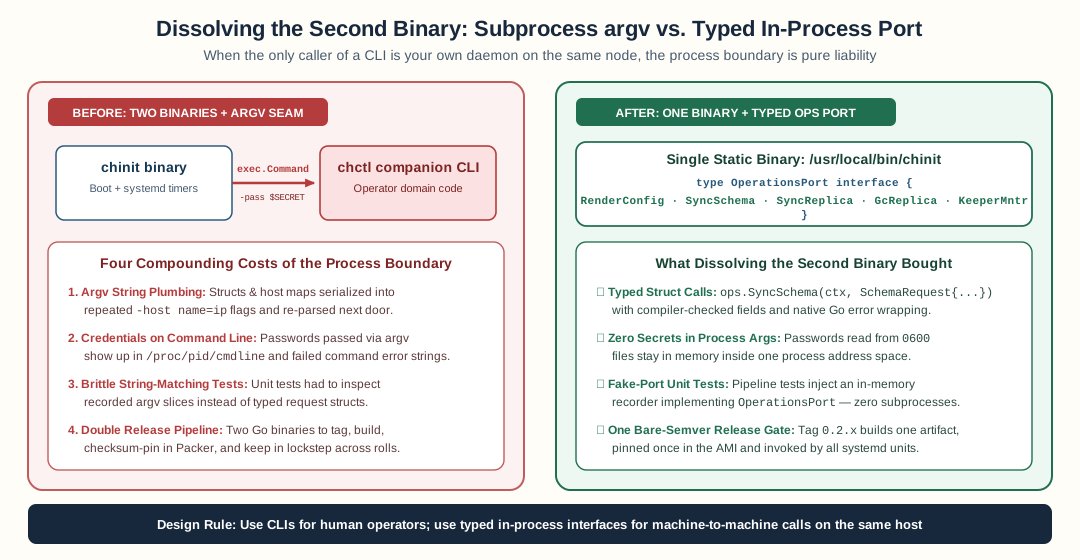
Dissolving the companion CLI into a typed in-process OperationsPort eliminated argv flag plumbing, command-line credential exposure, brittle string-matching tests, and a second release pipeline.
The companion CLI — chctl in our case — existed for good reasons. The cluster operations it carried (schema propagation, replica sync and cleanup, keeper health, configuration rendering) were the operator’s domain code, and a CLI was the fastest way to make that code callable from systemd units, shell scripts, and a terminal. Every recurring job became one ExecStart line:
chctl schema sync -spec ... -cluster ... -host name=address ...
The problem was never the CLI’s existence. It was the direction of the calls:
flowchart TB
    subgraph NODE["One node, two binaries"]
        CH["chinit<br/>boot + recurring units"]
        CC["companion CLI<br/>cluster operations"]
        DB[("ClickHouse")]
        K[("Keeper")]
        CH -- "exec argv<br/>(dash-flags, lists)" --> CC
        CH -- "exec argv" --> DB
        CC --> DB
        CC --> K
    end
    subgraph OUTER["Off-node release machinery"]
        R1["release pipeline A<br/>version pin + checksum"]
        R2["release pipeline B<br/>version pin + checksum"]
        IMG["golden image<br/>must carry BOTH"]
    end
    R1 --> IMG
    R2 --> IMG
    IMG --> CH
    IMG --> CC
    style CH fill:#2d5a27,color:#fff
    style CC fill:#5c1f1f,color:#fff
    style IMG fill:#1f3a5c,color:#fff
Four costs lived in that graph, each small and each compounding:
Argv plumbing. The typed inventory inside chinit — a list of
slot-to-address pairs — had to be flattened into repeated -host
flags for the CLI to parse it back into the same list. Lists,
credentials, patterns: everything crossed the boundary twice, once as
a string and once as a parse.
Credentials on the command line. The Structured Query Language (SQL) operations authenticate, and the password rode an argv flag — because that was the CLI’s only input channel. argv is the easiest place in a system to leak: error messages echo it, process listings show it.
Duplicated validation and error shapes. Flag validation at the CLI boundary, argument re-validation in the domain layer, and a combined output string back. Every error path formatted twice, with the invariants enforced in neither place authoritatively.
Two release pipelines. Two artifacts to version, tag, checksum, stage into the image, and version-gate. The image contract grew a second knob, the bootstrap grew a second download path, and every image build could ship a version mismatch nobody would notice until the calls crossed.
None of these kills a system. All of them tax every change — and the tax is paid in the least-tested medium on the node: string assembly.
The seam that made dissolution safe
The rewrite did not start with “delete the CLI.” It started with a seam — a typed interface over the operations the CLI exposed:
// The port: typed requests, no argv, no process.
type Ops interface {
    SyncSchema(ctx, SyncSchemaRequest) error
    SyncReplica(ctx, SyncReplicaRequest) error
    DropReplica(ctx, DropReplicaRequest) error
    GcReplica(ctx, GcReplicaRequest) (*GcResult, error)
    KeeperMntr(ctx, MntrRequest) (string, error)
    Health(ctx, HealthRequest) (*HealthReport, error)
}

// A request is data; credentials ride the struct, not a flag.
type ClusterRequest struct {
    ClusterName string
    SpecPath    string   // the CR spec the loader reads
    Hosts       []Host   // inventory: slot-to-address pairs
    Credentials Credentials
}
Production binds the real services over that interface — the same
operator domain packages the CLI had called, now linked directly.
Tests substitute a recorder implementing the same interface. The
subcommands’ systemd lines do not change at all: chinit schema-sync
is still what the timer runs. Only the interior changed, from exec to
call:
sequenceDiagram
    participant T as systemd timer
    participant C as chinit subcommand
    participant P as Ops port (in-process)
    participant D as domain services
    participant DB as ClickHouse
    T->>C: exec chinit schema-sync
    C->>C: load state file<br/>(settled identity)
    C->>P: SyncSchema(ctx, request)
    P->>D: typed request
    D->>DB: SQL over the domain client
    DB-->>D: result
    D-->>P: typed result / error
    P-->>C: error or success
    C-->>T: exit code (typed)
    Note over C,DB: One process. No argv, no<br/>credential on a command line,<br/>no second binary to version.
The interesting part is what the seam did to tests. The old suite
recorded argv — a fake runner captured
["replica","gc","-on","writer-0","-name-pattern","reader-*",...] and
asserted on dash-flag strings. Reverse-engineering a flag back into
intent is archaeology. The new fakes assert typed requests: “the
writer pass ran with these hosts excluded, this pattern, these
credentials.” The failure modes the fake simulates match production
exactly, because both implement the same interface.
That is the general argument, in one place: a process boundary is a contract you maintain. Maintain it for humans; do not maintain it for yourself. When the caller is your own binary on the same node, replace the boundary with an interface and keep the CLI only where a human still types.
The release pipeline: two failures that taught one lesson
Dissolving the binary halved the release surface, but getting the remaining release right broke twice in public, and both failures are worth keeping.
The releases build through standard Go release automation: a tag triggers the build, the build validates the tag against the checked-out commit, and the artifacts publish under the tag’s name. Our tags carried a prefix — the tool’s name, to namespace it away from the repository’s other releases. Two consecutive gates failed:
- The stripped form: a fix fed the release tool the tag without
the prefix so it would parse as a semantic version. The tool then
validated that a tag by that exact name existed against the
checked-out commit — it didn’t, and never would.
git tag v0.2.0
was not made against commit
. - The real form: pointing the tool back at the actual prefixed tag
fixed the commit check and failed the version parse instead.
failed to parse tag 'chinit-v0.2.0' as semver.
The working shape, which the tool’s own documentation states plainly:
the tag must both exist in the repository state (the commit check)
and parse as a semantic version (the parse check). A prefixed tag
cannot satisfy both, no matter which form you feed the tool. The fix
was to stop prefixing: bare v0.2.0 tags, one trigger, one consumer
of the artifact URL updated in lockstep.
flowchart LR
    subgraph T1["Attempt 1: stripped env"]
        A1[v0.2.0 fed to tool] --> X1["✗ commit check<br/>ref never exists"]
    end
    subgraph T2["Attempt 2: real tag"]
        A2[prefixed tag fed to tool] --> X2["✗ semver parse"]
    end
    subgraph OK["Working shape"]
        B1["bare v* tag"] --> B2["✓ exists against HEAD"]
        B1 --> B3["✓ parses as semver"]
        B2 --> B4["build + publish"]
        B3 --> B4
    end
    style X1 fill:#5c1f1f,color:#fff
    style X2 fill:#5c1f1f,color:#fff
    style B4 fill:#2d5a27,color:#fff
The transferable lessons from those two failures:
- Read the tool’s validation order before working around one error. Both errors named the same constraint from opposite sides; either failure alone invites a “clever” fix that guarantees the other.
- A naming convention is a release interface. The prefix existed for namespace hygiene; downstream consumers (image builds staging artifacts by URL) encode it. Changing the convention means changing every consumer in the same change set — ours was one URL template, and that is the small version of this lesson.
- Let the gate fail loudly. The failed gates produced no release, no artifacts, no half-state. A tag that fails its suite is worse than no tag — these binaries run as root on every node — and the pipeline enforced that correctly both times it failed.
The end state, and the rule it teaches
One binary. One release pipeline, one version gate, one place where a missing artifact means a broken image. The maintenance jobs are subcommands of the thing they maintain. Credentials ride typed structs, never argv. The only CLI left on the node is the one a human uses, and it calls the same interface the subcommands do.
The rule this arc left me with, worth more than either post:
A boundary between two things you own is not isolation; it is maintenance. Process boundaries, tag-prefix conventions, argv contracts — each is a promise you have to keep forever, and the only buyer is you. Delete the ones nobody else depends on.
The next post takes the identity question this arc kept deferring: what a node is called, and who decides, when the instance is ephemeral — the lease pattern that made a horizontally scaled fleet of stateful replicas possible.
Related in this series: why chinit exists, the boot sequence as a contract, and teaching an operator without Kubernetes.
FAQ
Why did chinit originally ship with a second binary?
The database's cluster operations — schema propagation, replica sync and cleanup, keeper health, config rendering — lived in an operator's Go packages, and the first port exposed them as a CLI: flag parsing, argv, one process per operation. chinit exec'd that CLI for its recurring jobs. It worked, but it kept two release pipelines, two version gates, an argv string boundary, and a place where credentials rode a command line.
What replaced the CLI boundary?
A typed operations port: an interface with methods like SyncSchema, DropReplica, GcReplica, KeeperMntr, Health — each taking a context and a request struct. Production binds the domain services in-process; tests substitute a recorder with the same interface. The subcommands' ExecStart lines stay identical; only the interior changed from exec to call.
What is the cost of keeping a process boundary for internal operations?
Four costs, each small and compounding: argv plumbing (inventory maps become dash-flags, lists become repeated args), credentials on the command line where error text echoes them, duplicated validation and error normalization at both ends of every invocation, and a second release artifact whose version must be pinned, staged, checksummed, and kept in sync with the first.
Why did the release pipeline break twice before working?
The release tooling validates the current tag against the checked-out commit and requires the tag to parse as a semantic version. A prefixed tag failed the semantic version check; a stripped version string failed the commit check because that ref never existed. The working shape: the tag must both exist in the repository state and parse as semver — bare version tags, one trigger, no rewriting.
When is a CLI the right boundary, and when is it not?
A CLI is right when the caller is a human or an untrusted context, when you want composability from a shell, or when the operations are exploratory. It is wrong when the only caller is your own binary on the same node: the process boundary buys isolation you do not need and costs a contract you must maintain. Machine-to-machine calls want types.
How do tests change when operations go in-process?
For the better. argv-recording fakes become interface fakes asserting typed requests — a test asserts the request struct (which hosts, which pattern, which credentials) instead of reverse-engineering a dash-flag string. The fake's failure modes match the real ones because both implement the same interface.
Stay in the loop — production notes on AI agents, workflows, and SRE.
Low volume — new posts and curated reading lists. Unsubscribe anytime.