Adopting the Pattern: A Migration Guide for Declarative Node Bootstrap and Lease Identity
ClickHouse on AWS: Self-Managed from First Principles · Part 20
This is the last post in the chinit arc, and it answers the question every reader of the first three has some version of: fine, but how would I do this on my fleet?
The arc so far: why one binary replaces the bash, why its companion CLI dissolved into typed in-process operations, and how lease identity reconciles stateful replicas with horizontal scaling groups. Each post defended one design. This one is the field manual: the staged order that worked, the traps that cost us live cutovers, what to leave behind, and how to know the pattern is finished taking over.
Everything here is cloud-neutral by construction — the bootstrapper’s provider factory is the portability layer, and the identity protocol needs only a store with conditional writes and a TTL, which every cloud and most on-prem stacks have.
The migration wants an order
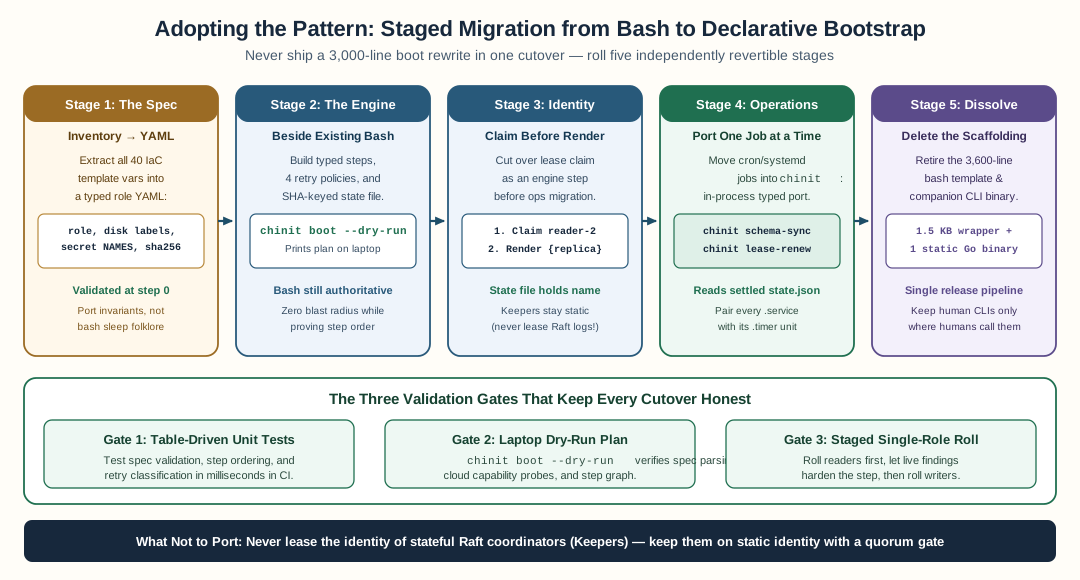
Migrate in five independently revertible stages — Spec, Engine alongside bash, Lease Identity before render, In-Process Operations, and Dissolve — gated by unit tests, --dry-run, and single-role rollouts.
A boot migration fails most often by attempting the whole thing at once — the three-thousand-line rewrite that ships with no stage verified against a real fleet. The order that worked for us had five stages, and each stage is independently revertible:
flowchart TB
    S0["Stage 0: INVENTORY<br/>every input the boot consumes<br/>every ordering that matters"] --> S1
    S1["Stage 1: THE SPEC<br/>YAML declaring intent:<br/>role, identity mode, disks,<br/>secret NAMES, bundle pin"] --> S2
    S2["Stage 2: THE ENGINE<br/>steps + retry policies +<br/>state file; bash still<br/>AUTHORITATIVE alongside"] --> S3
    S3["Stage 3: IDENTITY<br/>lease claim as a step;<br/>claim-before-render enforced"] --> S4
    S4["Stage 4: OPERATIONS<br/>recurring jobs become<br/>subcommands over a<br/>typed port - one at a time"]
    S4 --> DONE["Stage 5: DISSOLVE<br/>retire the bash and<br/>any second binary"]
    style S1 fill:#1f3a5c,color:#fff
    style S2 fill:#1f3a5c,color:#fff
    style S3 fill:#1f3a5c,color:#fff
    style S4 fill:#1f3a5c,color:#fff
    style DONE fill:#2d5a27,color:#fff
Stage 0 — inventory, and it is more than it sounds. Every variable the IaC tool interpolates into your script; every ordering constraint (“disks before service start”); every step that has ever needed a retry; every role difference. This inventory is the spec’s content and the pipeline’s step list — the migration’s real requirements gathering, and the bash era never wrote it down anywhere.
Stage 1 — the spec is the contract. Write the YAML that declares what the boot wants, not what it does: role, identity mode, disk labels, secret names, the config bundle and its checksum. Two rules that matter: secrets are references, never values, and validation happens once at load — malformed specs fail before any side effect.
Stage 2 — the engine, with bash still authoritative. Build the pipeline — steps with declared criticality, four named retry policies, the state file keyed to the bundle checksum — but run it beside the existing boot, not instead of it. This is the stage with the highest-value flag in the whole design: dry-run mode, which loads the spec, detects the cloud, and prints the plan without touching the machine. The dry-run validates the whole stack on a laptop, before any instance exists.
Stage 3 — identity, as a step. The lease claim becomes a pipeline step before any render, which is the enforcement mechanism for the pattern’s hardest constraint. Identity persists to the state file the moment it settles — not at pipeline completion — because every later step and subcommand reads it from there.
Stage 4 — operations, one subcommand at a time. Each recurring job becomes a subcommand calling through the typed port. Cut them over individually: schema propagation first (most exercised, clearest signal), then replica sync, then the garbage collector with its live-lease safety gate, then health. Each keeps its systemd line; only the interior changes.
Stage 5 — dissolve. Retire the bash. Retire the second binary if you grew one. The fleet rolls on the golden image, and the image is now the version gate: one binary, one pin, one checksum.
The three gates that keep the migration honest
At every stage, the same three gates, in escalating fidelity:
flowchart LR
    G1["Gate 1: unit tests<br/>spec validation,<br/>retry policies,<br/>state machine"] --> G2["Gate 2: dry-run<br/>spec load + cloud detect<br/>+ step plan,<br/>no instance needed"]
    G2 --> G3["Gate 3: staged roll<br/>real nodes, real churn,<br/>old path warm"]
    G3 --> FIND["production finding?"]
    FIND -- "yes - expect one per roll" --> G2
    FIND -- "no" --> NEXT["next stage"]
    style FIND fill:#5c1f1f,color:#fff
    style NEXT fill:#2d5a27,color:#fff
The loop at the bottom is the honest part: expect one production finding per roll. Our cutovers produced them like clockwork — identity rendered before it settled, a crash leaving an orphaned state, a fatal health gate wedging a boot loop, a peer selection hardcoded to a node that was itself being replaced. The pattern is not that a good design avoids findings; it is that a good design makes each finding a one-line fix in a typed step instead of a sed across three scripts. That difference — the cost of a lesson — is the actual argument for the whole migration.
The traps, from the field
Each of these cost us a live-cutover debugging cycle; none is obvious from the outside:
Porting the bash instead of the intent. The bash encodes folklore: sleeps that papered over race conditions, orderings that mattered for forgotten reasons. Write the spec from the invariants, not from the script. Where the bash’s behavior is inexplicable, the pipeline forces the choice into the open — and about half turn out to be bugs you are glad to leave behind. The other half are requirements nobody ever wrote down; put them in the spec’s comments, because they are the real documentation.
Identity as a convention instead of a step. The lease claim wants to live inside the pipeline, where claim-before-render is structural. As a convention (“call the claim script first”), it is one refactor away from violated — and the violation’s failure mode is the worst kind: an ephemeral identity baked into durable replication paths, invisible until the third replacement.
The health gate that must not be fatal. A boot that aborts on peer failure wedges a fleet roll: node boots mid-roll, peer is down, health fails, replacement replaces the node, the new node sees the same peer, loop. The gate is a warning — loud, logged, never blocking the boot-finished marker. This wants to be a declared property of the step, not a discipline in the code.
Crash semantics define the state file’s shape. The test that matters is not the clean boot; it is the node killed at step fourteen of twenty. Persist identity immediately; record each step on completion; invalidate all records when the bundle checksum changes. If you cannot answer “what does a re-run do after a crash at step N?” for every N, the state file is not done.
A second binary’s version pin is a distributed bug. Every extra artifact in the image is a version that can mismatch — and the mismatch surfaces at 3 a.m. as a call with a subtly wrong interface. Dissolve aggressively; keep a CLI only where a human types.
What not to port
Two deliberate exceptions, both from the hard-won side:
- Keep a human-facing CLI. The terminal is a legitimate interface — exploratory queries, break-glass operations, debugging at the node. The argument against a process boundary applies to machine-to-machine calls, not to humans. The right end state is the CLI calling the same typed interface the subcommands do, not the CLI’s absence.
- Do not lease coordination members. Keeper-like ensemble nodes are the exception that proves the stateless rule: their state is a Raft log that cannot be rebuilt from peers, their identity is their quorum seat, and a replacement is an ensemble event, not a scaling action. They belong outside the scaling group, with persistent identity, a quorum gate on every restart, and one-at-a- time discipline. The lease pattern is for the replicated data plane — the tier where durability lives in peers and object storage.
How you know it is done
The migration is finished not when the binary ships, but when the fleet’s behavior answers these without hesitation:
- What does a re-run do? Skips done steps, re-runs on a checksum change, resumes after a crash — one sentence, and the sentence is true because the state file enforces it.
- What happens when a node dies mid-boot? The lease expires, the replacement claims it, the catalog rebuilds. No human action.
- What does a fleet roll cost? One instance-warmup window per node, staggered, with the drain protocol covering each outgoing replacement.
- Where does a secret live? Named in the spec, resolved at boot to a 0600 file, and nowhere else — not the spec, not the IaC state, not the log, not argv.
- How many binaries are in the image? One. Its version is the image’s version, and the image is the gate.
The series continues beyond the arc with the operations that this foundation made possible — the drain hooks, the rolling refreshes, the garbage collectors that each became a subcommand in the one binary.
This closes the four-post chinit arc: one binary over bash, dissolving the second binary, lease identity for ephemeral fleets, and this migration guide. The arc sits inside self-managed ClickHouse from first principles — start at the beginning, or jump to what the boot sequence is a contract for.
FAQ
What order should a team migrate their boot surface in?
Spec first, then engine, then identity, then operations. Inventory every input your boot script consumes and write the YAML spec that declares the same intent; build the pipeline engine against the spec with the old script still authoritative; cut over identity (the lease claim) while everything else still runs bash; then port the recurring operations in-process, one subcommand at a time, each behind the same typed seam. The cutover is a roll, not a rewrite — every stage is independently revertible.
How long does a migration like this take?
The design is days; the trust is built in staged rollouts. The pattern that worked: implement one stage, roll real nodes, let production findings drive the next stage, and never batch two unverified stages. Our cutovers surfaced a finding roughly every roll — identity order, crash persistence, fatal health gates — and each fix was one typed step, not a three-script sed.
What is the most common trap in the migration?
Porting the bash faithfully instead of the intent. The bash encodes folklore — sleeps that papered over race conditions, orderings that mattered for forgotten reasons. Write the spec from the invariants, not from the script: what must be true before what, which failures abort, which warn. Where the bash's behavior is inexplicable, the pipeline makes the choice explicit, and half of those turn out to be bugs you are happy to leave behind.
Should the identity lease be built before or after the pipeline?
After the pipeline, before the operations port. The claim must be a pipeline step — the engine enforces claim-before-render — so build the engine first. But lease the identity before porting the operations, because the recurring jobs read the identity from the state file: they want to read it in its final settled shape, not a shape that changes under them.
What parts of this pattern are worth not porting?
Two. Keep a CLI where a human is the caller — the terminal is a legitimate interface, and dissolving it serves nobody. And do not lease the identity of coordination members (Keeper-like ensemble nodes): their state is a Raft log that cannot be rebuilt from peers, so they belong outside the scaling group with persistent identity and a quorum gate on every restart.
How do you validate each stage without betting the fleet?
Three gates, in order: unit tests over the typed spec and pipeline (the part the bash era never had), a boot dry-run flag that renders the plan without touching the machine, and a staged fleet roll with the old path still warm. The dry-run is the highest-value flag in the whole design — it validates spec parsing, cloud detection, and the step plan on a laptop, before any instance exists.
Stay in the loop — production notes on AI agents, workflows, and SRE.
Low volume — new posts and curated reading lists. Unsubscribe anytime.