Free Is a Route, Not a Setting: The S3 Gateway Endpoint at 30 TB/day
ClickHouse on AWS: Self-Managed from First Principles · Part 38
The most expensive line item in my November AWS bill was one I never configured. It was a default.
A ClickHouse log fleet — three writers, three readers, three keepers — ingesting 30 TB/day of logs into S3-backed storage should have a network bill of roughly $70/month: two NLBs, one NAT gateway for control-plane egress, three public IPv4 addresses, a Route 53 zone. That’s what the cost model said. What the actual account showed, once the fleet ran its first real soak, was a network path quietly moving terabytes a day through a component priced at $0.045 per GB.
The S3 Gateway Endpoint is the difference between those two bills. It costs nothing. It takes fifteen minutes to create. And at this scale, whether traffic rides it or bypasses it is the difference between ~$70/month and ~$2,700–$9,300/month — with no error message, no alarm, and no functional difference whatsoever on either path. The pipeline works identically both ways. That’s what makes it dangerous.
The arithmetic that makes it invisible
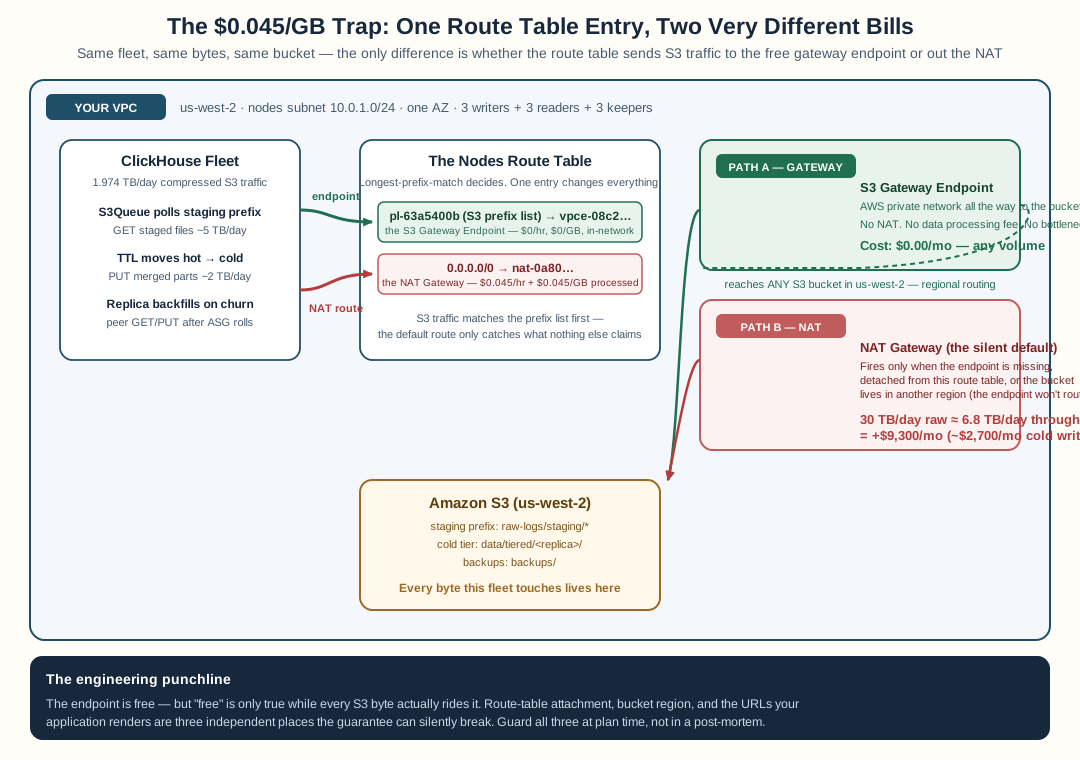
Start with what the fleet actually does with S3 in a day. At 30 TB/day of uncompressed logs, ClickHouse’s ~15× ZSTD compression puts ~1.97 TB/day of merged parts into the cold tier. The ingest path reads ~5 TB/day of staged NDJSON files out of the raw-logs bucket. Replica backfills after ASG churn re-fetch the recent window across nodes. Add nightly backups. Round to 6–7 TB/day of S3 traffic on a calm day.
Now price two network paths for that traffic:
| Path | Rate | Monthly cost @ ~6.8 TB/day (~207 TB/mo) |
|---|---|---|
| S3 Gateway Endpoint | $0/hr + $0/GB | $0.00 |
| NAT Gateway fallback | $0.045/hr + $0.045/GB processed | ~$9,300/mo (~$306/day across all ~6.8 TB/day; ~$2,700/mo on the ~1.97 TB/day cold-tier writes alone) |
The NAT gateway is not a mistake. It exists for the fleet’s control plane — SSM agents, Secrets Manager, apt packages, the odd outbound API call. Priced for that job, it’s $32.85 of hourly time plus $3–8 of data processing per month. Priced for the fleet’s entire S3 diet, it’s a second storage bill. The same resource. The only variable is which route the bytes take.
Why “used it” and “created it” are different guarantees
A gateway endpoint is not an appliance — it’s a route table attachment. You create the endpoint, AWS gives you the S3 prefix list for your region, and you attach the endpoint to a route table. The route table then carries two entries:
pl-63a5400b (S3 prefix list) → the endpoint   ← more specific
0.0.0.0/0                   → the NAT        ← the default
S3 traffic matches the prefix-list route first, rides the
free path, and never reaches the NAT. This works with zero
application changes: ClickHouse’s S3 disks, the S3Queue
engine, and clickhouse-backup all open ordinary HTTPS
sessions to regional bucket endpoints; the route table
decides the network those requests travel.
The trap is that “attached” is a state, not a property. And there are three completely different ways for the state to be wrong while everything continues to work:
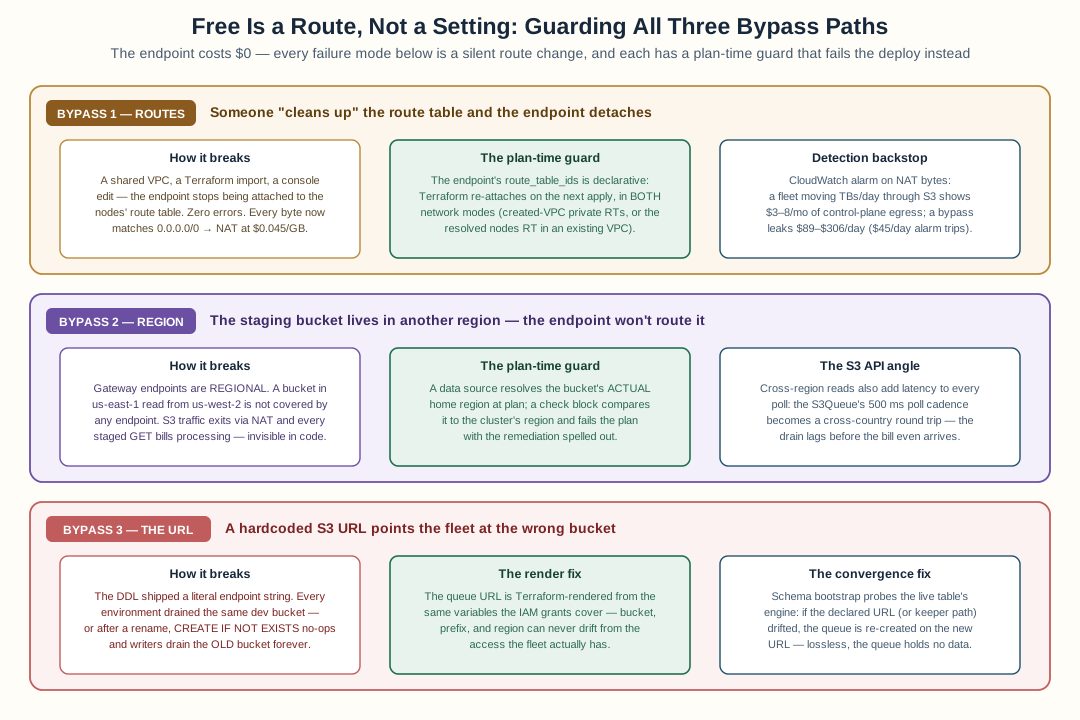
Bypass 1 — the route table. A shared VPC gets
reorganized. Someone imports the route table into another
Terraform state, or “cleans up” the endpoint attachment in
the console. The nodes keep their default route. Every byte
of S3 traffic now matches 0.0.0.0/0 instead of the prefix
list. No errors, no latency spike worth noticing — just a
bill that quietly grows 40–130×.
Bypass 2 — the region. Gateway endpoints are regional.
The endpoint in us-west-2 routes to S3 in us-west-2 and
nothing else. Point your ingest at a staging bucket in
us-east-1 — because that’s where the producers live, say —
and the endpoint is useless for that traffic: cross-region
S3 rides the NAT, billed at $0.045/GB plus inter-region
transfer, and the S3Queue’s 500 ms poll cadence becomes a
cross-country round trip before the bill even arrives.
Bypass 3 — the URL. The nastiest one, because it’s pure
config drift. Our ClickHouse bootstrap DDL declared the
S3Queue’s drain URL as a literal string:
https://acme-edge-dev-raw-logs.s3.us-west-2....
Every environment that DDL shipped to would drain the dev
bucket. And the deeper version of the same bug: after a
bucket rename, the declared URL changes but the live table’s
CREATE IF NOT EXISTS silently no-ops — writers keep
draining the old bucket forever, IAM grants pointing one way,
traffic flowing another.
Turning free into an invariant
The endpoint itself is a five-line Terraform resource. What makes it trustworthy is guarding all three bypass paths at plan time — so a silent route change becomes a loud failed plan instead of a line-item surprise:
flowchart LR
    A["Fleet renders<br/>storage config"] --> B{"Check: staging bucket<br/>resolved region ==<br/>cluster region?"}
    B -- "mismatch" --> X["PLAN FAILS<br/>with the NAT tax<br/>spelled out"]
    B -- "match" --> C{"Check: URL rendered from<br/>the same vars the<br/>IAM grants cover?"}
    C -- "drift" --> X
    C -- "match" --> D["Endpoint attached to the<br/>nodes route table<br/>(declarative, both VPC modes)"]
    D --> E["S3 traffic rides the<br/>free path"]
    X -.->|"fix + re-plan"| A
    style E fill:#e8f3ee,stroke:#1f6f50,stroke-width:2px
    style X fill:#fdf2f2,stroke:#c05c5c,stroke-width:2px
-
The attachment is declarative. The endpoint’s
route_table_idscovers the nodes’ route tables in both network modes — the created-VPC mode attaches to the private route tables, and the existing-VPC mode resolves the nodes’ route table (caller-specified, the subnet’s, or the VPC main). A hand-edit survives exactly until the next apply. -
A plan-time check resolves the bucket’s real region. The staging bucket is just a string in tfvars — it could live anywhere. A
data "aws_s3_bucket"lookup resolves its actual home region, and acheckblock compares it to the cluster’s region. A cross-region bucket fails the plan with the remediation in the error message, not the invoice. -
The URL renders from configuration. The S3Queue’s drain URL is now
templatefile-rendered from the samestorage_configvariables the IAM grants cover — bucket, prefix, and region can never drift from the access the fleet actually has. And the schema bootstrap pass probes the live table: if the declared URL drifted from what the running queue polls, the queue is re-created on the new URL — lossless, because a queue table holds no data underafter_processing = 'delete'.
Then one detection backstop for whatever a human does by hand anyway: a CloudWatch alarm on NAT bytes. A healthy fleet shows single-digit dollars a month of NAT processing; a bypass leaks ~$89/day (~$2,700/month) on cold-tier writes alone and ~$306/day (~$9,300/month) across the full S3 path, so a $45/day (~1 TB/day) alarm trips on the first day. The alarm is a smoke detector — everything above is the fire code.
The request-cost blind spot the endpoint doesn’t cover
One clarification worth making, because the audit that started all this conflated two things: the gateway endpoint covers the network path, not the API pricing. S3 still bills PUT/COPY/LIST at $0.005 per thousand and GET at $0.0004 per thousand — and at 30 TB/day, those requests are their own blind spot.
The Cost Explorer numbers from the soak: $45.89/day of S3
API charges ($40.31 of Tier-1 PUT/LIST + $5.58 of Tier-2
GET) against a model that had penciled in $45/month. The
amplifiers were all part-shape problems — small 64 GiB hot
disks hitting move_factor = 0.1 within hours and pushing
unmerged small parts to S3, wide parts storing one S3 object
per column (~35 objects per part where ~11 would do), TTL
expiry rewriting parts instead of dropping them whole, and
per-replica claim-tree duplication before the shared
keeper_path fix. The collapse levers are the mirrors of
each amplifier: hot disks big enough that merges complete
locally, min_bytes_for_wide_part = 1 GiB (the ClickHouse
Cloud default, for exactly this reason), whole-part TTL
drops on day-partitioned data, and one shared claim tree.
That story — the API amplifiers and their fixes — is its own post. The point here is the division of labor: the endpoint makes the bytes free; part shape makes the requests cheap. You need both, and neither substitutes for the other.
The punchline
There’s a genre of cloud cost advice that stops at “create the gateway endpoint, it’s free.” That advice is correct and insufficient. At 30 TB/day the endpoint is not a checkbox — it’s a structural assumption that three independent things can silently invalidate, and the difference between honored and violated is a 40–130× swing on a bill with no accompanying failure.
Free, in infrastructure, is a property of a route — not of a resource. Treat it like one: make the attachment declarative, resolve the bucket’s real region at plan, render the URLs your data planes call, and keep a smoke detector on the NAT. The fifteen minutes it takes to guard is the cheapest engineering in the whole pipeline.
FAQ
What is an S3 Gateway Endpoint and why is it free?
A gateway endpoint is a route-table attachment that keeps traffic between your VPC and S3 inside the AWS private network. Unlike interface endpoints (which cost ~$7/month per AZ per endpoint), gateway endpoints bill nothing — no hourly charge, no per-GB charge — because AWS is routing your existing traffic more efficiently, not provisioning you a new network appliance. For a fleet that moves terabytes per day to and from S3, it is the single highest-leverage free resource in the account.
How much does it actually save at 30 TB/day?
Without the endpoint, all S3 traffic exits through the NAT Gateway, which charges $0.045 per GB processed. At 30 TB/day raw ingest, just the ~1.97 TB/day of compressed cold-tier writes (~60 TB/month) would bill ~$2,700/month (~$89/day) in NAT processing — and routing the full ~6.8 TB/day of S3 traffic (staged reads, cold-tier writes, replica backfills) through NAT would bill ~$9,300/month (~$306/day). With the endpoint, the same traffic costs $0 and the NAT shrinks to a control-plane egress trickle of $3–8/month.
If it's free, what can go wrong?
The endpoint being free and the endpoint being USED are different guarantees. Three things silently bypass it: a route-table change that detaches the endpoint (traffic falls back to the 0.0.0.0/0 NAT route), a bucket in a different region (gateway endpoints are regional and refuse to route cross-region S3 — NAT catches it), and an application URL pointing at a bucket outside the guarded path. All three produce zero errors; the only symptom is the bill.
How do you make 'free' an invariant instead of a hope?
Guard each bypass path at plan time. The endpoint attachment is declarative in Terraform, covering both created-VPC and existing-VPC network modes. A data source resolves the staging bucket's actual home region and a check block fails the plan on a cross-region mismatch. The queue's S3 URL renders from the same variables the IAM grants cover, and the schema bootstrap converges URL drift by re-creating the queue. Then one CloudWatch alarm on NAT bytes catches whatever a human does by hand.
Does ClickHouse need anything special to use the endpoint?
No — the routing is entirely below the application. ClickHouse's S3 disks, the S3Queue engine, and clickhouse-backup all use ordinary HTTPS to the regional bucket endpoints; the route table decides which network path those requests take. What ClickHouse DOES need is for the URL it's given to point at the right regionally-addressable bucket — which is why the URL should be rendered from configuration rather than hardcoded.
What about the S3 API request costs themselves?
The endpoint covers the network path, not the request pricing — PUT/LIST/GET still bill normally. At 30 TB/day the request cost is a separate blind spot entirely: unmerged small parts and per-replica copies drove ~$45/day (~$1,395/month) of API charges in one audit, mostly Tier-1 PUT/LIST at $0.005 per thousand. The fixes are part-shape fixes — bigger hot disks so merges complete locally, 1 GiB compact parts instead of wide parts, whole-part TTL drops — which collapse it to a ~$60–120/month physics floor.
Stay in the loop — production notes on AI agents, workflows, and SRE.
Low volume — new posts and curated reading lists. Unsubscribe anytime.