Service Rendered Efficiently: SRE AI Is Not an Engineering Credibility Project
Site reliability engineering (SRE) teams run and improve the systems other teams depend on. I have seen a team spend more effort demonstrating its engineering capability than reducing work for people on call. A framework can be good engineering and still fail to help during an incident.
I use Service Rendered Efficiently as a way to ask who benefits from our work, how the service is delivered, and whether the effort is proportionate.
The incident patterns below are composite and anonymized. Counts are rounded. Names, IDs, and infrastructure details are fictionalized to protect customer confidentiality.
Three words
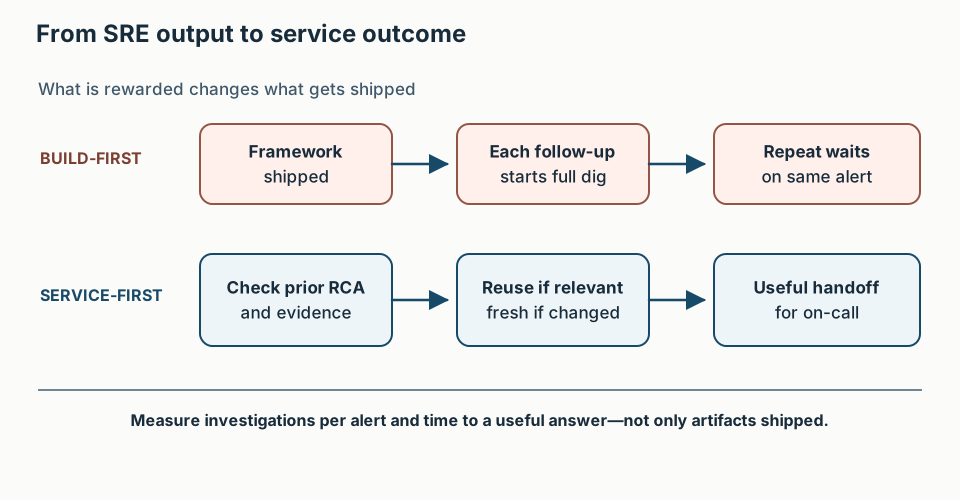
Service means you exist for the teams building the product — not competing with them. If a bot starts a full investigation every time someone mentions it on the same alert, it may be more useful to link the existing root-cause analysis (RCA): the record of what happened and why. Re-investigation still makes sense when the evidence has changed.
Rendered means operational craft: how you run systems, respond to incidents, build automation, and maintain reliability. The doing, not just the designing. If the cause is still undetermined, a triage update should say what was checked, what was found, and what remains unknown. An “Incomplete” status alone cannot guide the next shift.
Efficiently means doing it intelligently — automation that understands the operational problem it is solving. A policy that reuses recent results, an honest notice when data was truncated, or a fix for startup delays may save operator time. An internal framework is useful when it solves a recurring problem, not simply because it is new.
The incentive shift
This comparison shows how rewarding a shipped framework differs from designing around a useful on-call answer and a relevant prior investigation.
| Engineering-org identity | Service-org identity |
|---|---|
| Success = what we built | Success = what on-call can do next |
| Showcase frameworks and tools | Showcase fewer duplicate investigations |
| Compete with product eng for “real work” | Amplify product eng during incidents |
| Measure agent LOC and model cleverness | Measure time-to-first-useful-answer and handoff quality |
The right measures depend on the service: a platform framework may matter when it enables safer changes, but its existence alone does not show whether incident response improved.
Definitions of triage vs RCA vs remediation still live in What Are SRE AI Agents?. This series is the culture and product layer on top.
A number that changed how we shipped
In one week of production debug export analysis for a mid-size SaaS customer’s AI investigate path, we saw roughly 100 investigations. About fifteen alert IDs had multiple full digs. One alert saw twenty-plus full reruns — same worker failure pattern, hourly cycle, Slack follow-ups that each launched a fresh workflow despite a completed RCA already sitting on the thread.
That pattern suggests a launch-policy problem before a model-quality problem: each follow-up started another run despite a completed RCA. Some follow-ups may warrant fresh analysis; the default should not assume they all do.
We prioritized reuse-first launch policy, correlation gates (checks that relate a new alert or message to an existing incident), and handoffs usable by support and on-call. Those stories are the rest of this series.
If you lead an SRE team
- Stop rewarding frameworks shipped as proof of engineering worth
- Start measuring investigations per alert, time-to-first-useful-answer, and whether undetermined runs still post findings
- Ask whether AI investigation reduces load on the teams you serve — or creates a second stream of work they have to babysit
If you ship the agent platform
- Prefer product gates (reuse cooldown, user-goal enforcement, spill honesty) over prompt pep talks
- Treat Slack and Activity UX as part of the investigation service, not a logging afterthought
- Review batches of production debug exports — that is how we prioritized reuse and correlation work
Where this series goes
- Service — reuse, Slack as triage board, entry-path context, correlation gates
- Rendered — truncated data honesty, budget findings, hypothesis delivery, plane blindness
- Efficiently — measure the firing expression, cut cold-start dead air, one-zip conversation handoff
Starter pack: SRE as service. Checklist: ten service questions. Archive: series page.
Next: Stop Re-Investigating the Same Alert.
Acknowledgments. Lessons here draw on shipping Aiden SRE investigation at StackGen with teammates across platform and customer rollouts. Patterns are composite.
If you are building AI for incident triage, Find me on GitHub or LinkedIn.
FAQ
What does Service Rendered Efficiently mean for SRE?
Service means you exist for product and on-call teams. Rendered means operational craft — how you run systems and investigations. Efficiently means automation that creates leverage, not work built mainly to demonstrate coding ability.
How should SRE teams measure AI investigation success?
By outcomes for the teams you serve: fewer duplicate digs on the same alert, honest partial findings, usable Slack cards, and one-zip handoffs — not solely by frameworks shipped or agent lines of code.
How is this series different from the Go agent platform series?
The Go series explains how the runtime and platform work. This series explains why SRE AI should be shipped as a service product — culture, incentives, and operator outcomes.
Stay in the loop — production notes on AI agents, workflows, and SRE.
Low volume — new posts and curated reading lists. Unsubscribe anytime.