Ungrounded Synthesis Must Read as Hypothesis
An AI-written root-cause analysis (RCA) may sound certain even when its service names or claims cannot be traced to the data it used. A grounding check compares the answer with tool results; if it fails, the message shown to responders must change, not merely the internal log.
The incident patterns below are composite and anonymized. Counts are rounded. Names, IDs, and infrastructure details are fictionalized to protect customer confidentiality.
Make the correction visible
A failed grounding check should prevent the original confident wording from appearing as the main chat or Slack message. Show a prominent notice and a corrected body: what was observed, what remains a hypothesis, and which names could not be verified. The check itself can miss errors, so a pass is not proof of correctness.
The failure mode
For example, suppose the agent names checkout-svc as the failed service, but the returned records contain no such entity. A checker returns is_factual: false. If the original headline remains the main message and the correction is tucked into a note, a reader may still act on the invented name.
The delivered message should reflect the verification result. This is related to curiosity before confidence and be creative, don’t invent: unsupported details should remain uncertain or be removed.
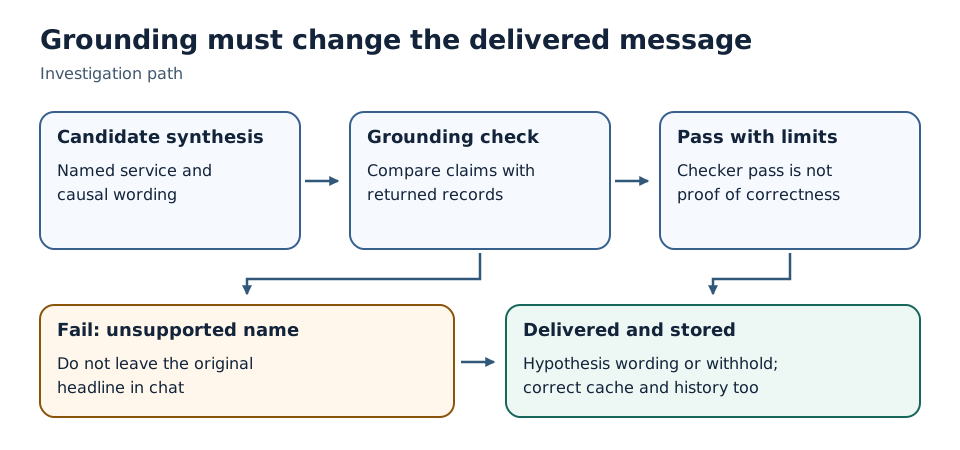
Diagram: The upper arrows compare a candidate narrative to returned records; the lower path shows a failed name check changing the primary message and stored copies to hypothesis wording, or withholding the claim.
If you lead an SRE team
- Reject any workflow where grounding failure is invisible in the primary UI
- Tell reviewers what the hypothesis notice means: the checker found a gap, not necessarily that the entire investigation was useless
- Keep unknowns visible, then use further checks or human review for decisions with consequences
If you ship the agent platform
- Render a corrected primary body with hypothesis language when grounding fails; if a safe rewrite is impossible, withhold the unsupported claim
- Cache and chat history must store the downgraded form
- Do not leave the invented narrative as the default render with a footnote humans miss
Related
- Previous: Deliver Findings at the Budget Cap
- Next: Empty Query ≠ Absent Signal
- Curiosity before confidence
- Evidence-based verification
Acknowledgments. Grounding delivery lessons from fail-closed verification in the Aiden runtime. Patterns composite.
Building AI for incident triage without the demo theater? Find me on GitHub or LinkedIn.
FAQ
What should happen when an AI RCA fails grounding?
Show a prominent notice and a corrected primary message distinguishing observations from hypotheses. Remove unsupported names rather than preserving a confident claim with a quiet annotation.
Why is fail-closed delivery a service concern?
Responders often act on the primary message. A failed check recorded only in logs leaves unsupported names visible in the main card.
How does this relate to curiosity before confidence?
Submission checks can reject unsupported confidence. Delivery should show that result in the main Slack or chat message rather than only in logs.
Stay in the loop — production notes on AI agents, workflows, and SRE.
Low volume — new posts and curated reading lists. Unsubscribe anytime.