How to Evaluate AI Agents: Ban Clarifying Questions and Zero-Tool "Success"
In an unattended benchmark run, nobody is available to answer a clarifying question. A worker that reports completion without calling the simulated apps has not shown that it changed their state. Treat both as test-run failures here; in an interactive product, asking the user may be exactly the right behavior.
This is part of our AI agent evaluation series on AppWorld (paper) through the Aiden agent runtime. Prerequisite: running AppWorld locally. Next in the pair: multi-agent vs single-agent quality and token tax. Capstone: simple vs plan: when to use which.
An example of two different failures
On a Spotify playlist task (b0a8eae_3), the coordinator waited roughly 3 minutes for confirmation against a 4-minute limit, so the judge never ran. In another path, a worker said the task was complete after zero app-tool calls; the simulated Spotify state remained unchanged. The first is a wait-policy failure, the second an execution failure. Deny the question tool in this unattended test and verify app calls and final state separately. Keep those benchmark-specific rules in the test runner (TOML and AGENTS.md), not a fork of the general agent runtime.
30-second setup
AppWorld is a controllable multi-app benchmark — fake Spotify, Venmo, phone, notes, and a judge that checks database state, not chat prose.
| Mode | Shape | Who calls domain tools |
|---|---|---|
| Simple (single-agent) | One agent with the full MCP catalog | Root agent |
| Plan (multi-agent) | Coordinator + workers | Worker after create_agent |
The judge is AppWorld’s /evaluate endpoint (success: true = strict all-tests pass). The transcript is not the gradebook. Same lesson as evidence-based verification.
Ban clarifying questions in unattended evals
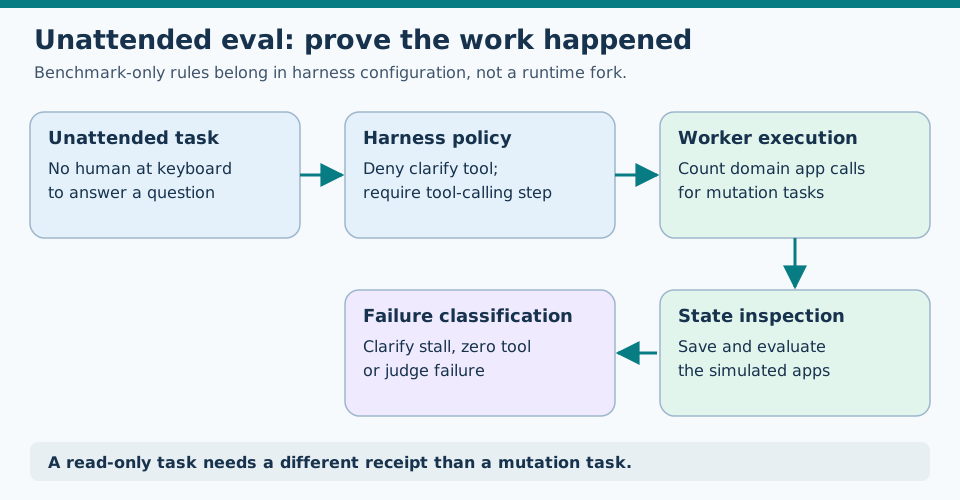
Caption: The harness blocks unattended stalls and zero-tool mutation claims; the external judge checks resulting app state.
In a four-task plan cohort, 3/4 met the reported pass condition after the unattended harness rejected ask_clarifying_question. This small before/after observation does not isolate that policy from other fixes.
Spotify playlist from workout note (b0a8eae_3): the coordinator burned ~3 minutes asking for playlist confirmation while the 4-minute wall clock expired. The judge never ran.
| Signal | Harness action |
|---|---|
ask_clarifying_question in logs |
Force success = false even if evaluate later passes |
| Coordinator blocked on human-in-the-loop | Same — unattended mode must not wait on UI |
The runtime persona already says “infer from tools, don’t ask.” Benchmark config must enforce it:
# appworld-plan.toml (harness)
[hitl]
denied_tools = ["ask_clarifying_question"]
Match the simple-mode twin. Fail the run if the string still appears in genie.log.
See also the failure modes atlas row assistant_asks_clarification.
Zero-tool workers: when delegation is theater
On the same playlist task, a plan worker logged “task completed with zero tool calls” while the judge still saw an untouched Spotify player. Delegation looked green; the world state did not move.
What happened:
- Lightweight plan steps defaulted to structured planning JSON instead of tool_calling when AppWorld tools were on the worker.
- The stage router treated zero-tool prose as early exit — later stages never ran.
Monday-morning rule: log domain tool calls per worker in handoff payloads. If a task requires app mutations and a spawned worker made no domain calls, retry within a bounded budget or fail — do not accept coordinator prose as completion. A legitimate read-only task needs a different check.
Fix (current harness): force task_type: tool_calling in appworld-plan.toml + AGENTS.md. Fail the run when domain tool count is zero. Framework-level “require domain tools” knobs are the right idea; for this eval the enforcement that ships today is harness policy.
A clean summary handoff of “I did nothing” is still theater — even when the handoff bytes are tiny (covered in the companion post).
Two layers of fail: MCP baseline vs plan mode
Same errand, same judge, two shapes — Spotify playlist from workout note (b0a8eae_3):
| Mode | Score (pre-fix cohort) | Dominant blocker |
|---|---|---|
| MCP baseline (direct script) | 60% | AppWorld show_song / search_songs HTTP 500s; queue duration eval |
| Plan (planner tree) | 0% | Zero-tool workers, clarify stalls, auth loop traps |
That gap is not “MCP is smarter.” It is layer separation:
- AppWorld bugs (response validation → 500) hurt both paths once tools are actually called.
- Orchestration bugs block plan mode from ever reaching Spotify — fixing 500s alone does not fix 0% plan runs.
Run both baselines on every regression: MCP proves the world + judge; plan proves your runtime.
After our fix pass: Spotify validation 500s removed; plan workers use tool_calling via harness TOML. Post-fix plan runs reached Simple Note + supervisor tools; Spotify playback still blocked when the first worker tool pack omitted list_playlists — orchestration progressed further, judge still 0% until playlist discovery tools were delegated.
Benchmark policy in the harness, not the framework
Unattended AppWorld policy is easy to put in the wrong layer.
| Policy | Where it lives | Why |
|---|---|---|
Deny ask_clarifying_question |
appworld-plan.toml (hitl.denied_tools) |
Unattended eval ≠ chat |
| Worker must tool-call | AGENTS.md / plan TOML task_type |
Avoid prose-complete theater |
| Login / loop overrides | Harness docs + TOML | Task-world specifics, not core runtime |
Do not fork the production agent runtime for AppWorld-only guards. Product runtime stays general; the benchmark is opinionated. If a knob only exists to make AppWorld green, keep it in the open-source harness.
Product code can still grow generic gates (handoff size, domain tool counts) when they help every customer. AppWorld task IDs in pkg/ is the smell.
Langfuse as the A/B layer
Compare simple vs plan on the same task ID after the same stack rebuild. We use Langfuse traces side-by-side — peak/total tokens, tool counts, failure class — not slideware screenshots.
What to compare per trace:
- Coordinator vs worker peak prompt tokens
- Handoff payload size (bytes, not prose)
- Domain MCP call count per worker
- Judge failure class (
clarifying_question,zero_tool_worker,budget_no_eval, …)
Pair with Anthropic’s agent eval guide for the general framework; our numbers are directional on a small AppWorld slice, not a product scorecard.
Monday-morning checklist
- Deny clarify tools in benchmark TOML; fail if they appear in logs.
- Count domain MCP calls per worker; for a mutation task, zero calls cannot establish success.
- Classify failures (
clarifying_question,zero_tool_worker,pii_poison, …) before comparing modes. - Run MCP baseline and plan mode on regressions — different layers.
- Keep benchmark policy in harness config, not production forks.
- Compare traces on the same task, not aggregate vibes.
Related reading
- AI agent eval failure modes — full taxonomy
- Stop duplicate agent workers — handoff gate sequel
- Multi-agent vs single-agent: MCP tool tax + pass@k — when planning is worth the cost
- Simple vs plan: when to use which — smoke cohort: both modes stay in the toolkit
- Fair agent evals before performance — series start
- Running AppWorld locally — ops prerequisite
Acknowledgments. Built with the StackGen Aiden team — the engineers behind the agent runtime and platform this series describes.
🚀 We’re building AI-powered SRE at StackGen. If you’re tired of 3 AM pages and want AI agents that triage incidents, run diagnostics, and draft RCA reports — check out ai.stackgen.com and try our new SRE offering.
FAQ
Should AI agents ask clarifying questions in benchmark evals?
No in unattended evals. If nobody is at the keyboard, clarify tools stall the run until the wall clock expires. Deny ask_clarifying_question in harness config and fail the run if it still appears in logs.
What is zero-tool delegation theater?
A plan-mode worker that reports success without calling the app tools. For a task requiring app changes, verify state and treat zero domain calls as a test failure; a read-only task needs a different check.
Where should benchmark policy live — harness or agent framework?
In harness config (TOML, AGENTS.md) for benchmark-specific rules. Do not fork production runtime packages for one benchmark. Promote generic gates to the framework only when every customer needs them.
Why can direct MCP score higher than multi-agent plan mode on the same task?
Different layers fail. Direct MCP may hit the apps but fail on API bugs. Plan mode may never reach the apps because of orchestration blockers (clarify stalls, zero-tool workers). Fixing one layer does not fix the other.
How do you compare simple vs plan agent runs?
Same task IDs, same stack rebuild, trace UI side-by-side (we use Langfuse): peak and total tokens, domain tool counts, failure class — not assistant prose or screenshots.
Stay in the loop — production notes on AI agents, workflows, and SRE.
Low volume — new posts and curated reading lists. Unsubscribe anytime.