Simple vs Plan: When to Use Which (AppWorld smoke cohort)
Earlier this week, planning beat reacting on a couple of AppWorld tasks — and paid the orchestration tax for it. That could suggest planning always wins, but this three-task follow-up does not support a general rule.
We ran a small simple vs plan smoke on three skill-shaped errands. Plan passed one task and had a higher partial score on another. Simple matched plan on a hard action task while spending far less. The practical choice depends on the task and the costs you can tolerate. Keep both modes available while measuring them on your own work.
Dataset: AppWorld, a simulated-app benchmark, via Model Context Protocol (MCP), the interface for app actions. Runtime: Aiden. Series id: simple-vs-plan-3-20260824T213004Z. n = 3 tasks — directional, not a launch scorecard.
What happened in the three tasks
Both paths scored 28.6% on a Spotify action task and failed the strict check. On a Venmo task, the planner scored 83.3% versus 66.7%, but both still failed. On a Spotify question-answering task, the planner reached 100% and passed, versus 50% for the single agent. These percentages are checks passed inside AppWorld, not success probabilities. In this sample, the single agent finished in ~40–73 seconds; planning took ~141–275 seconds and ~5–6× the total prompt text processed. If speed matters and the task is straightforward, start with one agent. Consider a planner for work that benefits from a narrow worker goal, then verify that benefit against its time and cost on more tasks.
Scorecard (skills_smoke_3)
| Task | Simple % | Plan % | Strict | Winner |
|---|---|---|---|---|
uc-06 Spotify rate liked playlist songs (692c77d_1) |
28.6 | 28.6 | both fail | tie |
uc-07 Venmo like roommate transactions (2a163ab_1) |
66.7 | 83.3 | both fail | plan on partial checks only |
uc-10 Spotify most-recommended artist Q&A (287e338_1) |
50.0 | 100.0 | plan pass | plan |
Caption: pass percentages from AppWorld /evaluate · series simple-vs-plan-3-20260824T213004Z.
What the table is not saying: “retire simple.” On uc-06, simple matched plan on a multi-step Spotify action while burning a fraction of the wall clock. On uc-10, the focused-worker run passed while the single-agent run did not; the sample does not prove which part of the plan caused the difference.
Cost and context (approx)
| Mode | Wall time | Prompt shape |
|---|---|---|
| Simple | ~40–73s | One agent; final context ~15–16k; Σ prompt ~15–16k |
| Plan | ~141–275s (~2–4×) | Σ prompt ~5–6× higher (orchestration tax); final coordinator turn often similar to or smaller than simple’s single turn |
Workers absorbed the bulk of the tokens. Subagent isolation held — compact handoffs stayed under 2KB, same class of boundary we saw in the MCP tool-tax post.
Monday-morning rule: quote peak per seat and sum across the run. If you only watch the coordinator gauge, plan can look “smaller.” If you only watch the sum, simple looks “cheaper.” Ship with both numbers on the receipt.
When to use which
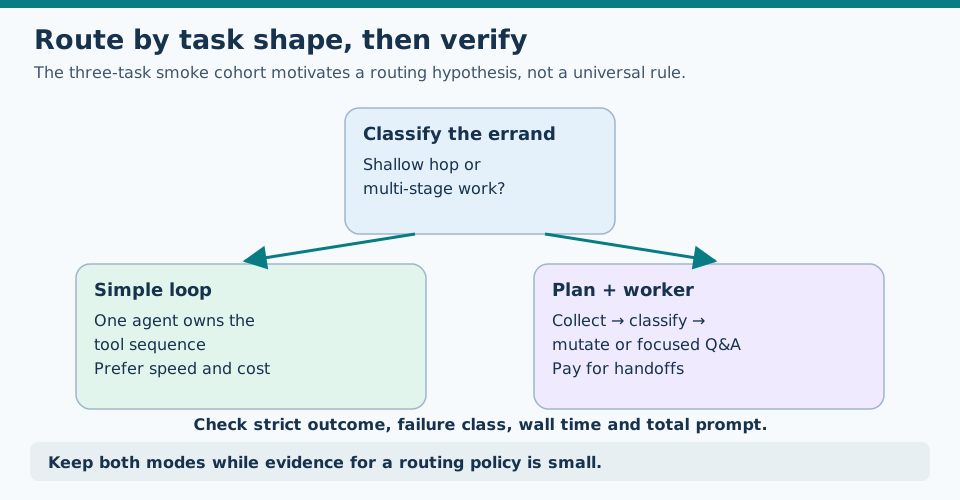
Caption: Route by task shape, then test strict outcome and cost rather than declaring a universal mode winner.
| Reach for simple when… | Reach for plan when… |
|---|---|
| Latency or $ matter more than a few points of judge score | The errand is collect → classify → mutate |
| The job is shallow / single-hop | You need tool packing (narrow tools on a worker) |
| You want a tight context budget on one agent | Q&A benefits from a focused worker (uc-10) |
| You’re still debugging the harness, not routing policy | You’ve already paid for fairness and want isolation |
Neither column is “smarter.” Simple is not dumb — it can tie plan on hard action work (uc-06) while finishing in under a minute. Plan is not free — you may gain task-specific quality at a cost in wall time and tokens; this small sample does not guarantee that tradeoff on other work.
One harness note that keeps paying off: document the real MCP tool names workers should call (e.g. review_song, delete_account, create_file). Wrong names burn turns on create-agent rewrites instead of domain work — a quiet tax that hits plan harder because workers inherit the packing list.
What we are not claiming
- This is not “plan always wins” or “simple is obsolete.”
- n = 3 smoke tasks with no repeated trials here — use them to form routing hypotheses, not to crown an architecture.
- Strict AppWorld success is still a separate bar from pass% — two of three tasks failed strict in both modes.
For the earlier cohort where plan moved failure classes (mutations vs wording) and paid catalog tax, see Multi-Agent vs Single-Agent: MCP Tool Tax + pass@k.
Monday-morning checklist
- Classify the errand: shallow hop vs collect→classify→mutate vs focused Q&A.
- Default simple when speed/cost dominate; escalate to plan when isolation or packing is the product.
- Log peak and total prompt; assert handoff bytes stay bounded.
- Record failure class next to pass% — a 83% with progress is a different ticket than a 28% tie on the wrong mutation.
- Keep both modes in the product — routing is a feature, not a religion.
Related reading
- Multi-Agent vs Single-Agent: MCP Tool Tax + pass@k
- Agent orchestration tax
- Single-Agent vs Multi-Agent Orchestration: How to Choose
- How to evaluate AI agents: clarify + zero-tool failures
- Fair agent evals before performance
- Running AppWorld locally
Acknowledgments. Built with the StackGen Aiden team — the engineers behind the agent runtime and platform this series describes.
🚀 We’re building AI-powered SRE at StackGen. If you’re tired of 3 AM pages and want AI agents that triage incidents, run diagnostics, and draft RCA reports — check out ai.stackgen.com and try our new SRE offering.
FAQ
Should I always use plan mode instead of simple mode?
No. Plan won quality on some AppWorld smoke tasks and tied on others — while costing ~2–4× wall time and ~5–6× total prompt tokens. Use plan when the errand needs collect→classify→mutate, tool packing, or a focused worker; use simple for speed, cost, and shallow single-hop work.
When is simple mode the better default?
When you want lower latency and cost, the job is a shallow or single-hop errand, or you need a tight context budget on one agent. On our smoke cohort, simple matched plan on a hard Spotify action task (28.6% each) while finishing in tens of seconds instead of minutes.
When is plan mode worth the orchestration tax?
When the job may benefit from a coordinator plus focused workers — multi-step collect→classify→mutate flows, packed tool lists, or Q&A that needs a specialist. Confirm the benefit against added time and tokens on your tasks. On our cohort, plan cleared a Spotify Q&A task that simple only half-cleared (100% vs 50%).
Does plan mode always use more context than simple?
Total prompt across the run is higher (~5–6× on this cohort). Peak on the final coordinator turn is often similar to — or smaller than — simple’s single seat, because workers absorb the bulk and handoffs stay compact (<2KB).
What AppWorld series are these numbers from?
Series simple-vs-plan-3-20260824T213004Z — three skills_smoke_3 tasks (Spotify rate liked songs, Venmo like roommate txs, Spotify most-recommended artist Q&A). Directional n=3; not a product scorecard.
Stay in the loop — production notes on AI agents, workflows, and SRE.
Low volume — new posts and curated reading lists. Unsubscribe anytime.