Agent Orchestration Tax: Tokens, Iterations, and Tool Calls After a Fair Eval
Once fair agent evals prove both modes can reach the same domain tools (part one), the next question is cost: what does the planner path charge for coordination?
We call the added coordination agent orchestration tax: tokens (pieces of text processed by the model), model turns, and worker launches spent managing delegation in addition to calling the AppWorld apps. It can be worth paying when work branches, but it needs to be measured rather than assumed.
Dataset: AppWorld, a simulated-app benchmark, with tools exposed through Model Context Protocol (MCP) and judged by its own evaluate test runner. Observability: Langfuse aggregates. Runtime: Aiden.
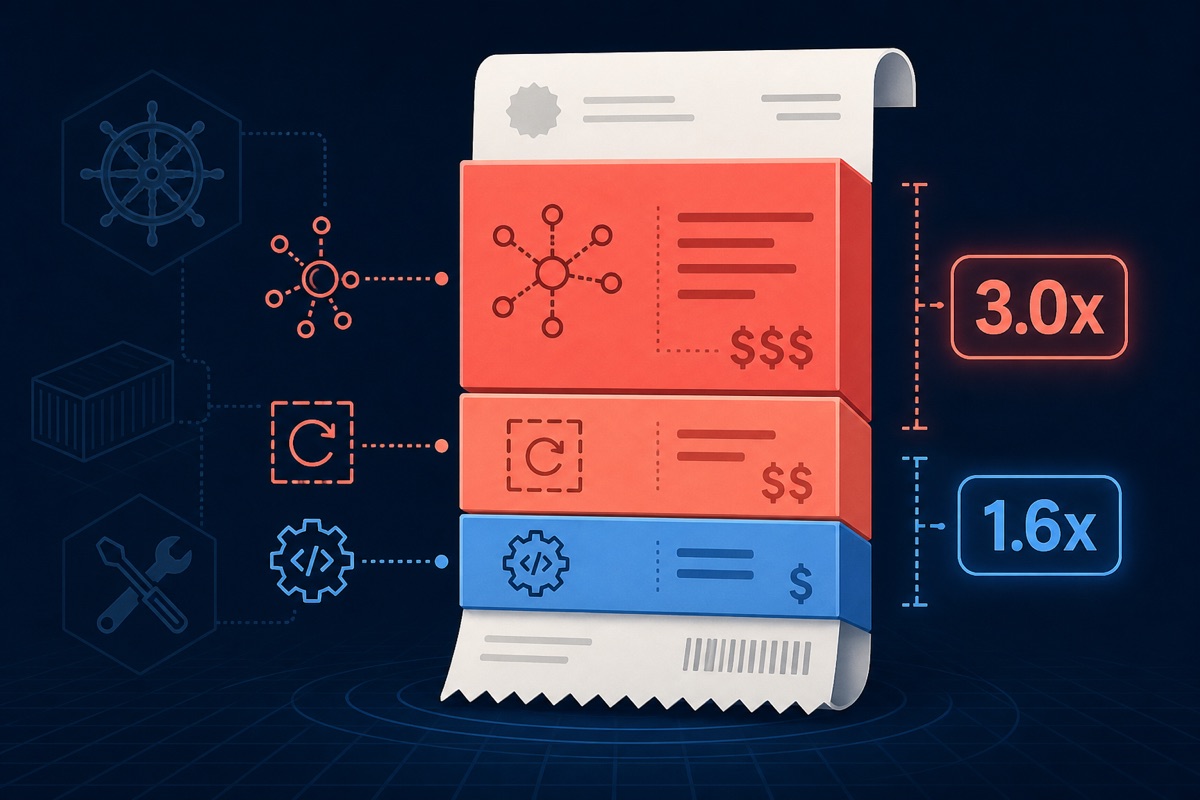
A concrete cost comparison
On ten paired tasks where both paths could reach the same app tools, the planner averaged 217,252 tokens and 43.8 model turns, versus 132,374 tokens and 14.6 turns for one agent. Both failed the strict AppWorld completion check on this small slice. More turns here show a coordination cost, not an improvement in finished tasks. If the job is “create a record, then use its new ID to update it,” one agent can keep that sequence together; parallel independent reads may justify separate workers. Test that tradeoff on your own tasks.
Scorecard (record these on every fair A/B)
| Metric | Why it matters |
|---|---|
| Tokens (prompt + completion) | Coordination shows up in root + worker streams |
| Model iterations | Spawn, repair, and gate retries are iterations, not “thinking harder” |
| Domain tool calls | Did extra loops translate into more API work or just overhead? |
| Worker spawns | Planner tax often scales with spawn count |
| External judge pass | AppWorld TGC/SGC — not assistant prose |
| Fairness OK | From part one checklist |
Fair mixed cohort (n = 10 tasks × 2 modes)
After the handoff fix, every pair passed tool-access fairness.
| Metric | Single-agent | Planner + worker | Ratio (planner / single) |
|---|---|---|---|
| Avg tokens | 132,374 | 217,252 | ~1.64× |
| Avg model iterations | 14.6 | 43.8 | ~3.0× |
| Avg domain tool calls | 13.8 | 20.5 | ~1.49× |
| Avg worker spawns | 0 | ~3.2 | — |
| Strict AppWorld TGC | not cleared (10/10) | not cleared (10/10) | tie on benchmark bar |
Outcomes texture: single-agent often hit its maximum number of turns without reaching evaluate (ran_without_judge on 7/10). Planner paths reached evaluate more often — useful for diagnosing harness gaps, not a routing win by itself.
Same findings class as our SRE agent benchmarks post: coordination multiplies iterations; it does not automatically deepen inspection.
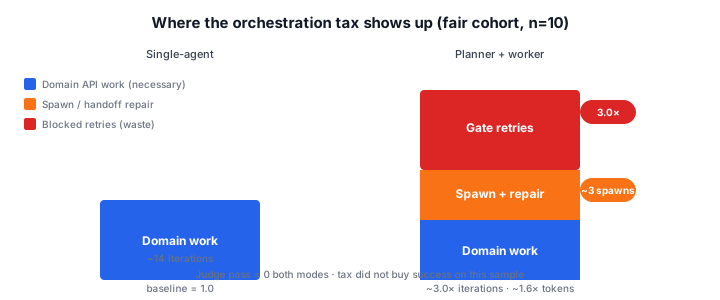
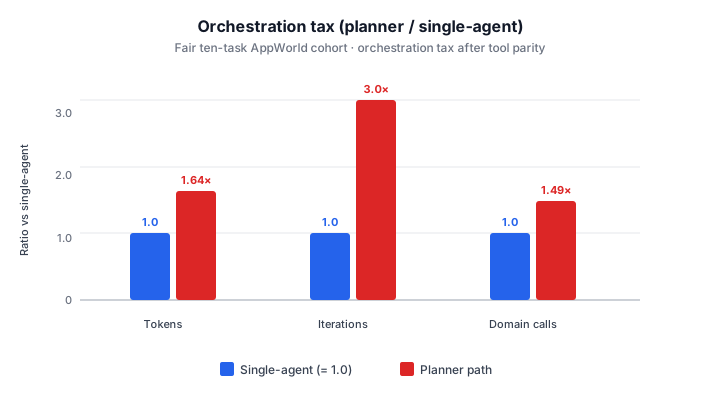
Caption: Fair ten-task AppWorld cohort · orchestration tax measured after tool parity.
Delegation-fit cohort (n = 5 tasks designed for planners)
We then picked five tasks that should favor delegate-then-synthesize: cross-app reads, batch fan-out, ledger reconciliation.
| Metric | Single-agent | Planner + worker |
|---|---|---|
| Avg tokens | 136,322 | 198,691 |
| Avg iterations | 14.6 | 38.4 |
| Token ratio | — | ~1.34× |
| Head-to-head | — | ties 5/5 (0 plan wins, 0 single wins) |
| Strict AppWorld TGC | not cleared (5/5) | not cleared (5/5) |
| Fairness | — | 2 / 5 pairs OK (infra tool drop on spawn) |
On “planner-shaped” work, neither mode cleared strict TGC on this five-task slice; only 2/5 pairs passed the tool-access check, so the ratios here are diagnostic, not a fair ranking. Higher pass_percentage in logs (often ~50%) did not imply success: true — a recurring theme for part three.
When the tax is worth paying
| Pay orchestration tax | Skip it |
|---|---|
| Parallel independent reads (metrics + logs + tickets) | Single-plane checklist one parent owns |
| Isolated worker budgets / blast-radius containment | ID-chained API mutations (create → pay → confirm) |
| Audit trail per specialist step | Latency-sensitive unattended eval with tiny node budget |
This mirrors single-agent vs multi-agent: branching is the job, not the slide deck.
For LLM token budget discipline when tax is unavoidable, see maintaining tokenomics — measure root + worker streams together.
Caveats (read before you quote these numbers)
- Small n: ten and five task cohorts — directional, not a leaderboard.
- Unequal caps: planner runs allowed slightly higher iteration and worker node limits in this harness.
- Missing telemetry: some planner rows showed zero Langfuse tokens while SSE showed tool activity — exclude or flag before averaging.
- Historical 168-task Grok pairing from an earlier era is a separate prior — different model and harness; do not overlay these OpenAI-family runs.
- We did not benchmark LangGraph, CrewAI, or AutoGen — we measured one runtime on AppWorld. Other systems may also pay for coordination, but the size and even direction of the cost need their own measurements.
Lessons learned
- Fairness first, tax second. Without tool parity, tax numbers are meaningless.
- More iterations ≠ better routing. ~3× iterations bought coordination overhead on this slice — compare against whether branching was actually required.
- Domain calls can rise without clearing TGC. Planner workers called more APIs; benchmark success is still a separate harness tuning track.
- Delegation-fit tasks are not auto-wins. 3/5 unfair spawns on infra naming dominated early runs — fix fairness before reading mode rankings.
- Record spawn count. ~3.2 spawns per task on a budget meant for “one worker” is its own failure mode.
Related reading
On this site
- Fair Agent Evals: Tools Must Match — part one
- AI Agent Eval Failure Modes — part three
- Simple vs Plan: When to Use Which — smoke cohort routing guide
- AI SRE Agent Benchmarks: Wall Time, Tools, Tokens — same tax idea on triage
- Single-Agent vs Multi-Agent — when to branch
Elsewhere
- AppWorld · paper
- Model Context Protocol
- Langfuse
- LangGraph · CrewAI · AutoGen · OpenAI Agents
- Google ADK evaluation
Acknowledgments. Built with the StackGen Aiden team — the engineers behind the agent runtime and platform this series describes.
🚀 We’re building AI-powered SRE at StackGen. If you’re tired of 3 AM pages and want AI agents that triage incidents, run diagnostics, and draft RCA reports — check out ai.stackgen.com and try our new SRE offering.
FAQ
What is agent orchestration tax?
Extra tokens, model iterations, and tool calls spent on spawning workers, repairing handoffs, and gate retries — on top of the domain work itself. It shows up whenever a planner coordinates instead of calling tools directly.
How much orchestration tax did planner mode pay on a fair AppWorld eval?
On a fair ten-task cohort with tool-access parity, planner paths averaged about 1.6× tokens, 3.0× model iterations, and 1.5× domain tool calls versus single-agent. Compare tax on equal footing — benchmark TGC is a separate gate from orchestration cost.
Does higher tool call count mean better results on agent benchmarks?
Not automatically. In our fair cohort, more domain calls and more iterations did not correlate with clearing strict AppWorld TGC on this slice. Measure tax separately from external judge success.
When is planner orchestration worth the tax?
When work branches — parallel independent reads across apps or planes, isolated worker budgets, or auditability of specialist steps. Skip it for ID-chained mutations one loop can own.
How does this relate to ReAcTree tax on SRE triage?
Same invoice, different job. Our SRE A/B showed ~1.6× wall time and ~3.9× tool calls for the same findings on single-plane triage. Here we measure the tax on a public multi-app benchmark after fixing tool fairness.
Stay in the loop — production notes on AI agents, workflows, and SRE.
Low volume — new posts and curated reading lists. Unsubscribe anytime.