AI Agent Eval Failure Modes: Budget, PII Placeholders, and Self-Reported Passes
One transcript claimed a pass even though no judge result confirmed it. In a tool-using benchmark, a readable account of work is not the same as the app state the benchmark checks. These runs exposed both test-harness problems and task errors; the sample is too small to assign a general share of blame to either.
Parts one and two fixed tool fairness and measured agent orchestration tax. This post classifies what blocked benchmark success on a small AppWorld slice — harness issues (budget, spawn infra, redaction) mixed with task-hardness signals.
Benchmark: AppWorld (paper). Tools: Model Context Protocol (MCP), which exposes actions the agent can call. Judge: AppWorld /evaluate — success: true is strict all-tests pass (TGC). Partial pass_percentage can look “close” while success stays false. We publish aggregates only — AppWorld data is license-protected; see their repo for terms.
What a failed run tells you
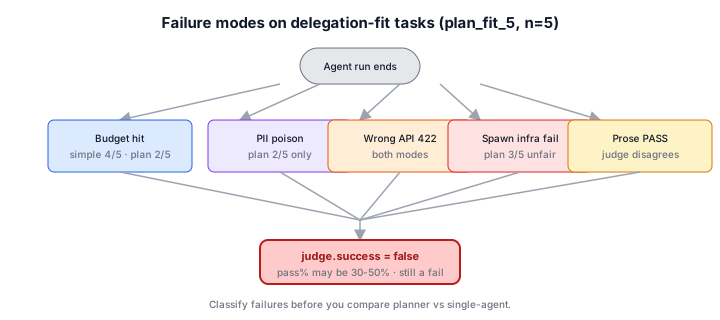
In this five-task paired sample, neither path passed AppWorld’s strict state checks, so the head-to-head rule recorded 5/5 ties. That does not mean they failed for the same reason. A single-agent run could use up its turn budget before /evaluate; a planner worker could copy a redacted method name into a call and get HTTP 422 (the server rejected the request). Record both the failure class and whether the external judge ran. A transcript saying “PASS” without a judge result is not a pass; see Is the task actually done? and evidence-based verification.
Failure-class taxonomy (what we saw on this slice)
| Class | What it means | Typical fix |
|---|---|---|
budget_no_eval |
Iteration/token budget hit before external judge | Raise cap or shorten loop; don’t score as partial pass |
true_tgc_fail |
Evaluate called; judge success: false |
Task logic, discovery, API usage |
pii_poison |
Redacted placeholder copied into tool method |
Align redaction policy for eval twins (PII post) |
wrong_method_422 |
Documented API name mismatch | Search docs tool before call; retry on did_you_mean |
create_agent_tools_unavailable |
Spawn hard-failed on missing tool names | Soft-drop or fix registry / AlwaysInclude |
assistant_asks_clarification |
Human prompt or clarify stall in unattended eval | Deny clarify tools in benchmark config (harness post) |
zero_tool_worker |
Plan step reports success with zero domain MCP calls | Force tool_calling on worker steps; fail when tool count is 0 |
Delegation-fit cohort (n = 5 per mode)
Tasks chosen to reward delegate-then-synthesize: phone → notes → SMS, inbox + contacts + payments, workout note → playlist sizing, batch social payments, trip ledger → settle debts.
Observed failure signals
These labels can overlap within one planner run (for example, a spawn failure can also leave no judge result). The columns are signal counts, not mutually exclusive partitions of five runs.
| Failure class | Single-agent (of 5) | Planner (of 5) |
|---|---|---|
| Budget, no evaluate | 4 | 2 |
| True judge fail | 1 | 0 |
| PII placeholder poison | 0 | 2 |
| Wrong API method (422) | 0 | 1 |
| Other (spawn infra, no judge) | 0 | 2 |
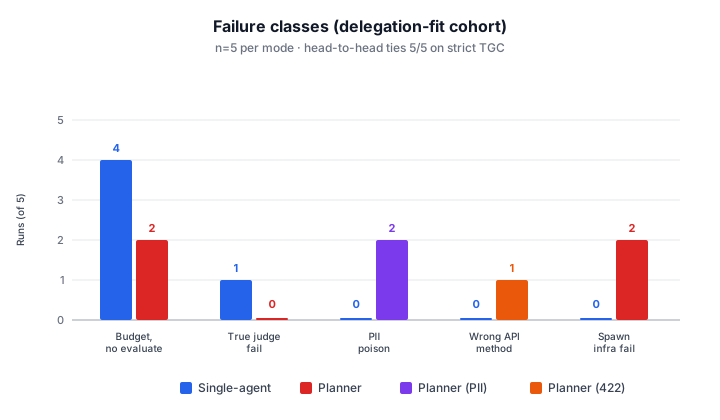
Caption: Failure-class mix on delegation-fit cohort · head-to-head ties 5/5 on strict TGC.
Why “tie” is not “good”
Harness winner rule: plan wins only if judge success is true for plan and not single-agent (and vice versa). Both fail → tie.
Examples from the paired runs:
- ~50% pass_percentage with
success: falseon both sides — looks “close,” is still a fail. - Planner transcript claimed EVALUATE PASS 100% while harness labeled
budget_no_evaland judge unknown. - Single-agent made partial mutations (e.g., comments on some payments) and still failed evaluate.
Use From Vibes to Contracts vocabulary: correctness, consistency, reliability are separate gates. On this slice, harness blockers (budget, poison, spawn) dominated before task logic could shine.
PII placeholder poison (not unique to one runtime)
When PII redaction (masking personal or sensitive information) replaces method names or tool tokens with [HIDDEN:…], the agent can call the placeholder as if it were a real API. AppWorld returns 422 — “no API named …”
This is the same two-view tension as SRE evals: redaction for safety vs pass-through for evidence. For fair A/B, eval twins must document which redaction layers are on. See also Microsoft Presidio for a public reference implementation of detect-and-replace redaction.
Planner paths hit pii_poison on 2/5 tasks in this cohort; single-agent hit 0 — not because single-agent is immune, but because fewer hops meant fewer chances to copy redacted tokens into worker spawns.
Budget before evaluate (single-agent’s main killer)
On the fair ten-task cohort, single-agent runs ended without judge on 7/10 tasks — fluent progress, then “execution budget” with no evaluate.
Planner paths reached evaluate more consistently on the ten-task cohort. That is a harness diagnostic (did we even reach the judge?), not evidence that planner mode is production-ready for AppWorld.
Checklist cross-link: Is the agent task done?
Spawn infra failures (planner-only)
On 3/5 delegation-fit pairs, planner fairness failed with create_agent_tools_unavailable — optional infra names in spawn payload that were not registered in the eval config (notes tooling disabled). Hard-fail spawn wastes the whole subtree.
Lesson: test configurations must provide the expected always-included tools, or spawns can fail for configuration reasons rather than task logic. Soft-dropping optional names is useful only when the omitted tools really are optional.
What we changed after these runs (diagnosis, not rescored here)
Without publishing internal wiring: we treated these as harness and policy issues — re-enable note tooling for eval, soft-drop benign extra tool names on spawn, stop duplicate workers after first successful handoff, fill empty worker context from parent goal. New judge scores after those patches are not in this post — rerun required.
Lessons learned
- Classify failures before comparing modes. Budget and poison are different fixes.
- pass_percentage without success misleads. Log both; gate on
success. - Prose PASS is a failure mode when judge disagrees.
- Ties on strict TGC mean “same benchmark ceiling,” not equal quality — check partial
pass_percentageand failure class. - Small n, separate concerns. Five tasks expose failure taxonomy; they are not a product scorecard for SRE workflows Aiden already runs.
Next: Stop Spawning Duplicate Workers — handoff gate fixed fairness 5/5 and cut planner token tax. Then how to evaluate unattended agents, multi-agent vs single-agent, and simple vs plan: when to use which.
Related reading
On this site
- Fair Agent Evals · Orchestration Tax
- How to evaluate AI agents (clarify + zero-tool)
- Multi-agent vs single-agent (MCP tool tax + pass@k)
- Simple vs plan: when to use which
- PII Redaction in AI Agents
- Evidence-Based Verification
- From Vibes to Contracts
- Agent done checklist
Elsewhere
- AppWorld · paper
- Model Context Protocol · Langfuse
- Microsoft Presidio — PII detection/redaction reference
- Anthropic: demystifying evals for AI agents
Acknowledgments. Built with the StackGen Aiden team — the engineers behind the agent runtime and platform this series describes.
🚀 We’re building AI-powered SRE at StackGen. If you’re tired of 3 AM pages and want AI agents that triage incidents, run diagnostics, and draft RCA reports — check out ai.stackgen.com and try our new SRE offering.
FAQ
Why do AI agents fail benchmarks even when the transcript looks successful?
Common modes: iteration budget exhausted before evaluate, PII redaction replacing API method names with placeholders the agent then calls, wrong documented API names (422), and assistant prose claiming PASS while the external judge returns false.
What is PII placeholder poison in agent evals?
When redaction turns real tool or method tokens into [HIDDEN:…] strings, the model may copy those placeholders into the next tool call. The API returns 422 — the agent is calling a name that never existed in the docs.
Should you use pass_percentage as the winner metric?
No as a sole gate. We saw ~50% pass_percentage with success false, ties when both modes failed, and prose EVALUATE PASS with harness budget_no_eval. Use the external judge's success bit and failure-class logging.
What failure classes should you log for tool-using agent evals?
At minimum: budget_no_eval, true judge fail, pii_poison, wrong_method_422, ran_without_judge, create_agent_tools_unavailable, and assistant_asks_clarification in unattended mode.
How does this connect to evidence-based verification?
Same contract: systems of record — here AppWorld's evaluate — vote before you trust narration. Self-report is a failure mode, not a tie-breaker.
Stay in the loop — production notes on AI agents, workflows, and SRE.
Low volume — new posts and curated reading lists. Unsubscribe anytime.