Reasoning vs Generate Models for Tool-Heavy Agents
Reasoning effort is not free. This is the cousin question: reasoning model vs normal chat model when the job is mostly tools. Which OpenAI API you call is a third choice (Completions vs Responses). A resp_ id identifies the Responses endpoint, not the cause of a slow dig. Compare per-turn reasoning tokens, tool wait, and retries before attributing time to a model or API.
Data: six combos, voice: what they write. We ran one single-agent ReAct and one hierarchical ReAcTree trial for each class (what is ReAcTree? · PDF).
What the evidence supports
| Class | Merit | Demerit | Wave-1 ballpark |
|---|---|---|---|
| xAI-class reasoning | Highest relative efficiency in this wave; full closes; hierarchical slightly faster | Still ~190k tokens | ~141–157s, corr 1.0 |
| Generate (gpt-5.4) | Solid falsifiers; hierarchical used fewer total tokens | Verbose; hierarchical can get expensive under load | ~148–154s, 255–373k tok |
| Responses reasoning preview | In this run, skeptical artifact Theories | Slow, costly; hierarchical can stub | ~200–285s, ~475–516k tok; hierarchical corr 0.69 once |
Merits of reasoning seats
- Alternative hypotheses — the preview run considered a sparse metric series rather than assuming the goroutine-growth alert proved a leak. Check the sample density before accepting either explanation.
- Numeric habit on efficient reasoners (derivatives, windows, baselines).
- Recovery options — after a failed query, a host can supply a typed error and permit a different probe. Whether that helps depends on the model and the tool failure.
Demerits of reasoning seats
- Elapsed time and tokens climb fast on preview-class models. Calling the Responses API is not the tax; hidden thinking tokens and high effort are (Completions vs Responses).
- Hierarchical ReAcTree fragility without observation gates.
- Catalog thrash — empty
search_file, skill loads, before the first PromQL.
Merits of generate seats
- Predictable closes with falsifier lines.
- Hierarchical runs can shrink total tokens on multi-part jobs (smaller context bill across the tree).
- Cheaper $/useful Theory than preview reasoning on this errand.
Demerits of generate seats
- Verbosity — operators skim less.
- Under contention, hierarchical may inflate tokens instead of compressing.
- In these closes, less emphasis on measurement-artifact hypotheses; a prompt or rubric can require an explicit alternative, but it cannot create missing evidence.
Practical mix
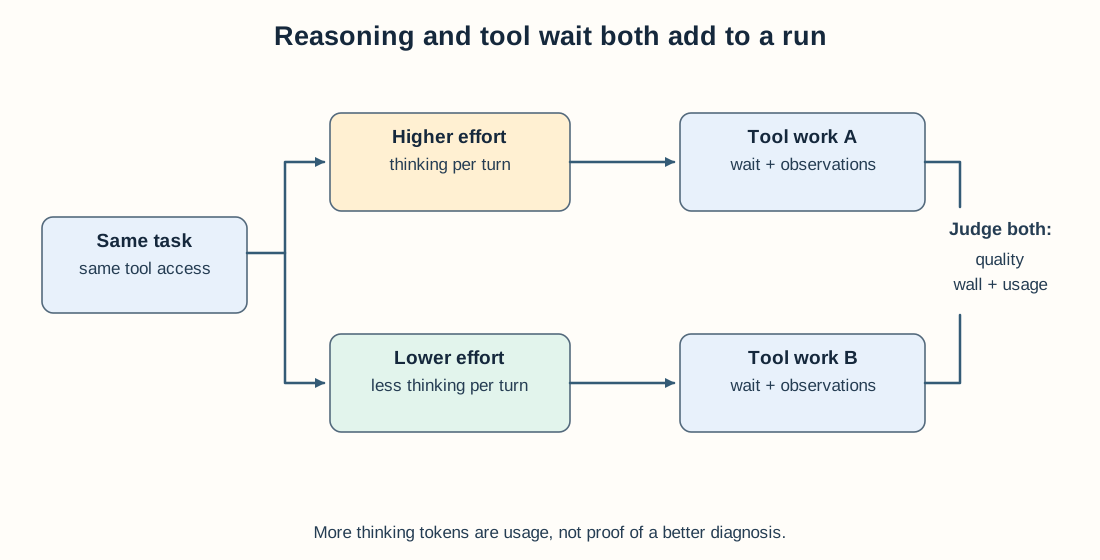
Compare how much the model thinks and what the tool calls actually return on the same task.
- Default Collect: efficient reasoning or generate, measured.
- Synthesis-only high effort: still valid (adaptive effort).
- Preview reasoning: canary behind gates, never silent default.
- Hierarchical plan: split the roster — reasoning on
planning, generate on digtool_calling(hybrid plan). Mapping high-effort reasoning onto every task is how digs burn eight minutes measuring one PromQL.
For this single alert-plus-logs task, the xAI-class seat had the best cohort-relative score; that is not a model-family ranking across incidents. Repeat the task and compare correctness before cost, including the full tree’s token use and the cost of failed tool calls.
FAQ
Should tool-heavy SRE agents always use reasoning models?
No. On our dual-part observability bench, a normal chat model (gpt-5.4) matched correctness with lower elapsed time than a heavy Responses reasoning preview, while an efficient xAI reasoning model won on cost/time. Pick by measured receipts, not brand.
What are the merits of reasoning models here?
Stronger skepticism (artifact vs leak), denser numeric Theories on efficient reasoners, and better recovery when host gates stop dead retries.
What are the demerits?
Higher elapsed time and tokens, hierarchical ReAcTree quality collapse without gates, and a habit of exploring catalogs before measuring.
Stay in the loop — production notes on AI agents, workflows, and SRE.
Low volume — new posts and curated reading lists. Unsubscribe anytime.