How to Evaluate an AI Agent for Root Cause Analysis
Root cause analysis (RCA) is an explanation of what caused an incident, supported by measurements and a mechanism. An agent can produce a fluent explanation without having checked the relevant system. A frozen prompt and explicit rubric make that difference inspectable.
What the evidence supports
- Freeze a dual-part prompt (alert + related logs/change).
- Score 13 binary checks (or your variant) before you look at latency.
- Then record wall, tokens, USD.
- Reject confident closes that invent series. Reward honest Unknowns with named gaps.
- Rematch after every harness change — and across orchestration shapes if you ship both.
The checklist we used
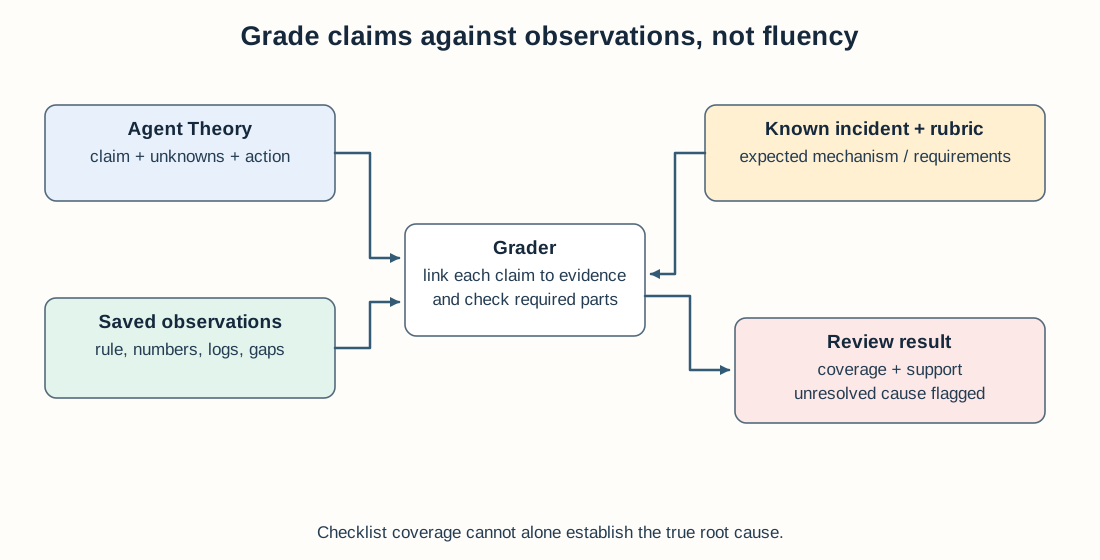
The evaluation checks whether the final claim matches the source record, not just how confident it sounds.
From a live Grafana/Loki job (numbers), comparing a single-agent ReAct loop and a hierarchical ReAcTree planner (primer · PDF):
Part A
- Theory section present
- Unknowns present
- Actionable next step
- Alert actually measured (rule / firing / query)
- Concrete numbers
Part B
- Target namespace named
- 24h window
- 7d (or stated baseline) window
- Compare / anomaly language
- Logs / LogQL evidence
Cross-cutting
- Honesty about gaps / truncated tool dumps
- Part A labeled
- Part B labeled
For this bench, correctness was hits / 13. A Responses hierarchical stub scored 0.69; full-checklist runs scored 1.0. These checks capture coverage and gap disclosure, not whether every proposed cause is true. Keep the known incident mechanism and human review alongside the score.
Use the operator evidence-gated RCA checklist as the human twin.
Metrics beside the checklist
| Metric | Why |
|---|---|
| Wall seconds | On-call patience |
| Tokens in+out | Bill and context pressure |
| USD | Finance will ask |
| Tool families | Measurement vs catalog |
| Child / tree node count | Orchestration tax |
First reject unsupported or incomplete diagnoses; then compare wall time and token use among acceptable runs. On-call time matters, but a fast answer that skips Part B does not satisfy this task.
Anti-patterns
- Judging on prose fluency
- Allowing human-in-the-loop (HITL) tools in an unattended bench without recording the human intervention
- Changing the prompt between A/B seats
- Reporting only relative efficiency
- Crowning one orchestration shape without rematching the other
Minimal harness
- Version a fixed prompt, expected mechanism, and scoring rubric in git.
- One config per model × orchestration shape (single-agent / hierarchical).
- Script that prints checklist + wall + tokens.
- Store the proposed Theory and its cited observations next to the score. A checklist can give credit for naming numbers even when they come from the wrong window (styles).
Repeat each configuration before inferring reliability. This 13-check rubric was designed for an alert-plus-logs job; adapt the evidence checks when the incident instead depends on deployments, traces, or configuration history.
FAQ
How do you evaluate an AI agent for root cause analysis?
Score the close against an explicit checklist (Theory disposition, Unknowns, next action, measured alert or query, numbers, honesty), then record wall time, tokens, and cost on a frozen prompt with live tools.
Is pass/fail enough?
Binary pass hides partial honesty. Use a weighted checklist so ‘Undetermined with named blocked query’ beats ‘confident fiction’.
What prompt shape works for RCA evals?
A dual-part job: one firing alert to triage, one related log or change plane to compare. Forces measurement and cross-linking instead of a single-paragraph vibe. Run both single-agent ReAct and hierarchical ReAcTree if your runtime supports both.
Stay in the loop — production notes on AI agents, workflows, and SRE.
Low volume — new posts and curated reading lists. Unsubscribe anytime.