AI Agent Runtime: What to Measure Before You Buy
An AI agent runtime is the software that routes model calls, executes tools, retains results, and decides when a run can finish. A vendor demo may show the final answer without exposing those controls. Before buying, test the runtime on a repeatable task using your tool permissions and data limits.
What the evidence supports
The model is only one component. Ask how the runtime classifies a failed tool call, limits repeated calls, handles truncated results, and blocks an answer that omits required evidence. A completion gate is a host-side check of those requirements; it is not proof that a hypothesis is true.
Use a “golden prompt”—a fixed test request with a grading rubric—and run it against the same tool environment. In our six-seat alert-and-logs test (scorecard), elapsed time ranged ~141–285s in wave 1; one hierarchical ReAcTree run scored 0.69 on the checklist. A later run with host gates scored higher, but the single trials and changed tool contention do not isolate the gates’ effect.
Shapes: single-agent ReAct loop vs hierarchical ReAcTree planner (what is ReAcTree? · PDF).
Five questions for any runtime vendor
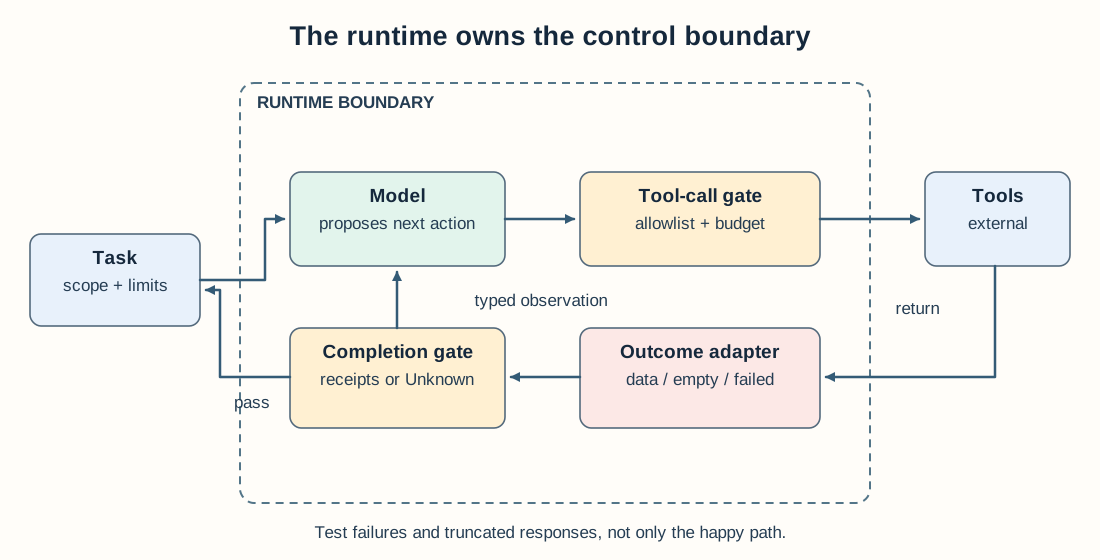
Ask a runtime vendor to show execution controls as well as a successful answer.
- Show the loop. Inspect a trace from model request to tool call to returned observation. If a result is truncated, what identifier and paging method retrieve the missing bytes?
- Show failure classes. A PromQL metric query with no matching series differs from a backend error or a truncated result. Does the tool envelope distinguish all three?
- Show the done condition. Can the host reject a final answer that skipped the log comparison, while allowing an explicit Unknown when Loki is unavailable?
- Show single-agent and hierarchical on the same prompt (merits).
- Show absolute elapsed seconds, tokens, priced cost where available, and correctness beside any cohort-relative score (efficiency trap).
What good looks like on a triage job
- Theory / Unknowns / Do-this-now with receipts (RCA eval)
- Measurement tools dominate catalog tools (tool menu)
- Dead queries halt (no-progress)
- Operator can steer mid-run
What bad looks like
- Demo on a mocked tool that never returns
failed - Only one model × one orchestration shape published
- Prompt-only “don’t retry” instructions
- Multi-agent diagrams with no orchestration tax numbers
If you are building in Go, see why Go and the runtime definition. If you are buying, ask for the raw trace and a rerun after one deliberately failed query. A runtime that handles normal results but silently treats tool failure as no data needs a different contract, not just a more fluent model.
FAQ
What is an AI agent runtime?
The production loop that turns goals into tool calls and durable state: model routing, tool contracts, budgets, completion gates, and audit — not a notebook demo or a single chat completion.
What should I measure before buying an agent runtime?
On your golden prompt: wall time, tokens, cost, checklist correctness, tool good-vs-waste, and behavior when queries fail. Ask for a rematch after they change models — and across single-agent ReAct vs hierarchical ReAcTree if both are offered.
Why do model cards fail as a buying guide?
The same prompt across six model×orchestration seats produced a 2× wall spread and a hierarchical correctness collapse on one reasoning preview. The runtime’s gates mattered as much as the model name.
Stay in the loop — production notes on AI agents, workflows, and SRE.
Low volume — new posts and curated reading lists. Unsubscribe anytime.