S3Queue Is a Multi-Node Engine: Stop Bottlenecking Ingest on One Writer
ClickHouse on AWS: Self-Managed from First Principles · Part 31
We ran a four-hour soak at 30 TB/day and found the most expensive bug in the fleet hiding behind a healthy dashboard: the ingest was running on exactly one node.
Fleet CPU looked fine — 24% average. The internal monitor disagreed in the only way it could: 600 “High CPU usage: 100% busy” warnings every ten minutes, all from one writer. Five writers were being paid for; one was doing the work. The autoscaler kept scaling the fleet out, and the fleet kept being exactly as slow, because the thing that needed to scale — the queue — was a table on one machine.
This post is about the bottleneck, the one-paragraph fix, and the ClickHouse source that makes the fix safe.
New to S3Queue entirely? The whole argument below turns on one mechanism — nodes claiming files through Keeper — and assumes you know why the pipeline stages files in S3 at all. For the missing background, read The Loading Dock and the Clipboard first: it walks the same claim mechanism this post relies on, from zero.
Key takeaways
- S3Queue is a multi-node engine by design. Every node with the identical table polls the same S3 prefix and claims files through Keeper; a file claimed by one node is skipped by all others. Exactly-once across the fleet, no coordinator process.
- The bottleneck was our own: the queue table existed on one writer. The other writers could not drain — a node without the queue table is not a slow drain node, it is a no drain node.
- Deploy the identical
CREATE TABLE IF NOT EXISTSon every ingest node (boot bundle or schema sync). Per-node settings — threads, commit caps — scale with the node count. N nodes ≈ N× the single-node drain ceiling. - Fleet-average CPU hides a single-node bottleneck by construction. Watch per-node CPU and the engine’s own overload warnings if you want to find the queue node that is quietly dying.
How S3Queue distributes work
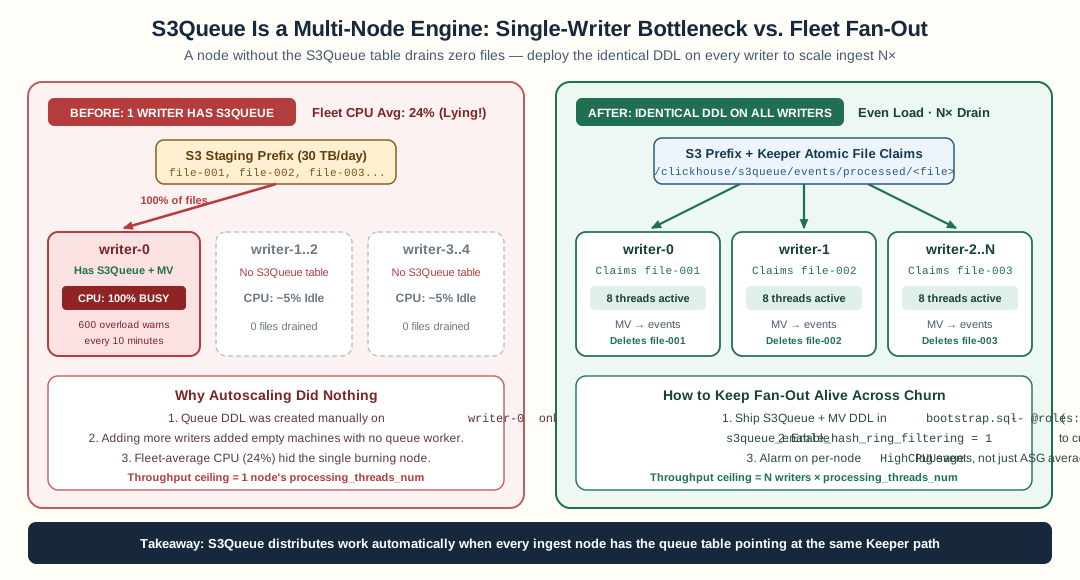
When the S3Queue table exists on only one writer, four peers idle while fleet-average CPU hides the hotspot; deploying the identical DDL on every writer lets Keeper distribute file claims across the fleet.
The mental model most people carry for S3Queue — including us, until the soak — is “one table drains a prefix.” The accurate model is:
flowchart TB
    S[("S3 prefix: staging files")]
    W1["writer-0<br/>S3Queue table"]
    W2["writer-1<br/>identical S3Queue table"]
    W3["writer-2<br/>identical S3Queue table"]
    K[("Keeper: per-file claims<br/>+ processed-file tracking")]
    E[("events table<br/>ReplicatedMergeTree")]

    W1 -- "polls prefix" --> S
    W2 -- "polls prefix" --> S
    W3 -- "polls prefix" --> S
    W1 -- "claim file-1<br/>(check-and-create)" --> K
    W2 -- "file-1 taken →<br/>claims file-2" --> K
    W3 -- "file-2 taken →<br/>claims file-3" --> K
    W1 -- "MV insert" --> E
    W2 -- "MV insert" --> E
    W3 -- "MV insert" --> E
    W1 -. "after_processing=delete<br/>deletes file-1" .-> S
Every node independently lists the prefix. Before processing a file, the node claims it — in unordered mode through a check-and-create on a per-file znode: the first node to create the znode for a file owns it, and every other node’s claim on the same file fails silently and moves on to the next listing. The znode set doubles as the processed-file record, which is why keeper health matters at backlog scale (the tracking TTL and limit settings are keeper hygiene, not just bookkeeping).
The exactly-once property falls out of the claim protocol, not from any coordinator: two nodes cannot both hold a file’s znode. And the fan-out needs no partitioning scheme — the same glob prefix on every node, the same claim namespace, work distributes itself by racing.
The bottleneck we built ourselves
The one-paragraph diagnosis, from the soak’s own data:
One writer held the queue table and its materialized view; the others held neither. Ingest was single-node bound at the queue node’s commit pace while four writers idled. The fix: deploy the identical queue table and view on every writer. Keeper claims make it safe. Each node’s commit caps apply per node.
The evidence was in the numbers. The queue node: 100% internal CPU,
warning every 30 seconds, drain rate capped by one node’s
processing_threads_num. The fleet: 24% average — because four idle
writers dilute one saturated node. And the scaling behavior that finally
gave it away: scaling the writers out changed nothing. Adding nodes to
an autoscaling group does not scale a table that exists on one of them.
After the fan-out: both writers processing in parallel — measured independently, each in the tens of millions of rows within minutes — and fleet CPU in single digits at the same ingest rate. Same instance count, same total files, the work just spread.
What scales with node count (and what doesn’t)
The useful mental split for tuning a fan-out:
| Setting | Scope | Effect of N nodes |
|---|---|---|
processing_threads_num |
per node | N× the claim/insert pipeline |
max_processed_rows_before_commit / ..._bytes_... |
per node | each node commits its own blocks; the memory ceiling is per node too |
list_objects_batch_size, polling intervals |
per node | more list calls against the same prefix — cheap; claims serialize, lists don’t |
tracked_files_limit, tracked_file_ttl_sec |
shared (keeper) | the tracking znode set is fleet-wide; these bound keeper state for the whole fleet |
after_processing |
shared (semantics) | whichever node processes a file deletes it |
The one thing to watch when fanning out: keeper znode count scales with files processed per unit time fleet-wide, not per node. The tracking limit and TTL are the bounds — and the mntr latencies tell you if the keeper is keeping up. Our keeper sat at a few milliseconds with two nodes claiming at full rate; if it climbs, the claim round-trips are the pressure point, not S3.
Keeping the fan-out across churn
A node without the queue table is a no-drain node, so the fan-out is only as durable as the deployment of the table. Two paths that compose:
- Ship the DDL in the boot bundle. The queue’s
CREATE TABLE IF NOT
EXISTS
rides with the node’s other bootstrap config, executed at boot. A churned node re-creates its table before the first drain poll — it joins the fan-out by itself. - Schema sync from a peer. The periodic schema-propagation job copies peer tables to new nodes — it covers the queue table the same way it covers the base tables.
One per-table footnote from the field: our queue needed
s3_allow_server_credentials_in_user_queries at table create time —
26.8 refuses S3 access with server-own credentials in user queries unless
the setting allows it
(the restriction and its setting live in Context.cpp).
If create works but the background workers hit 403 AccessDenied on
list, the credential path is the suspect — either thread the setting
through the profile or ensure it rides the session that creates the
table.
The dashboard that would have caught it
Fleet-average CPU is a seductive lie when your bottleneck is one node. The two views that caught ours:
- Per-node CPU — the queue node pegged at 100% against idle peers is unambiguous. Fleet-average divided it into harmlessness.
- The engine’s own warnings — ClickHouse’s internal overload monitor (AsynchronousMetrics.cpp) was telling the truth every thirty seconds. We just had no alarm on the log line. Once a log filter fed it into an alarm, the bottleneck announced itself.
If you run a queue-based ingest on a fleet, ask this today: which nodes hold the queue table, and how does a newly launched one get it? The answer is either “every node, from the boot bundle or schema sync” — or you are paying for a fleet to idle behind one node’s commit pace, and your dashboards are averaging the evidence away.
FAQ
Can the S3Queue engine run on multiple nodes at once?
Yes — it is the design. Every node with the identical S3Queue table polls the same prefix and claims files through Keeper: in unordered mode each processed file gets a check-and-create on a per-file znode, so a file claimed by one node is skipped by every other. That gives exactly-once processing across the fleet with no coordinator. Deploy the same CREATE TABLE on each node and the fan-out is automatic.
Why does one node become the ingest bottleneck?
Because the queue table has to exist on a node for that node to drain. In our fleet the table (and its materialized view into the events table) existed only on the writer that happened to boot first — the other writers never drained a single file. Ingest throughput was one node's worth while the rest of the fleet idled, which is invisible on a fleet-average CPU dashboard and glaring on a per-node one.
What settings scale with the node count?
The per-node ones: processing_threads_num and the commit caps (max_processed_rows_before_commit / max_processed_bytes_before_commit) are per node, so N nodes give roughly N times the single-node drain ceiling. The bucket-side settings — list_objects_batch_size, polling intervals — are per node too but hit the same prefix, which is fine: S3 list calls are cheap and the keeper claims are what serialize.
How do you keep the queue table on every node as the fleet churns?
Ship the DDL with the node's boot bundle and execute it idempotently — CREATE IF NOT EXISTS with the same engine settings, deployed by the bootstrap or by periodic schema sync from a peer. A churned node re-creates its queue table on boot and joins the fan-out immediately; no manual step, no per-node ritual.
Stay in the loop — production notes on AI agents, workflows, and SRE.
Low volume — new posts and curated reading lists. Unsubscribe anytime.