The Cloud-Neutral Bootstrapper That Wasn't: Auditing chinit for Azure and What It Taught Us About Portability
ClickHouse on AWS: Self-Managed from First Principles · Part 32
We wrote about chinit as the one-binary answer to a 3,600-line bash boot script, and about the provider factory that was supposed to make a second cloud “one constructor plus one infrastructure package.” This post is the audit that tested that claim — pointing the bootstrapper at the Azure port of the same ClickHouse stack and finding everything between the claim and reality.
The short version: the factory was real, the pipeline around it was not neutral, and the gap had been invisible for eighteen releases because the port it affected had never fully booted. Closing that gap made chinit better on both clouds — which is the actual lesson, and the reason this post is not titled “adding Azure support.”
The setup: two ports of one stack
The fleet runs
self-managed ClickHouse
— writers, readers, keepers, a backup replica — with a golden-image
boot pipeline: packer bakes the node image with a pinned chinit
binary, Terraform renders a small YAML spec per role, and a
user-data wrapper execs chinit boot. The AWS port is the production
one, live through the incident
and the self-healing
work. The Azure port exists as a full Terraform tree — VMSS writers
and readers, fixed keeper VMs, Blob Storage, Key Vault, Private DNS —
cut over from its own 2,400-line bash script at chinit 0.2.0.
“Cut over” turned out to be generous. What had really happened: the Azure port’s wrapper was calling chinit, and its image pinned chinit 0.2.0 — the release where the port was first wired. AWS was on 0.2.18. Eighteen releases of live findings — the lease identity, the hosts convergence, the remote_servers filters, the drain protocol — had never reached the Azure image, because nobody could verify a bump on a port that couldn’t boot.
The audit question was simple: what does chinit 0.2.18 actually do on an Azure node? The answer was four Fatal steps and a checksum that could never pass. None of them were in the provider package.
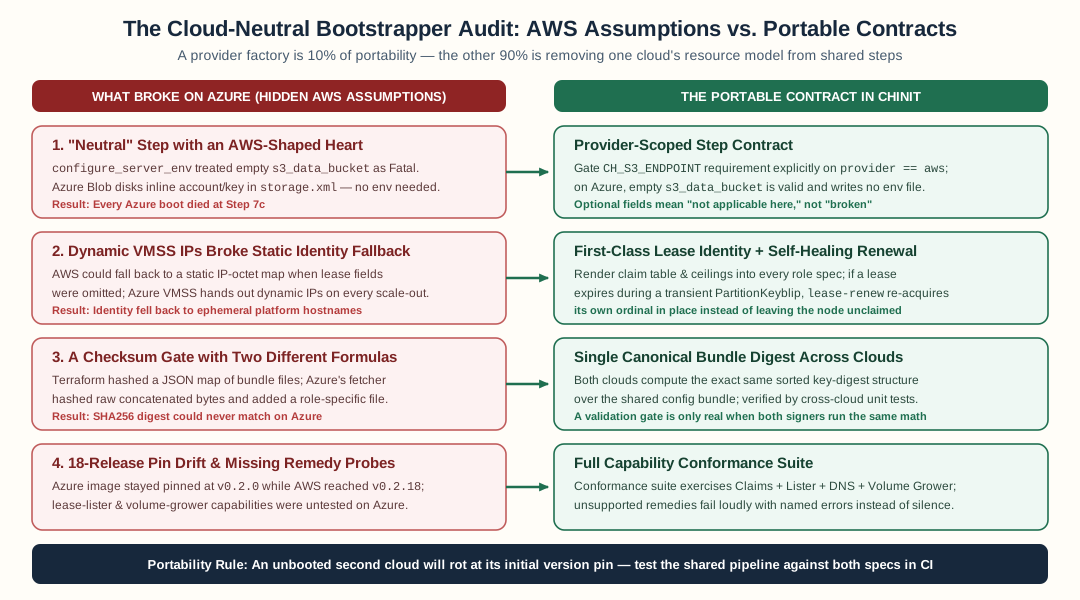
A provider factory is only ten percent of cloud portability; the other ninety percent is removing one cloud’s resource assumptions from shared pipeline steps, identity fallbacks, checksum math, and conformance tests.
Finding one: a “neutral” step with an AWS-shaped heart
The pipeline’s configure_server_env step writes the server’s
environment file — on AWS, the CH_S3_ENDPOINT variable that
storage.xml’s <endpoint from_env> requires at server start. The
step’s code was in the shared domain layer, and its first line was:
if b.Spec.S3DataBucket == "" {
    return Fatal(fmt.Errorf("spec s3_data_bucket is empty — " +
        "storage.xml's endpoint env cannot be set (Code 36 at server start)"))
}
That gate is correct on AWS — an unset endpoint is a guaranteed
start failure we had hit live. But on Azure, the storage disk is
azure_blob_storage with the account name and key inline in the
storage XML. There is no endpoint environment variable. The Azure
spec template never rendered an s3_data_bucket field at all —
because the field is meaningless there — so every Azure boot died at
step 7c with a spec error that was not an error.
The fix looks almost embarrassingly small:
if b.Spec.S3DataBucket == "" && b.Provider.Name() == "aws" {
    return Fatal(...)
}
The lesson is not the two-line diff. It is that the step’s name — configure server env — was neutral while its contract — “every node needs an S3 endpoint” — was AWS-shaped all the way down. We had put the cloud seam at the provider factory and then quietly built a cloud assumption into a domain step. The audit found three more of these (see below); the pattern is the finding, not the gate.
Finding two: dynamic IPs turn a fallback into the only path
Our lease identity protocol was born on AWS where the fleet also had a static identity fallback: Terraform allocates fixed private IPs at known octet offsets (writers at +10..19, keepers at +20..29, backup at +30), and chinit’s static mode maps an IP’s last octet straight to a hostname. Keepers and backup still use it — raft members should not be leasing names.
The Azure port’s Terraform rendered identity_mode: static for
every role. And the Azure scale sets’ NICs were — correctly, per the
module’s own comments — allocated Dynamic. Static identity over a
dynamic address is a coin flip: StaticHostname(10.0.1.37) returns
writer-7, but a replaced VM gets a different address and the map
Fatals with “does not map to a static role offset,” or worse, maps to
a different node’s name.
On Azure the lease table is not an optimization. It is the only
identity a scale-set member can have. So the port needed what AWS
already had — a claims table — and Azure has the exact right
primitive for it: Table Storage, whose conditional
If-None-Match insert and ETag-guarded MERGE give the same
claim/renew/release semantics the DynamoDB path implements. The
provider already had the claimer; what it lacked was the listing
half — ListActiveClaims, which renders remote_servers from live
claims instead of static reserved lists.
That listing half is the difference between the two remote_servers
generations we lived through on AWS: the
vacant-slot DNS storms
(688 error events per 10 minutes, 92% of them DNS resolution against
reserved-but-empty slots) were exactly the failure a claims-listing
inventory prevents. Porting the capability was cheaper than the first
finding was: one file, the same lease-row shape, a server-side
$filter on lease_until, and the code-side expiry guard the AWS
lister taught us to keep.
Finding three: a checksum contract with one signer
The config bundle arrives at boot with a SHA256 gate: Terraform computes a digest over the bundle’s members, renders it into the spec, and chinit recomputes the same digest over what it fetched — mismatch is Fatal, because a drifted bundle means the release does not vouch for what the node is about to install.
That contract is only as good as both sides computing it
identically. On AWS we had verified the shape byte-for-byte:
sha256(jsonencode(map)) — Terraform’s jsonencode and Go’s
json.Marshal produce identical bytes for the same string map, and
the parity test pins it. The Azure fetcher, written on an earlier
understanding, hashed raw concatenated bytes and included
keeper.yaml in the digest — a role-dependent member Terraform’s
hash never included.
Which means: no Terraform value, ever, could match what the Azure fetcher computed. The gate would refuse every bundle on every boot, forever, with an error that looks like a stale tfvars problem. A validation contract nobody exercises on both sides is a contract with one signer.
The fix mirrors the AWS implementation exactly: the same closed
member list, the same configs/-prefixed keys, keeper.yaml fetched
but excluded from the digest, and the jsonencode digest shape. And the
Terraform side now computes its config_files_hash with the same
formula over the same members — which is also why the Azure
config_files_hash changed from an md5-chain (which had never
matched anything) to sha256(jsonencode(...)).
Finding four: the remedy gap
The self-healing
work gave chinit a disk-autoscale job: when ClickHouse’s effective
free space (the keep_free_space-aware number, not df) drops below
a floor, the job grows the node’s own data volume and the ext4
filesystem online. On AWS that is an EBS ModifyVolume. The port
exists as a capability — AsVolumeGrower(provider) returns the
cloud’s implementation or nil, and the job fails loudly when the
remedy is absent.
Loud failure is better than silence, but on Azure the answer was
always nil. Pressure found, remedy absent, every five minutes. So the
Azure provider grew a grower: the ARM managed-disk resize — a PATCH
on diskSizeGB, no detach, no downtime — with DescribeOwnVolume
resolving the VM’s data disk by LUN and WaitForModification polling
the disk’s provisioning state until the resize lands.
What made this worth doing is the seam. The job’s logic did not change by one line to gain a second cloud’s remedy — the capability pattern absorbed it. This is the part of the original chinit design that the audit confirmed: where the seams were real, adding Azure was genuinely one package. Where they weren’t, the pipeline had already encroached.
What the Azure port’s Terraform was missing (and got)
The binary was half the gap; the IaC around it was the rest. If you run the same audit on a port of your own, this is the checklist shape of what we found:
flowchart TB
    subgraph BEFORE["Before: the port that couldn't boot"]
        B1["pin: chinit 0.2.0<br/>(18 releases behind)"]
        B2["identity_mode: static<br/>over Dynamic IPs"]
        B3["no claims table<br/>no live-claims inventory"]
        B4["no chi.yaml in the bundle<br/>render step Fatals"]
        B5["md5-chain config hash<br/>never matched the gate"]
    end
    subgraph AFTER["After: one release, both clouds"]
        A1["pin: 0.2.19 — same binary<br/>as the AWS fleet"]
        A2["writers/readers: lease claims<br/>keepers/backup: static IPs<br/>at the octet offsets"]
        A3["<cluster>-node-claims table<br/>+ live-claims rendering"]
        A4["chi.yaml + keeper.yaml +<br/>bootstrap DDL in the bundle"]
        A5["sha256(jsonencode(...))<br/>over the fetcher's member set"]
    end
    BEFORE -- "one audit,<br/>one release" --> AFTER
    style BEFORE fill:#7a2d2d,color:#fff
    style AFTER fill:#2d5a27,color:#fff
Three details worth pulling out of that diagram:
The keepers kept static identity — and now it actually works. The
octet-offset map requires the Terraform to allocate those offsets.
The AWS module always did (cidrhost(subnet, 20 + i) for keepers,
+30 for backup). The Azure module’s keeper and backup NICs were
Dynamic — the same coin-flip identity problem the scale sets had,
on the nodes where identity matters most (raft server IDs). They now
allocate static addresses at the same offsets, and the map is
deterministic on both clouds.
The schema ships with the bundle on both clouds. The
full-churn finding — every
peer replaced within one refresh leaves schema-sync with no peer to
propagate from — got its durable fix on AWS first: a
bootstrap-ddl.sql in the config bundle, executed idempotently by a
boot step. The Azure port got the same file and the same upload in
the same release. A fleet that cannot re-materialize its own tables
after full churn is not a portable design; it’s two ports, each one
incident away from a manual DDL session.
Environment variables are the provider’s config surface. The
spec stays provider-neutral — names, secrets, topology — and the
cloud-specific coordinates the binary needs (which storage account,
which subscription, which resource group, which VM am I) ride as
CHINIT_AZURE_* exports in the wrapper, the same pattern the AWS
wrapper uses for its region and table. One quirk worth writing down:
keeper VMs are fixed resources with per-ordinal names
(clickhouse-keeper-0/1/2), so their wrapper derives the VM name
from the hostname the platform already assigned, while scale-set
roles use the rendered resource name. The env pin is data; it can
vary per role without forking the wrapper.
The uncomfortable lessons
“Cloud-neutral” is a discipline, not an architecture. The provider factory, the capability probes, the conformance suite — all real, all necessary, all insufficient. Every pipeline step is a place where one cloud’s resource model can masquerade as a universal truth. We found ours by pointing the binary at a port that had never worked; you can find yours the same way, or by asking a sharper question in review: for this step, what does the other cloud’s equivalent look like? If the answer is “there isn’t one,” the step needs a gate, not a comment.
Capability absence must be loud and named. The volume-grower gap was harmless because the job failed loudly with the provider’s name in the error. That failure shape — pressure reported, remedy named as missing — is what turns a capability gap into a work item instead of a silent degradation. The keeper-silence incident was the same lesson from the other side: the cost of a gap is the time it stays invisible.
Drift is a symptom, not a cause. Eighteen releases of pin drift wasn’t carelessness — it was a rational response to a port nobody could verify. You cannot keep a pin current on a path you cannot test. The audit’s biggest single deliverable wasn’t any fix; it was that the Azure port could finally run the current binary, which means the next bump is a one-line diff someone can actually verify.
The conformance suite is where portability lives or dies. Both providers run the same contract scenarios against fake IMDS and canned bundles — deterministic, no cloud credentials, minutes to run. Every capability the audit added (claims listing, volume growing, the server-env gate) grew a spec in that suite. The suite is the only reason “one constructor plus one package” is a claim you can test rather than a hope you hold.
The checklist, if you audit your own
- Point your newest binary at your oldest port. Whatever the docs promise, the oldest port tells you what the shared pipeline actually assumes. Expect Fatal steps, not feature gaps — unbootable before unusable.
- Read every shared step for a resource model. An S3 endpoint, a device name, a subnet octet, a tag key — anything one cloud’s Terraform owns by convention. Gate it on the provider’s name and write down the other cloud’s answer, even if the answer is “this step is a no-op there.”
- Verify contracts on both sides or not at all. A checksum, a validation order, a field format — anything computed independently by two codebases is two implementations of one spec. Pin them to each other with a parity test, and make the test compute the expected value independently (ours builds the Terraform-side digest in Go and refuses a one-bit change).
- Make capability absence an error with a name. “Provider X cannot grow volumes” at the failure site beats a TODO in a design doc — and it makes the gap show up in logs, alarms, and audits where humans actually look.
- Bump the pin on the port you just fixed, in the same release. A fix that ships without its pin bump is a fix that exists only on the cloud that already worked.
The Azure port now runs the same chinit the production fleet runs — one release train, one conformance suite, two providers — and the next cloud that gets a constructor will inherit the audit instead of relearning it.
FAQ
What does 'cloud-neutral' actually require of a node bootstrapper?
Three things, not one. A provider factory so the cloud calls live behind interfaces — chinit had that. But also: no pipeline step may encode one cloud's resource model (a boot step that writes an S3 endpoint URL is an AWS step wearing a neutral name), every spec field must be optional in a way that means 'not applicable here' rather than 'misconfigured', and the checksum or validation contract between the binary and the IaC must be computed identically on both sides. The factory is the easy tenth; the other nine are discipline.
How does chinit now handle the two clouds' different storage models?
The server-env boot step is gated by provider: on AWS the S3-disk endpoint is a START requirement (an unset from_env variable kills the server with Code 36), so an empty data-bucket field is Fatal. On Azure the blob disk carries the account name and key inline in storage.xml — there is no endpoint env to write at all — so the same empty field is correct, the step writes nothing, and the gate stays AWS-only. One step, two contracts, decided by the provider's name — explicit, not discovered in production.
Why did the Azure port drift 18 releases behind?
Because the pin is a manual knob in the image template, and the port had never fully booted — every release bump was verified on AWS where the fleet lives, while the Azure template kept its original pin because nobody could verify a bump there. Drift is a symptom of an unbootable port: you cannot keep a pin current on a path you cannot test. The fix was making the port boot at all, then bumping the pin as part of the same release.
What is a claims-table identity, and why does Azure need it more than AWS did?
Lease identity: a node claims a stable name (writer-2) from a small ordinal range with one conditional write, renews it on a heartbeat, and releases it on drain. The name is what replication paths and per-replica storage prefixes key on. Both clouds need it for scale-set members — but on AWS we could fall back to a static IP-octet map because our Terraform allocated fixed addresses. Azure's scale sets hand out dynamic IPs, so the claims table is not an optimization there; it is the only identity the fleet has.
How can a checksum gate 'never match' on one cloud?
The gate is a digest the boot recomputes over the fetched config bundle and compares against a hash Terraform renders into the spec. The contract is only as good as both sides computing it identically — same member list, same key names, same encoding. The Azure fetcher was hashing raw concatenated bytes and including a role-dependent member (the keeper spec) that Terraform's hash never included; no Terraform value could ever equal it. A validation contract nobody exercises on every side is a contract with one signer.
What changed so the next cloud is actually one constructor plus one package?
The capability set the conformance suite exercises per cloud now includes the lease table's listing half and the volume grower, not just claims and DNS. A cloud without a capability degrades loudly (the disk-autoscale job reports pressure and fails with a named error) instead of silently missing a remedy. And the spec template renders the claim ceilings and table name for every role — so the identity wiring is data, not a per-cloud code fork.
Stay in the loop — production notes on AI agents, workflows, and SRE.
Low volume — new posts and curated reading lists. Unsubscribe anytime.