Session Efficiency Should Not Beat Accuracy
We said the score goes from 0 to 100.
A run that got every problem right, used fewer tokens than we allowed, and finished faster than we allowed printed 125.
The dashboard was not broken. The formula was giving extra credit for finishing early, then multiplying those bonuses together.
Words we use
If you have never scored an AI agent eval, these five terms are enough:
| Word | Plain meaning |
|---|---|
| Accuracy | Share of problems graded Correct (right diagnosis). 1.0 means all Correct. |
| Tokens | How much text the model read and wrote. Rough proxy for dollar cost. |
| Wall time | Clock time until the run finished. |
| Budget / allowance | The token count and wall time we hoped not to exceed. |
| Efficiency score | One headline that mixes “were you Correct?” with “did you stay near budget?” |
A combined score (or composite) can be a convenient pass/fail gate, but its scale must agree with the formula. It also cannot replace the individual time and cost measurements.
What the evidence supports
- We built a session efficiency score for agent evals: Correct-rate times a token factor times a wall-time factor.
- Each factor could go up to 1.25 when the run beat the allowance (25% bonus for finishing early).
- Two bonuses multiplied: √1.25 × √1.25 = 1.25. With every problem Correct, that prints 125 on a chart labeled 0-100.
- Cap each factor at 1.0. Finishing early does not grade above “you were Correct.” Put the savings in tokens, wall seconds, and dollars per Correct.
- Same idea as AgentSLABench’s efficiency-adjusted success: success times budget ratios, never above success.
How the old formula overshot
We scored suite runs with something like this:
token_factor = clip(token_allowance / tokens_used, 0.25, 1.25)
wall_factor  = clip(wall_allowance / wall_seconds, 0.25, 1.25)
score        = 100 × accuracy × √token_factor × √wall_factor
clip just means “keep the number between these two ends.”
The intent was to penalize over-budget runs while retaining one pass/fail number. The upper end at 1.25 was inconsistent with a 0–100 label. It turns “beat the budget” into extra points for finishing early. When both token and wall bonuses sit at 1.25, their square roots multiply to 1.25. Accuracy 1.0 × 1.25 × 100 = 125.
Walk one real seat in sentences, then numbers.
We allowed about 1 million tokens and 180 seconds. The run used about 565k tokens and 132 seconds, and was Correct. Tokens were under allowance, so the old formula gave up to a 25% bonus. Wall was also under, so another 25% bonus. Those bonuses compound. Result: raw 125. A cleaner shape that never grades above Correct would print 100 for the same seat.
| Field | Value |
|---|---|
| Accuracy | 1 (all Correct) |
| Tokens used | ≈ 565k (allowance 1M) |
| Wall time | ≈ 132s (allowance 180s) |
| Old raw score | 125 |
| Score with bonuses capped at 1.0 | 100 |
Same Correct. Same thrift. Different story if your pass/fail check says “must be at least 80 on a 0-100 scale.”
What other people already do
AgentSLABench publishes an efficiency-adjusted success rate: multiply success by how close you stayed to each budget, and never give more than full credit for finishing early. Under budget does not inflate the score. Over budget shrinks it. For you: the headline cannot exceed “how often were you Correct?”
Cost-of-Pass is total dollars divided by the number of Correct problems. Report the denominator and handle a zero-Correct suite explicitly: the ratio is undefined then. It is a spending metric, not a substitute for diagnosis quality.
When people benchmark agents, they still need absolute wall, tools, and tokens on the page. A combined score is one possible gate, not the only number in a changelog. Keep absolute measurements beside it, and publish whether token totals include cached reads. Keep evals fair before you chase performance, start with canaries, and keep RCA judge checklists readable next to the score.
The shape that stays honest
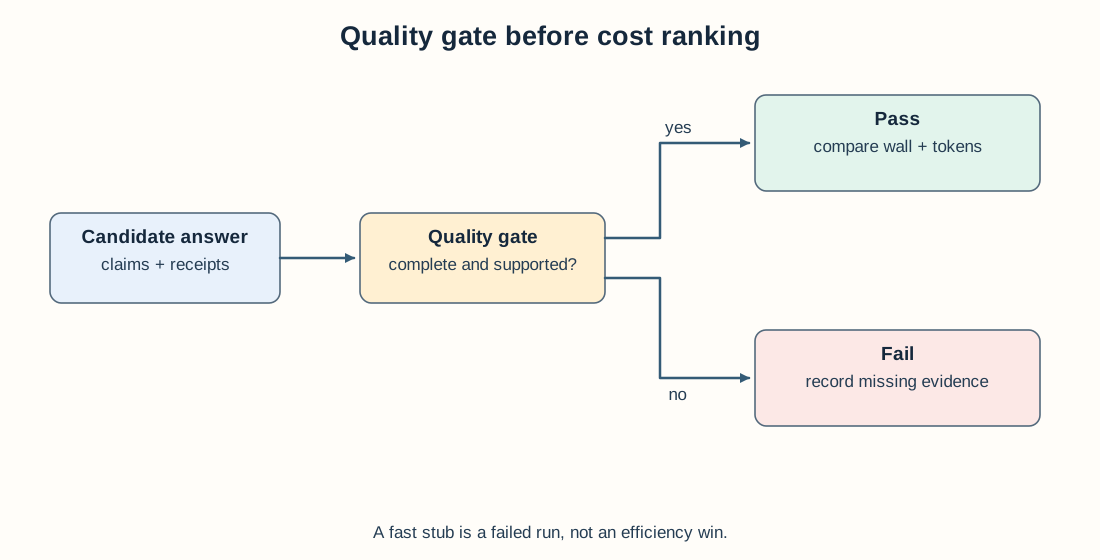
Fewer tokens are not valuable if the diagnosis is wrong.
token_factor = clip(token_allowance / tokens_used, 0.25, 1.0)
wall_factor  = clip(wall_allowance / wall_seconds, 0.25, 1.0)
score        = 100 × accuracy × token_factor × wall_factor
What changed:
- Upper end at 1.0, not 1.25. Beat the allowance → factor = 1. No extra points past Correct.
- Multiply the factors directly. No nested square roots that still let a 1.25 product through when the upper clip is above 1.
- Floor at 0.25 prevents an over-budget factor from approaching zero. That is a policy choice, not a mathematical necessity: if severe overruns should fail the suite outright, add a separate hard budget gate.
On the same worked seat: accuracy 1, both factors clip to 1.0 → score = 100. Thrift still shows as fewer tokens, shorter wall, and lower Cost-of-Pass. The pass/fail check stops lying about the scale.
Two ways efficiency scores lie
| Lie | What goes wrong | What you see |
|---|---|---|
| Normalize to this week’s average | Everyone got slower, so the “average” rose | Score rises while real wall time doubles |
| Extra points for finishing early (this post) | Bonuses above 1.0 multiply | Score rises past Correct on a 0-100 label |
Rule for both:
Publish Correct-rate, wall seconds, tokens, and dollars first. Only then print a combined score. Never invent a scale that “all Correct + thrifty” can exceed by design.
For a suite that needs one pass/fail number, this capped formula cannot exceed accuracy × 100. Under-budget Correct runs tie at 100; use wall seconds, tokens, and priced cost to distinguish them. A different rubric may legitimately score speed as a separate objective, but should label its scale accordingly.
Worked example: a frozen checkout-outage rematch where every Correct seat under budget printed the same 100, so we ranked on wall and new input tokens instead (same incident, five models).
FAQ
Why can a 0-100 efficiency score print above 100?
If the formula gives extra points for finishing under the token and time allowances, and multiplies those extras together, a fully Correct run can land above 100. Capping the final number at 100 hides a bad formula.
What should the score do instead?
Multiply Correct-rate by how close you stayed to each budget, but never give more than full credit for finishing early. Finishing under budget stays a perfect efficiency score for that part. Savings show up as lower dollars and shorter wall clock.
Where do I see that we used less money or time?
In the absolute numbers: tokens used, wall seconds, and Cost-of-Pass (total dollars divided by how many problems were Correct). Keep those visible. Use the combined efficiency score as a short headline, not the only number.
Stay in the loop — production notes on AI agents, workflows, and SRE.
Low volume — new posts and curated reading lists. Unsubscribe anytime.